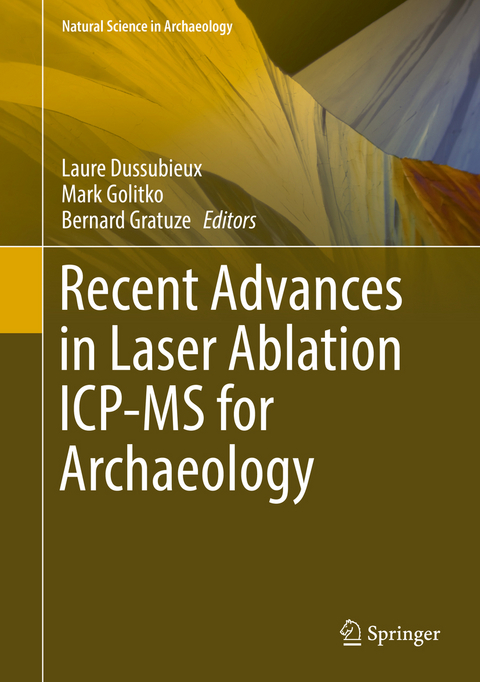
Recent Advances in Laser Ablation ICP-MS for Archaeology (eBook)
358 Seiten
Springer Berlin (Verlag)
978-3-662-49894-1 (ISBN)

Prologue 6
References 8
Contents 10
Contributing Authors 12
Abbreviations 16
1: Instrumentation, Fundamentals, and Application of Laser Ablation-Inductively Coupled Plasma-Mass Spectrometry 19
1.1 Introduction 19
1.2 Instrumentation 21
1.2.1 Inductively Coupled Plasma-Mass Spectrometry 21
1.2.2 Laser Ablation 23
1.2.3 Ablation Cells 26
1.3 Quantification 30
1.4 Summary and Outlook 32
References 32
Part I: Sample Introduction 38
2: Introduction to Solid Sampling Strategies 39
2.1 Solid Sampling Strategies 39
References 41
3: Open-Cell Ablation of Killke and Inka Pottery from the Cuzco Area: Museum Collections as Repositories of Provenience Inform... 42
3.1 Introduction 42
3.2 Open-Cell Ablation 44
3.3 Samples 46
3.3.1 Analyzed Ceramics 46
3.3.2 Cuzco Area Clay Survey 48
3.4 Method 49
3.4.1 Closed-Cell Ablation 49
3.4.2 Open-Cell Ablation 53
3.5 Comparison of Chamber Performance 54
3.5.1 Limits of Detection 54
3.5.2 Precision 54
3.5.3 Fractionation 56
3.5.4 Accuracy and Comparability of Open- and Closed-Cell Ablation Results 57
3.6 Preliminary Results of Analysis of Cuzco Area Ceramics and Clays 59
3.6.1 Ceramics Analyzed by Closed-Cell Ablation 59
3.6.2 Open-Cell Analyses 63
3.6.3 Comparison to Cuzco Area Clays 64
3.7 Conclusion 64
References 65
4: Optimization of 2D LA-ICP-MS Mapping of Glass with Decorative Colored Features: Application to Analysis of a Polychrome Ves... 68
4.1 Introduction 69
4.2 Background 71
4.3 Materials and Methods 72
4.3.1 Archaeological Glass Sample 72
4.3.2 Sample Handling and Glass Calibration Standards 73
4.3.3 LA-ICP-MS Instrumentation and Mapping Conditions 73
4.3.4 Quantification and Image Analysis 75
4.3.5 Software for Virtual LA-ICP-MS Mapping 75
4.4 Results and Discussion 77
4.4.1 Validation of the Combined Computational and Experimental Strategy 77
4.4.2 Computational and Experimental Strategy 78
4.4.3 Application to 2D Mapping of a Pre-Roman Glass 80
4.5 Conclusion 83
References 83
5: LA-ICP-MS Analysis of Ancient Silver Coins Using Concentration Profiles 87
5.1 Introduction 87
5.2 Background 88
5.2.1 Ancient Silver Coins 88
5.2.2 Analysis of Ancient Silver Coins: Different Approaches and Their Limitations 89
5.3 LA-ICP-MS for the Analysis of Depth-Heterogeneous Materials 90
5.4 Protocol 92
5.4.1 Instrumentation 92
5.4.2 Development of the Protocol 92
5.5 Validation of the Protocol 97
5.5.1 Reproducibility of Analysis of Silver Coins by LA-ICP-MS 97
5.5.2 Analysis of Cross-Sections 98
5.5.3 Limitations 98
5.6 Conclusion 99
References 99
Part II: Application to Non-siliceous Materials 102
6: Analysis of Non-siliceous Archaeological Materials by LA-ICP-MS 103
6.1 Analysis of Non-siliceous Materials 103
References 105
7: Precise and Accurate Analysis of Gold Alloys: Varna, the Earliest Gold of Mankind-A Case Study 106
7.1 Introduction 106
7.2 General Background 107
7.3 Methods 108
7.3.1 Instrumentation 108
7.3.2 Liquid Calibration (Wet Plasma Conditions) 110
7.3.3 External Calibration by SRMs (Dry Plasma Conditions) 111
7.4 Results 112
7.5 Varna: An Archaeometric Case Study 114
7.6 Discussion and Conclusion 120
Appendix 122
References 123
8: LA-ICP-MS Analysis of Prehistoric Copper and Bronze Metalwork from Armenia 125
8.1 Introduction 126
8.2 General Background 127
8.3 The Horom Necropolis 129
8.4 LA-ICP-MS Analysis: Goals and Methods 130
8.5 Results of Arc OES Analysis of the Horom Metalwork 133
8.6 LA-ICP-MS Results 136
8.7 Discussion 139
8.8 Conclusions 141
References 142
Part III: Application to Vitreous Materials 144
9: Analysis of Vitreous Archaeological Materials by LA-ICP-MS 145
9.1 Analysis of Vitreous Materials 145
References 147
10: Contributions of LA-ICP-MS to Obsidian Sourcing in the Pacific 148
10.1 Introduction 148
10.1.1 Obsidian Sources in the Southwestern Pacific 150
10.1.2 Prior Chemical Characterization of Pacific Volcanic Glass 151
10.2 Methods 151
10.2.1 Sampling Method 151
10.2.2 Sample Preparation 151
10.2.3 Scanning Electron Microscopy with Energy Dispersive X-Ray Analysis (SEM-EDX) 152
10.2.4 Laser Ablation-Inductively Coupled Plasma-Mass Spectrometry (LA-ICP-MS) 153
10.2.5 Calibration Protocol 153
10.2.6 Data Treatment, Inter-method Comparability and Statistics 153
10.2.7 Mantle Normalized Trace Element Patterns 154
10.3 Results 154
10.3.1 Admiralty Islands 154
10.3.2 West New Britain 156
10.3.3 D´Entrecasteaux Islands 158
10.3.4 Northern Vanuatu Obsidian Sources 162
10.3.5 Tonga 162
10.4 Discussion 164
10.5 Conclusion 166
References 167
11: The Role of LA-ICP-MS in the Investigation of Archaeological Glass 170
11.1 LA-ICP-MS as a Tool for Chemical Analysis of Historical Glass 170
11.2 Analytical Approach 172
11.2.1 Quantification Protocols 173
11.2.2 Comparison SN and ISI Methods 175
11.3 Black-Appearing Roman Glass 175
11.3.1 Background 175
11.3.2 Analyses of Black Roman Glass 179
11.4 Conclusion 183
References 183
12: Glass Characterization Using Laser Ablation-Inductively Coupled Plasma-Mass Spectrometry Methods 186
12.1 Introduction 186
12.2 Background 187
12.3 Analytical Protocol 188
12.4 DP-LA-ICP-MS Applied to Ancient Glass 192
12.4.1 Estimation of the Analyzed Depth for Profile Analysis 192
12.4.2 High Potassium (LMHK) Glass Beads of the Late Bronze Age in Western Europe 192
12.4.3 Seventeenth Century Lead Gold Ruby Glass 194
12.5 Conclusion 201
References 201
13: A Proficiency Test for LA-ICP-MS Laboratories Analyzing Ancient Glass 204
13.1 Introduction 204
13.2 Inter-comparison Test 205
13.2.1 Factors Impacting Inter-laboratory Comparability 205
13.2.2 Samples 206
13.2.3 List of Participating Laboratories 207
13.3 Results 208
13.3.1 Heterogeneity of Samples 208
13.3.2 Comparison of Results from Different Laboratories 209
13.4 Archaeological Implications 215
13.5 Conclusion 218
References 218
14: Characterization of Slag Inclusions in Iron Objects 220
14.1 Introduction 220
14.2 Background 221
14.3 Protocol 224
14.4 Archaeological Application: The Tie-Rods of Bourges Cathedral 228
14.5 Conclusion 233
References 234
Part IV: Expanding the Application of LA-ICP-MS in Archaeology 236
15: Expanded Applications of Laser Ablation-ICP-MS in Archaeology 237
15.1 Expanded Applications of LA-ICP-MS 237
References 238
16: Determining the Provenience of Garnet Beads Using LA-ICP-MS 240
16.1 Introduction 240
16.2 Garnet Samples 241
16.2.1 Previous Geochemical Studies of Garnet Artifacts 242
16.2.2 Garnet Artifacts Analyzed in This Study 243
16.2.3 Garnet Source Samples Included in This Study 246
16.3 Method 250
16.4 Identifying Compositional Differences Between Garnet Groups 251
16.5 Results and Discussion 254
16.6 Conclusion 257
References 269
17: Application of LA-ICP-MS to Black Stone Objects Used During the Iron Age in Celtic Europe 272
17.1 Introduction 273
17.2 Prior Characterization Studies of Black Stones 274
17.3 Materials and Methods 277
17.3.1 Sampling 277
17.3.2 Analytical Protocol 279
17.3.3 Reliability of the Results and Errors 281
17.4 Results 281
17.4.1 Characterization of Geological Sources 282
17.4.2 Characterization of Archaeological Materials 287
17.4.3 Relationships Between Artifacts and Sources 287
17.5 The Procurement of Black Stones During the Iron Age in Europe 297
17.6 Conclusions 298
Appendix 1 Major Results 299
Minor Results 307
Continuation of the Results for the Minor, Traces Elements and Correlations Between Elements 316
References 325
18: Investigating Biogenic Versus Diagenetic Trace Element Incorporation in Archaeological Mineralized Tissues with LA-ICP-MS 327
18.1 Introduction 327
18.2 Mineralized Tissues 328
18.3 Understanding the Biological Implications of Archaeometallurgy 330
18.4 Materials and Methods 332
18.4.1 LA-ICP-MS Analysis 332
18.4.2 SEM-EDS Analysis 333
18.4.3 Post-Analysis Calibration 335
18.5 Discussion 338
18.6 Conclusion 342
References 343
19: Pb Isotopic Composition of Panamanian Colonial Majolica by LA-ICP-MS 346
19.1 Introduction 347
19.1.1 The Old City of Panama or Panam Viejo 347
19.1.2 Majolica and Spanish Production 347
19.1.3 Archaeology of Panamanian Colonial Majolica 349
19.1.4 Pb Isotopic Studies of Colonial Ceramics and Provenance Studies of Panamanian Majolica 350
19.2 Goals and Sample 351
19.3 Analytical Methods 354
19.4 Results and Discussion 355
19.5 Final Remarks 359
References 359
| Erscheint lt. Verlag | 5.9.2016 |
|---|---|
| Reihe/Serie | Natural Science in Archaeology | Natural Science in Archaeology |
| Zusatzinfo | XVII, 358 p. 132 illus., 38 illus. in color. |
| Verlagsort | Berlin |
| Sprache | englisch |
| Themenwelt | Geschichte ► Allgemeine Geschichte ► Altertum / Antike |
| Technik ► Maschinenbau | |
| Schlagworte | archaeology • Elemental Analysis • Isotope Analysis • Isotopic Composition • LA-ICP-MS • Laser Ablation • Provenance |
| ISBN-10 | 3-662-49894-4 / 3662498944 |
| ISBN-13 | 978-3-662-49894-1 / 9783662498941 |
| Informationen gemäß Produktsicherheitsverordnung (GPSR) | |
| Haben Sie eine Frage zum Produkt? |
 PDF (Wasserzeichen)
DRM: Digitales Wasserzeichen
Dieses eBook enthält ein digitales Wasserzeichen und ist damit für Sie personalisiert. Bei einer missbräuchlichen Weitergabe des eBooks an Dritte ist eine Rückverfolgung an die Quelle möglich.
Dateiformat: PDF (Portable Document Format)
Mit einem festen Seitenlayout eignet sich die PDF besonders für Fachbücher mit Spalten, Tabellen und Abbildungen. Eine PDF kann auf fast allen Geräten angezeigt werden, ist aber für kleine Displays (Smartphone, eReader) nur eingeschränkt geeignet.
Systemvoraussetzungen:
PC/Mac: Mit einem PC oder Mac können Sie dieses eBook lesen. Sie benötigen dafür einen PDF-Viewer - z.B. den Adobe Reader oder Adobe Digital Editions.
eReader: Dieses eBook kann mit (fast) allen eBook-Readern gelesen werden. Mit dem amazon-Kindle ist es aber nicht kompatibel.
Smartphone/Tablet: Egal ob Apple oder Android, dieses eBook können Sie lesen. Sie benötigen dafür einen PDF-Viewer - z.B. die kostenlose Adobe Digital Editions-App.
Buying eBooks from abroad
For tax law reasons we can sell eBooks just within Germany and Switzerland. Regrettably we cannot fulfill eBook-orders from other countries.
aus dem Bereich