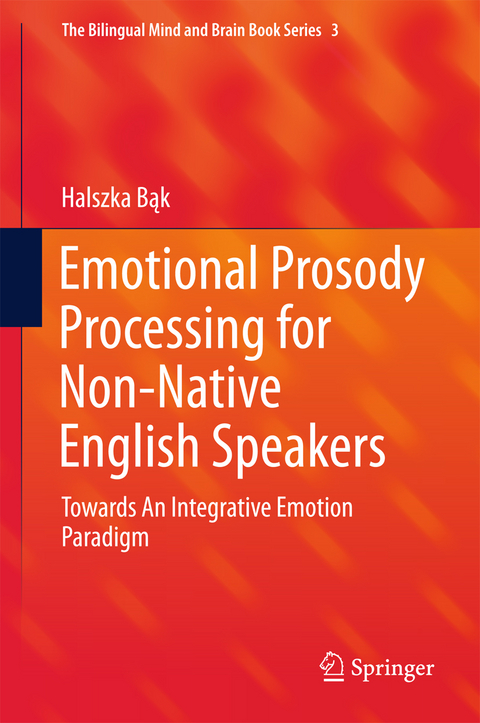
Emotional Prosody Processing for Non-Native English Speakers (eBook)
XIX, 197 Seiten
Springer International Publishing (Verlag)
978-3-319-44042-2 (ISBN)
This volume provides the first systematic and data-driven exploration of English emotional prosody processing in the minds of non-native speakers of the language. Over the past few decades emotional prosody has attracted the interest of researchers from a variety of disciplines such as psychiatry, neuropsychology, psycholinguistics, and linguistics. Although a considerable collective body of empirical evidence exists regarding emotional prosody processing in native speakers of various languages, non-native speakers have been virtually ignored. This constitutes a knowledge gap of increasing relevance, as we approach 2050, the year when the global population of non-native speakers of English is estimated to overtake that of native speakers of the language. This volume aims to fill this gap and provide insights into how emotions are processed on multiple levels while also presenting novel methodological solutions.
Crucially, Emotional Prosody Processing for Non-Native English Speakers: Towards an Integrative Emotion Paradigm begins by providing a conceptual background of emotion research, and then demonstrates a novel, workable, completely integrative paradigm for emotion research. This integrative approach reconciles theories such as the dimensional view of emotions, the standard basic emotions view, and the appraisal view of emotions. Following this theoretical section is an empirical exploration of the topic: the volume explores those views via experimental tasks. The insight into overall processing such a multiple-level approach allows a comprehensive answer to the question of how non native speakers of English process emotional prosody in their second language. By offering a critical, data-driven, integrative approach to investigating emotions in the minds of non-native English speakers, this volume is a significant and timely contribution to the literature on emotion prosody processing, bilingual research, and broadly understood emotion research.
Dr. Halszka Kinga Bąk received his PhD in 2015 from the Faculty of English at Adam Mickiewicz in English and Cognition. Previously, she has received her MA in English, Experimental Pragmatics, and an MA in Russian Language, Pragmatics.
Dr. Halszka Kinga Bąk received her PhD in 2015 from the Faculty of English at Adam Mickiewicz in English and Cognition. Previously, she has received her MA in English, Experimental Pragmatics, and an MA in Russian Language, Pragmatics.
Chapter 1 Emotional relativity – argument from nurture 1.1 Introduction 1.2 The relativity of emotions in anthropology 1.1.1 The dawn of relativity – Franz Boas and salvage anthropology 1.1.2 The principle of linguistic relativity and the dual system of language – Edward Sapir 1.1.3 Relativity through habituation and the seeds of confusion – Benjamin Lee Whorf 1.1.4 From linguistic relativity principle to the Sapir-Whorf Hypothesis 1.1.5 Relativity of emotions in syntactic structures 1.1.6 Emotional relativity in semantics 1.1.7 Non-verbal and pragmatic emotional relativity 1.3 Conclusions - emotional relativity Chapter 2 Emotion universals – argument from nature 2.1 Universalism in the psychological research on emotions 2.1.1 The great pioneer – Charles Darwin’s Expression of emotions in man and animal 2.1.2 The forefathers of psychology: Wilhelm Wundt and William James 2.1.3 Between the dawn and rebirth – from the forefathers to Paul Ekman 2.1.4 The universalist – Paul Ekman 2.1.5 Resistance and revisionism – the Post-Ekmanians 2.1.6 Conclusions – emotional universalism 2.2 Between specificity and universalism – conclusion Chapter 3 Linguistics – the great absentee 3.1 Introduction 3.2 From Saussure to Chomsky – The Great Abstraction 3.3 Semiotics 3.4 Semantics 3.5 Pragmatics 3.6 Conclusions Chapter 4 A different look at emotion processing models 4.1 A different approach to modelling and visualization 4.2 The classic models of emotion processing 4.3 Transition stage – Discrete emotions vs. Early dimensional models of emotion processing 4.4 Current approaches – From skeptical resistance to deep complexity 4.5 Conclusions – The Cartesian see-saw Chapter 5 The state of emotional prosody research – A meta-analysis 5.1 Introduction 5.2 Consensus on the nature of emotional prosody processing 5.3 Literature review selection criteria 5.3.1 On the development and validity of stimuli for emotional prosody research 5.3.2 On the populations involved in emotional prosody research 5.4 The state of emotional research - evaluation 5.5 Investigating emotional prosody in non-native English speakers – study design 5.5.1 Creating stimuli 5.5.2 Stimuli exploration 5.5.3 Population sampling – Non-native English speakers 5.6 Conclusion Chapter 6 The development of stimuli for emotional prosody research With contributions from Prof Dr. Jeanette Altarriba, State University of New York, Albany, USA 6.1. Introduction 6.2 Stimuli creation stage 6.2.1 Speakers providing emotional speech samples 6.2.2 Materials – elicitation and acting 6.2.3 Recording procedure 6.2.4 Results – the recorded material and emotion elicitation evaluation 6.3. Stimuli exploration study 6.3.1 The judges 6.3.2 The evaluation procedures 6.3.3 Determining “accuracy” across evaluation procedures 6.3.4 The results of the exploration study 6.4 Conclusions Chapter 7 Emotional prosody processing in non-native English speakers 7.1 Introduction 7.2 Participants7.3 Materials 7.4 Experimental Procedure 7.5 Data processing and determining accuracy 7.6 Results7.6.1 The Valence and Arousal Evaluation Task (ValAr) Results 7.6.2 The Categorization Task (Cat.) Results 7.6.3 The Free (naming) Task Results – Statistical Analysis Results 7.6.4 The Free (naming) Task – Qualitative Results Analysis 7.6.5 Task Difficulty Effects Analysis 7.6.6 The Post-probe questionnaire results Chapter 8 Emotional prosody processing for non-native English speakers 8.1 Introduction 8.2 On reductionism 8.3 On negativity bias 8.4 On language 8.5 On method 8.6 Conclusions Appendix 1 Appendix 2
| Erscheint lt. Verlag | 2.9.2016 |
|---|---|
| Reihe/Serie | The Bilingual Mind and Brain Book Series | The Bilingual Mind and Brain Book Series |
| Zusatzinfo | XIX, 197 p. 9 illus. |
| Verlagsort | Cham |
| Sprache | englisch |
| Themenwelt | Geisteswissenschaften ► Psychologie |
| Schlagworte | anthropology of emotion research • appraisal view of emotions • bilingual cognition • bilingual emotion processing • bilingualism and pragmatics • bilingual sentence processing • dimensional view of emotions • discrete basic emotion • emotion and bilingualism • emotion processing in psychology • experimental psychology and psycholinguistics • gender specific patterns in emotion identification • language processing in bilinguals • linguistics and emotions • negativity bias • neurolinguistic aspects of bilingualism • neuroscience of emotion research • research methods in bilingualism |
| ISBN-10 | 3-319-44042-X / 331944042X |
| ISBN-13 | 978-3-319-44042-2 / 9783319440422 |
| Informationen gemäß Produktsicherheitsverordnung (GPSR) | |
| Haben Sie eine Frage zum Produkt? |
 PDF (Wasserzeichen)
DRM: Digitales Wasserzeichen
Dieses eBook enthält ein digitales Wasserzeichen und ist damit für Sie personalisiert. Bei einer missbräuchlichen Weitergabe des eBooks an Dritte ist eine Rückverfolgung an die Quelle möglich.
Dateiformat: PDF (Portable Document Format)
Mit einem festen Seitenlayout eignet sich die PDF besonders für Fachbücher mit Spalten, Tabellen und Abbildungen. Eine PDF kann auf fast allen Geräten angezeigt werden, ist aber für kleine Displays (Smartphone, eReader) nur eingeschränkt geeignet.
Systemvoraussetzungen:
PC/Mac: Mit einem PC oder Mac können Sie dieses eBook lesen. Sie benötigen dafür einen PDF-Viewer - z.B. den Adobe Reader oder Adobe Digital Editions.
eReader: Dieses eBook kann mit (fast) allen eBook-Readern gelesen werden. Mit dem amazon-Kindle ist es aber nicht kompatibel.
Smartphone/Tablet: Egal ob Apple oder Android, dieses eBook können Sie lesen. Sie benötigen dafür einen PDF-Viewer - z.B. die kostenlose Adobe Digital Editions-App.
Buying eBooks from abroad
For tax law reasons we can sell eBooks just within Germany and Switzerland. Regrettably we cannot fulfill eBook-orders from other countries.
aus dem Bereich