


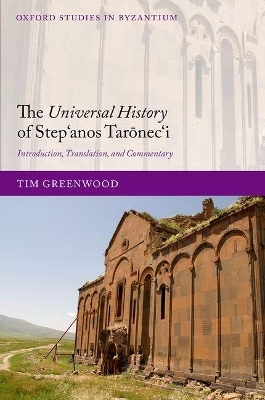
The Universal History of Stepʻanos Tarōnecʻi
Introduction, Translation, and Commentary
Seiten
2017
Oxford University Press (Verlag)
978-0-19-879251-2 (ISBN)
Oxford University Press (Verlag)
978-0-19-879251-2 (ISBN)
This first English translation of the Universal History of Stepʻanos Tarōnecʻi offers an accessible guide to the text, with extensive annotations and a substantial introduction providing valuable new insights into its contents, the intellectual and literary contexts within which it was composed, and its place in the Armenian tradition.
The Universal History (Patmutʻiwn tiezerakan) of Stepʻanos Tarōnecʻi is a history of the world in three books, composed by the Armenian scholar at the end of the tenth century and extending from the era of Abraham to the turn of the first millennium. It was completed in 1004/5 CE, at a time when the Byzantine Empire was expanding eastwards across the districts of historic Armenia and challenging key aspects of Armenian identity. Stepʻanos responded to these changing circumstances by looking to the past and fusing Armenian tradition with Persian, Roman, and Islamic history, thereby asserting that Armenia had a prominent and independent place in world history. The Universal History was intended to affirm and reinforce Armenian cultural memory. As well as assembling and revising extracts from existing Armenian texts, Stepʻanos also visited monastic communities where he learned about prominent Armenian scholars and ascetics who feature in his construction of the Armenian past. During his travels he gathered stories about local Armenian, Georgian, Persian, and Kurdish lords, which were then repeated in his composition. The Universal History therefore preserves a valuable narrative of events in Byzantium, Armenia, and the wider Middle East in the second half of the tenth century.
This volume presents the first ever English translation of this work, drawing upon Manukyan's 2012 critical edition of the text, and is also the first study and translation of the Universal History to be published outside Armenia for a century. Fully annotated and with a substantial introduction, it not only provides an accessible guide to the text, drawing on the most up-to-date scholarship available, but also offers valuable new insights into the significance of an often overlooked work, the intellectual and literary contexts within which it was composed, and its place in the Armenian tradition.
The Universal History (Patmutʻiwn tiezerakan) of Stepʻanos Tarōnecʻi is a history of the world in three books, composed by the Armenian scholar at the end of the tenth century and extending from the era of Abraham to the turn of the first millennium. It was completed in 1004/5 CE, at a time when the Byzantine Empire was expanding eastwards across the districts of historic Armenia and challenging key aspects of Armenian identity. Stepʻanos responded to these changing circumstances by looking to the past and fusing Armenian tradition with Persian, Roman, and Islamic history, thereby asserting that Armenia had a prominent and independent place in world history. The Universal History was intended to affirm and reinforce Armenian cultural memory. As well as assembling and revising extracts from existing Armenian texts, Stepʻanos also visited monastic communities where he learned about prominent Armenian scholars and ascetics who feature in his construction of the Armenian past. During his travels he gathered stories about local Armenian, Georgian, Persian, and Kurdish lords, which were then repeated in his composition. The Universal History therefore preserves a valuable narrative of events in Byzantium, Armenia, and the wider Middle East in the second half of the tenth century.
This volume presents the first ever English translation of this work, drawing upon Manukyan's 2012 critical edition of the text, and is also the first study and translation of the Universal History to be published outside Armenia for a century. Fully annotated and with a substantial introduction, it not only provides an accessible guide to the text, drawing on the most up-to-date scholarship available, but also offers valuable new insights into the significance of an often overlooked work, the intellectual and literary contexts within which it was composed, and its place in the Armenian tradition.
Tim Greenwood completed his doctorate in early medieval Armenian historiography at the University of Oxford in 2000, having made the move from a prior career as a solicitor in London in 1995. After holding postdoctoral positions in Oxford, he was appointed to a permanent post in the School of History at the University of St Andrews in 2005. His research continues to focus on medieval Armenia, and he has published widely on Armenian history, historiography, epigraphy, material culture, art history, theology, and law.
FRONTMATTER; INTRODUCTION; NOTE ON TRANSLATION; BOOK I; BOOK II; BOOK III; MAPS; ENDMATTER
| Erscheinungsdatum | 23.06.2017 |
|---|---|
| Reihe/Serie | Oxford Studies in Byzantium |
| Zusatzinfo | 6 black-and-white maps |
| Verlagsort | Oxford |
| Sprache | englisch |
| Maße | 168 x 241 mm |
| Gewicht | 714 g |
| Themenwelt | Geschichte ► Allgemeine Geschichte ► Mittelalter |
| Geisteswissenschaften ► Geschichte ► Regional- / Ländergeschichte | |
| Geisteswissenschaften ► Sprach- / Literaturwissenschaft ► Anglistik / Amerikanistik | |
| ISBN-10 | 0-19-879251-4 / 0198792514 |
| ISBN-13 | 978-0-19-879251-2 / 9780198792512 |
| Zustand | Neuware |
| Informationen gemäß Produktsicherheitsverordnung (GPSR) | |
| Haben Sie eine Frage zum Produkt? |
Mehr entdecken
aus dem Bereich


aus dem Bereich
Geschichte einer Augsburger Familie (1367-1650)
Buch | Softcover (2024)
Kohlhammer (Verlag)
CHF 47,60


