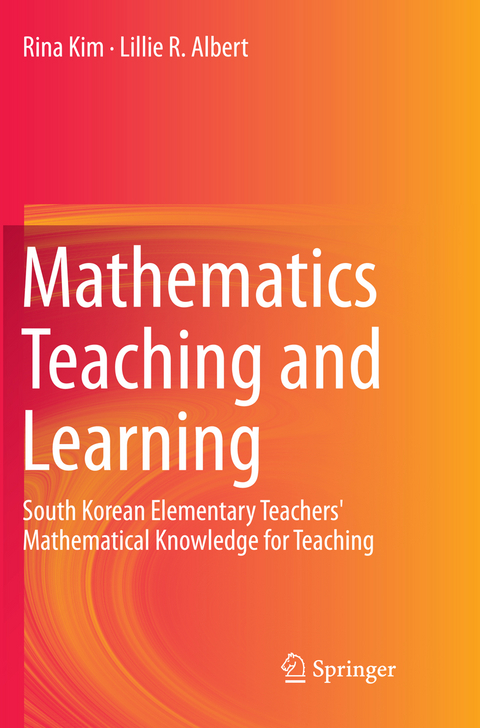
Mathematics Teaching and Learning
Springer International Publishing (Verlag)
978-3-319-36615-9 (ISBN)
Rina Kim has Ph. D in Curriculum and Instruction from Boston College. She works as an elementary school teacher in South Korea and teaches courses in mathematics education at Seoul National University of Education. Her academic focus is mathematics education at the elementary level. Her research interests also include using technology to improve the quality of mathematics instruction. She has published her research in leading journals in her field and presented papers at major research conferences. Her other recent book is Reading, Writing, and Discussing at the Graduate Level: A Guidebook for International Graduate Students coauthored with Lillie R. Albert and Hang Gyun Sihn. Lillie R. Albert, an associate professor at Boston College Lynch School of Education, has a Ph.D. in Curriculum and Instruction from the University of Illinois at Urbana-Champaign. Her research focuses on the influence that sociocultural historic contexts have on learning and development of learners across the lifespan. Her specialization includes the exploration of the relationship between the teaching and learning of mathematics and the use of cultural and communicative tools to develop conceptual understanding of mathematics, which includes collaborating with mathematics education scholars at Seoul National University of Education, Seoul, South Korea to explore government policies in supporting the preparation of mathematics teachers. She has published her research in leading national and international journals in her field and presented papers at major research conferences. Her other recent books are Rhetorical Ways of Thinking: Vygotskian Theory and Mathematical Learning, in collaboration with Danielle Corea and Vittoria Macadino and Reading, Writing, and Discussing at the Graduate Level: A Guidebook for International Graduate Students coauthored with Rina Kim and Hang Gyun Sihn.
CHAPTER 1: Introduction.- 1.1. Why elementary teachers' knowledge matter.- 1.2. Purpose of the Study and Research Question.- 1.3. Framework.- 1.3.1. Theoretical Orientation.- 1.3.2. Conceptual Framework.- 1.4. Organization of the Book.- References.- CHAPTER 2: A Pedagogical Overview of Related Research.- 2.1. Introduction.- 2.2. Sociocultural Theory.- 2.3. Research on Teachers' Mathematical Knowledge for Teaching.- 2.3.1. Shulman's Research on Teachers' Knowledge for Teaching.- 2.3.2. Fennema and Franke's Research on Mathematics Teachers' Knowledge .- 2.3.3. Hill, Ball and Schilling's Research on Teachers' Mathematical Knowledge for Teaching.- 2.3.4. Mishra and Koehler's New Category of Teachers' Mathematical Knowledge for Teaching.- 2.5. Interpretive Summary and Critical Analysis.-References.- CHAPTER 3: Methodology.- 3.1. Introduction.- 3.2. Research Design.- 3.3. Participants.- 3.4. Settings.- 3.5. Data Collection.-3.6. Data Analysis.- References.- CHAPTER 4: Context of Elementary Mathematics Education in South Korea.- 4.1. Introduction.- 4.2. The National Curriculum in South Korea.- 4.3. The National Curriculum and Education Fever in South Korea.- 4.4. The National Mathematics Curriculum at the Elementary Level in South Korea .- 4.5. Summary.-References.- CHAPTER 5: Mathematics Curriculum Knowledge (MCK).- 5.1. Introduction.- 5.2. Mathematics Curriculum Knowledge in Mathematics Instruction.- 5.2.1. Using MCK When Developing and Instructional Process.- 5.2.2. Using MCK When Teaching the Lesson in a Classroom.- 5.2.3. Using MCK When Assessing Students' Work.- 5.3. Interpretative Summary.- References.- CHAPTER 6: Mathematics Learner Knowledge (MLK).- 6.1. Introduction.- 6.2. Mathematics Learner Knowledge.- 6.3. Mathematics Learner Knowledge in Mathematics Instruction.- 6.3.1. Using MLK When Developing and Instructional Process.- 6.3.2. Using MCK When Teaching the Lesson in aClassroom.- 6.3.3. Using MLK When Assessing Students' Work.- 6.4 Interpretative Summary.- References.- CHAPTER 7: Fundamental Mathematics Conceptual Knowledge (FMCK).- 7.1. Introduction.- 7.2. Fundamental Mathematics Conceptual Knowledge.- 7.3. Fundamental Mathematics Conceptual Knowledge in Mathematics Instruction.- 7.3.1. Using FMCK When Developing and Instructional Process.- 7.3.2. Using FMCK When Teaching the Lesson in a Classroom.- 7.3.3. Using FMLK When Assessing Students' Work.- 7.4. Interpretative Summary.- References.- CHAPTER 8: Mathematics Pedagogical Content Knowledge (MPCK) and Mathematics Pedagogical Procedural Knowledge (MPPK).- 8.1. Introduction.- 8.2. The Nature of Categories of Knowledge for Teaching Mathematics.- 8.3. The Relationship Among Categories of Knowledge for Teaching Mathematics.- 8.4. Mathematics Pedagogical Content Knowledge.- 8.5. Mathematics Pedagogical Procedural Knowledge.- 8.6. The Structure of South Korean Elementary Teachers' Knowledge for Teaching Mathematics.- 8.7. Interpretative Summary.- References.- CHAPTER 9: Concluding Remarks, Implications and Future Directions.- 9.1. Introduction.- 9.2. Relationship Among the Categories of Mathematical Knowledge.- 9.3. Conclusion and Implications.-9.5. Future Directions.- 9.6. Closing Comments.- References.
| Erscheinungsdatum | 14.10.2016 |
|---|---|
| Zusatzinfo | XV, 152 p. 26 illus., 2 illus. in color. |
| Verlagsort | Cham |
| Sprache | englisch |
| Maße | 155 x 235 mm |
| Themenwelt | Schulbuch / Wörterbuch ► Unterrichtsvorbereitung ► Unterrichts-Handreichungen |
| Geisteswissenschaften ► Psychologie ► Allgemeine Psychologie | |
| Geisteswissenschaften ► Psychologie ► Pädagogische Psychologie | |
| Sozialwissenschaften ► Pädagogik ► Schulpädagogik / Grundschule | |
| Schlagworte | Cognition and cognitive psychology • Education • Educational technology • Educational: Technology • Learning & Instruction • Learning and Instruction • Learning & Instruction • Mathematical Knowledge for Teaching • Mathematics Concept • Mathematics teacher education • Pedagogical Content Knowledge • South Korea Education • Teaching skills and techniques |
| ISBN-10 | 3-319-36615-7 / 3319366157 |
| ISBN-13 | 978-3-319-36615-9 / 9783319366159 |
| Zustand | Neuware |
| Informationen gemäß Produktsicherheitsverordnung (GPSR) | |
| Haben Sie eine Frage zum Produkt? |
aus dem Bereich