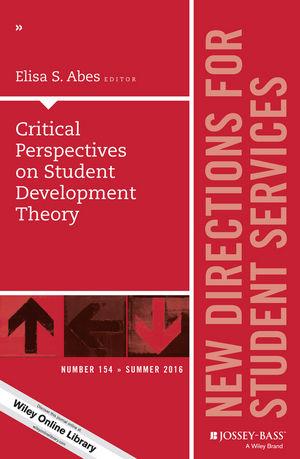
Critical Perspectives on Student Development Theory (eBook)
112 Seiten
John Wiley & Sons (Verlag)
978-1-119-28396-6 (ISBN)
This volume offers some of the most contemporary thinking about student development by:
* reviewing recent critical post-structural scholarship;
* offering new possibilities for using theoretical lenses; and
* translating these theories into student affairs practice.
This is the 154th volume of this Jossey-Bass higher education quarterly series. An indispensable resource for vice presidents of student affairs, deans of students, student counselors, and other student services professionals, New Directions for Student Services offers guidelines and programs for aiding students in their total development: emotional, social, physical, and intellectual.
Elisa S. Abes is associate professor in the student affairs in higher education program in the Department of Educational Leadership at Miami University.
EDITOR'S NOTES 5
Elisa S. Abes
1. Situating Paradigms in Student Development Theory 9
Elisa S. Abes
This chapter describes four paradigms that situate student development, emphasizing how theory addresses systems of oppression.
2. Evolution of Student Development Theory 17
Susan R. Jones, Dafina-Lazarus Stewart
The authors frame the evolution of student development theory as three waves, with critical and poststructural perspectives comprising the most contemporary, evolving "third" wave.
3. Diverse and Critical Perspectives on Cognitive Development Theory 29
Kari B. Taylor
This chapter synthesizes foundational theories of cognitive development and examines how diverse worldviews and systems of power influence the nature of cognitive development.
4. Embracing the Messiness: Critical and Diverse Perspectives on Racial and Ethnic Identity Development 43
Marc P. Johnston-Guerrero
This chapter addresses multiple possibilities for the relationship between race and ethnicity in identity development, exploring how racism shapes these relationships.
5. Critical and Poststructural Perspectives on Sexual Identity Formation 57
J. Michael Denton
This chapter explores college students' sexual identity formation using concepts from feminism, intersectionality, poststructuralism, and queer theory.
6. Intersectional Perspectives on Gender and Gender Identity Development 71
Claire K. Robbins, Brian L. McGowan
The authors challenge normative ways of describing gender and gender identity of college students, focusing on intersectionality as a critical lens.
7. Critical Perspectives on Disability Identity 85
Edlyn Vallejo Pe~ na, Lissa D. Stapleton, Lenore Malone Schaffer
This chapter reviews diversity among disabilities and encourages critical disability and intersectional approaches to conceptualizing disability identity.
8. Critical and Poststructural Perspectives on Self-Authorship 97
Elisa S. Abes, Ebelia Hernández
This chapter explores how systems of oppression challenge the meaning of development and self-authorship.
INDEX 109
| Erscheint lt. Verlag | 14.6.2016 |
|---|---|
| Reihe/Serie | J-B SS Single Issue Student Services |
| Sprache | englisch |
| Themenwelt | Geisteswissenschaften |
| Sozialwissenschaften ► Pädagogik ► Allgemeines / Lexika | |
| Sozialwissenschaften ► Pädagogik ► Bildungstheorie | |
| Schlagworte | Allg. Bildungswesen (Hochschulen) • Bildungswesen • Education • Education Special Topics • Higher Education General • Hochschulen / Dienstleistungen f. Studenten • Spezialthemen Bildungswesen • Student Affairs & Development (Higher Education) |
| ISBN-10 | 1-119-28396-5 / 1119283965 |
| ISBN-13 | 978-1-119-28396-6 / 9781119283966 |
| Informationen gemäß Produktsicherheitsverordnung (GPSR) | |
| Haben Sie eine Frage zum Produkt? |
 PDF (Adobe DRM)
Kopierschutz: Adobe-DRM
Adobe-DRM ist ein Kopierschutz, der das eBook vor Mißbrauch schützen soll. Dabei wird das eBook bereits beim Download auf Ihre persönliche Adobe-ID autorisiert. Lesen können Sie das eBook dann nur auf den Geräten, welche ebenfalls auf Ihre Adobe-ID registriert sind.
Details zum Adobe-DRM
Dateiformat: PDF (Portable Document Format)
Mit einem festen Seitenlayout eignet sich die PDF besonders für Fachbücher mit Spalten, Tabellen und Abbildungen. Eine PDF kann auf fast allen Geräten angezeigt werden, ist aber für kleine Displays (Smartphone, eReader) nur eingeschränkt geeignet.
Systemvoraussetzungen:
PC/Mac: Mit einem PC oder Mac können Sie dieses eBook lesen. Sie benötigen eine
eReader: Dieses eBook kann mit (fast) allen eBook-Readern gelesen werden. Mit dem amazon-Kindle ist es aber nicht kompatibel.
Smartphone/Tablet: Egal ob Apple oder Android, dieses eBook können Sie lesen. Sie benötigen eine
Geräteliste und zusätzliche Hinweise
Buying eBooks from abroad
For tax law reasons we can sell eBooks just within Germany and Switzerland. Regrettably we cannot fulfill eBook-orders from other countries.
aus dem Bereich