


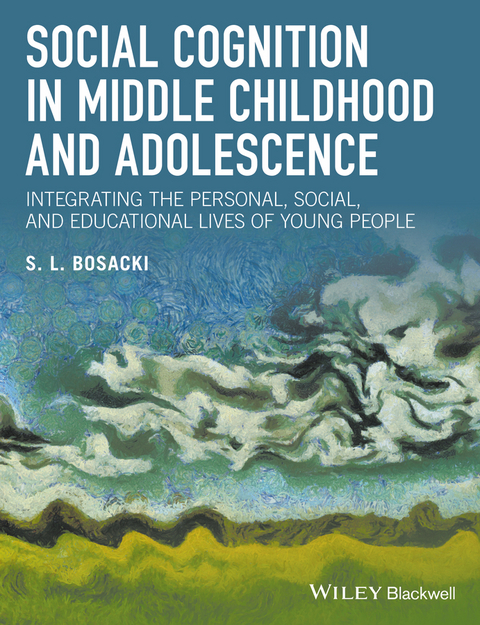
Social Cognition in Middle Childhood and Adolescence (eBook)
John Wiley & Sons (Verlag)
978-1-118-93802-7 (ISBN)
Bridging psychological theory and educational practice, this is an innovative textbook on the emotional and social aspects of young people's development. Bosacki's Social Cognition in Middle Childhood and Adolescence, First Edition moves beyond tradition cognitivist representations of how children learn and grow, focusing on how to integrate the emotional, cognitive, moral, spiritual and social in young people's experiences. This text bridges the gap between theory and practice; analyses cutting edge research and translates it into culturally sensitive and developmentally appropriate strategies for future educational practice.
Bridging psychological theory and educational practice, this is an innovative textbook on the emotional and social aspects of young people's development. Bosacki's Social Cognition in Middle Childhood and Adolescence, First Edition moves beyond tradition cognitivist representations of how children learn and grow, focusing on how to integrate the emotional, cognitive, moral, spiritual and social in young people s experiences. This text bridges the gap between theory and practice; analyses cutting edge research and translates it into culturally sensitive and developmentally appropriate strategies for future educational practice.
Sandra Bosacki is Professor in the Department of Graduate and Undergraduate Studies in Education, at Brock University, Canada, where she teaches graduate courses in applied developmental psychology. Her teaching and research interests include socio-cognitive, emotional, moral, and spiritual development within diverse cultural and educational contexts. She is Assistant Editor of the Journal of Adolescence, and the author of numerous journal articles and books, including Culture of Ambiguity (2012), Children's Emotional Lives (2008), and The Culture of Classroom Silence (2005).
Preface ix
Acknowledgments xi
Introduction 1
Part I Foundations 13
1 Social Cognitive Abilities and School Experiences of Young People: Theory and Evidence 15
2 Developmental Social Cognition and Research Methodologies 34
Part II Social Cognitive Educational and Developmental Research: Self 55
3 The Cognitive Self: Language and Executive Functions 57
4 The Emotional Self: Self?]Development and Emotional Regulation 82
5 The Moral Self: Morality, Spirituality, and Self?]Development 109
Part III Social Cognitive Educational and Developmental Research: Social 133
6 Peer Relationships 135
7 Family Relationships 157
8 Gender and Culture 188
Part IV Ecologies of Social Cognitive Development 223
9 Digital Worlds and Social Media 225
10 Social Cognition and Behavioral and Emotional Challenges 248
Part V Future Questions and Implications for Practice: Helping Young People to Move Forward 277
11 Developmental Social Cognitive Pedagogy 279
12 Beyond Social Cognition 307
Conclusion: Closing Thoughts and New Questions 324
Index 328
Introduction
“You’re thinking about something, my dear, and that makes you forget to talk. I can’t tell you just now what the moral of that is, but I shall remember in a bit.”
(Carroll, 1865/1984; p. 105)
Overview
The aim of this chapter is to provide the reader with a broad overview of the field of developmental social cognition, and a rationale for this book. In doing so, I touch upon some of the key issues that I will address in more depth later in the text. To provide the reader with a sense of what is to follow, in the closing section of this chapter I provide a concise overview of the structure and content of the book.
Rationale for the book
In general, this book focuses on some of the main questions of the personal, social, and educational lives of children as they approach adolescence. That is, how can we help young people grow emotionally and socially during the transition from later childhood to early adolescence? How can we encourage them to develop adaptive skills that will help them navigate their identity and relationships through the turbulent transition from approximately ages 7 or 8 to 12 or 13? Why is this important? What are the key issues and implications for children’s emotional health and educational lives? That is, how can educators and researchers draw on developmental theory and research to integrate the emotional, cognitive, and social worlds of the child into the classroom, and develop innovative strategies for progressive educational practice?
Given the growth in research on developmental social cognition and emotion regulation, it is surprising that the majority of research in learning and development continues to focus largely on cognitive aspects. Challenging this dominant view, the proposed book discusses theoretical, empirical, and intervention issues relating to emotional and social aspects of emerging adolescents’ educational experiences that may contribute to their broader emotional health and relationships. Drawing largely upon the social cognitive research field of Theory of Mind (ToM) or the ability to “read” others’ mental states within the context of social action that allows us to grasp multiple perspectives and thus communicate effectively, I will explore young people’s ability to understand or make meaning of human thoughts and feelings, and how such “psychological understanding” relates to their sense of self, peer relations, and sociocommunicative competence within the school setting.
Drawing on examples from recent research and findings from longitudinal studies on children’s social cognition, the book will integrate emotional and social accounts of development during childhood and the transition to adolescence. In particular, this book will focus on the ambiguities and challenges young people experience as they navigate the uncharted waters of personal identity and relationships. The book will build on and move beyond traditional cognitive‐developmental representations of how children and adolescents learn.
Specifically, the text will provide a critical analysis of cutting‐edge empirical evidence from psychological studies, and then translate these research findings into practical suggestions for progressive education. The overriding aim of this book is to foster the growth of new ideas in developmental and educational psychology. Most importantly, this book aims to encourage innovative, forward‐thinking strategies that will help young people to develop healthy minds and relationships in the classroom, community, and beyond.
Research has shown that the ability to make sense of the signs and symbols evident in human communication may influence children’s self‐conceptions and their social interactions in childhood and adolescence. The book will investigate which aspects of these experiences foster the growth of psychological understanding. That is, it will explore how young people understand mind, emotion, and spirit and use this ability to help them navigate their personal identity and relationships with the classroom. This book aims to bridge the gap between theory and practice within the fields of human development and education through a critical review of the literature from the perspective of a researcher and a practitioner.
In particular, this book will critically analyze empirical research evidence concerning aspects of adolescents’ social and emotional worlds, including psychological understanding, self‐conceptions, and peer relations, and then explore implications for educational practice. Unlike some books that focus either on theory and research or on education, this book seeks to integrate the two, encouraging educators and researchers to critically engage the two disciplines in an ongoing discourse. By combining research findings with real‐world applications, the book aims to be of empirical, inspirational, and practical value to readers.
As one of the few existing books that examines social and emotional development during later childhood and early adolescence from a dual perspective of both research and practice, this book is targeted at a wide variety of researchers and educators that range from youth workers to academics. In particular, as the book explores the developmentally appropriate needs of the “whole young person” in education, I hope that the topic will interest “developmental interventionists.” Given that the topics of cognition, spirituality, emotion, and education are of interest to educators across the globe, this book also aims to reflect the international scope of social cognitive developmental research.
What Is Social Cognition?
Social cognition research finds that most children between 5 and 8 years develop: (a) an understanding of self‐conscious or complex emotions (e.g., pride, embarrassment); (b) complex self‐understandings of people as psychological beings; (c) ideas about the nature of the divine, the concept of faith, and the meaning of prayer (Coles, 1990; Fowler, 1981); and (d) an understanding of ambiguity within social and personal contexts. Based on this research and our previous work, this book explores how children in late childhood and early adolescence use their understandings of mind to navigate their identity and relationships during the elementary to secondary school transition.
Why Is There So Little Research on Later Childhood and Early Adolescence?
Since the turn of the 21st century, the age‐old debate of traditional, cognitive, and academic‐focused versus more student‐centered progressive education that recognizes the socioemotional and ethical aspects of learning (Malti & Krettenauer, 2013; Siegel, 2013) continues to remain somewhat contentious. Although there is a broad consensus among parents, educators, school administrators, academics, and community leaders that suggests schools need to help young people become productive, globally aware, and emotionally well citizens, at the same time there remains a group that suggests the main goal of education is to promote cognitive development and academic success. That is, although the majority of researchers and educators agree that young people need to learn how to share responsibility for nurturing social‐emotional learning, character development, social engagement, and emotional health (Hughes & Devine, 2015; Neff, 2011), the disciplines of research and education have, until fairly recently, been focused on the cognitive aspects of learning.
Thus, many educators continue to face difficult choices about priorities between academic and socioemotional goals, and continue to be subjected to increasing pressure from policymakers regarding academic achievement (Goldstein & Winner, 2012). Given this demand, schools around the world have become highly demanding environments, and middle schools in particular may be vulnerable. That is, given that the middle‐school grades include the student population that involves older children and emerging adolescents, past research suggests that this particular population has been associated with substantial academic and social stress and psychoemotional challenges among young adolescents (Siegel, 2013; Tough, 2012; Twenge, 2006, 2011; World Health Organization, 1999).
Past research shows that juvenile transition, or the transition between later childhood and early adolescence, involves simultaneous changes in school environments, social interactions, and academic expectations, and it coincides with other biological and social and emotional changes associated with the transition from childhood to adolescence (Del Giudice, 2014). Past research from an evolutionary developmental approach claims that the transition encompasses all the major domains of behavior—from learning and self‐regulation to attachment and sexuality. Moreover, this juvenile transition has been considered to represent a switch point in the development of life history strategies, which according to Del Giudice (2014) are coordinate suites of physiological, morphological, and behavioral traits that partly determine how organisms allocate their resources to key biological activities such as reproduction, growth, mating, and parenting. In particular, this approach claims that gonadarche and adrenarche are endocrinological events during which the adrenal glands are awakened, usually between the ages of 6 to 8 years when the adrenal glands begin to secrete increasing amounts of androgens, mainly dehydroepiandrosterone...
| Erscheint lt. Verlag | 14.9.2016 |
|---|---|
| Sprache | englisch |
| Themenwelt | Geisteswissenschaften ► Psychologie ► Entwicklungspsychologie |
| Schlagworte | adolescence • Behavior • Developmental Psychology • Education • Educational & School Psychology • emotional self • Entwicklungspsychologie • Entwicklungspsychologie / Jugendalter • Erziehungs- u. Schulpsychologie • Jugend • Kindheit • <p>Cognitive abilities • neurocognitive science • neuroeducation • Peer relationships • Psychologie • Psychology • School psychology • SEL • sensitive • Social and Emotional Learning • social cognition</p> • Soziale Kognition • Theory of Mind • withdrawn |
| ISBN-10 | 1-118-93802-X / 111893802X |
| ISBN-13 | 978-1-118-93802-7 / 9781118938027 |
| Informationen gemäß Produktsicherheitsverordnung (GPSR) | |
| Haben Sie eine Frage zum Produkt? |
 EPUB (Adobe DRM)
Kopierschutz: Adobe-DRM
Adobe-DRM ist ein Kopierschutz, der das eBook vor Mißbrauch schützen soll. Dabei wird das eBook bereits beim Download auf Ihre persönliche Adobe-ID autorisiert. Lesen können Sie das eBook dann nur auf den Geräten, welche ebenfalls auf Ihre Adobe-ID registriert sind.
Details zum Adobe-DRM
Dateiformat: EPUB (Electronic Publication)
EPUB ist ein offener Standard für eBooks und eignet sich besonders zur Darstellung von Belletristik und Sachbüchern. Der Fließtext wird dynamisch an die Display- und Schriftgröße angepasst. Auch für mobile Lesegeräte ist EPUB daher gut geeignet.
Systemvoraussetzungen:
PC/Mac: Mit einem PC oder Mac können Sie dieses eBook lesen. Sie benötigen eine
eReader: Dieses eBook kann mit (fast) allen eBook-Readern gelesen werden. Mit dem amazon-Kindle ist es aber nicht kompatibel.
Smartphone/Tablet: Egal ob Apple oder Android, dieses eBook können Sie lesen. Sie benötigen eine
Geräteliste und zusätzliche Hinweise
Buying eBooks from abroad
For tax law reasons we can sell eBooks just within Germany and Switzerland. Regrettably we cannot fulfill eBook-orders from other countries.
aus dem Bereich


