Ancient Greek Civilization (eBook)
John Wiley & Sons (Verlag)
978-1-119-09812-6 (ISBN)
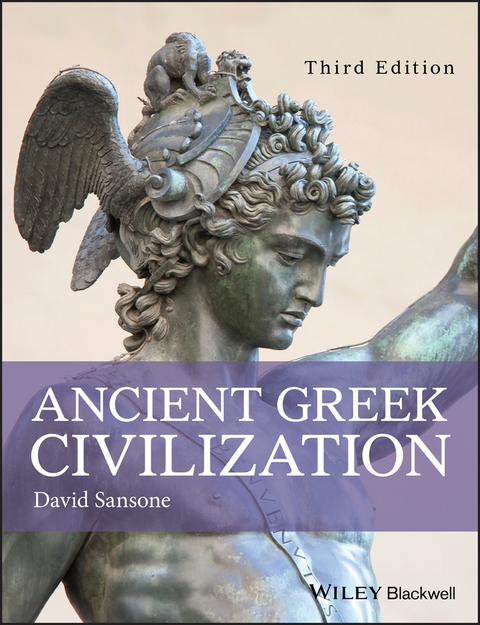
The third edition of Ancient Greek Civilization is a concise, engaging introduction to the history and culture of ancient Greece from the Minoan civilization to the age of the Roman Empire.
- Explores the evolution and development of Greek art, literature, politics, and thought across history, as well as the ways in which these were affected by Greek interaction with other cultures
- Now includes additional illustrations and maps, updated notes and references throughout, and an expanded discussion of the Hellenistic period
- Weaves the latest scholarship and archeological excavations into the narrative at an appropriate level for undergraduates
David Sansone is Professor Emeritus of Classics at the University of Illinois at Urbana-Champaign. He is a former editor of Illinois Classical Studies, served on the editorial boards of Classical Philology and Bryn Mawr Classical Review, and was a member of the Board of Directors of the American Philological Association. While his research focuses on Greek literature of the Classical Period, his publications include work on such subjects as textual criticism, theories of the origin of sport, Bronze Age iconography, John Milton, and Richard Wagner. He is the author of Greek Athletics and the Genesis of Sport (1988), Plutarch: Lives of Aristeides and Cato (1989), and Greek Drama and the Invention of Rhetoric (Wiley Blackwell, 2012).
David Sansone is Professor Emeritus of Classics at the University of Illinois at Urbana-Champaign. He is a former editor of Illinois Classical Studies, served on the editorial boards of Classical Philology and Bryn Mawr Classical Review, and was a member of the Board of Directors of the American Philological Association. While his research focuses on Greek literature of the Classical Period, his publications include work on such subjects as textual criticism, theories of the origin of sport, Bronze Age iconography, John Milton, and Richard Wagner. He is the author of Greek Athletics and the Genesis of Sport (1988), Plutarch: Lives of Aristeides and Cato (1989), and Greek Drama and the Invention of Rhetoric (Wiley Blackwell, 2012).
List of Figures vii
List of Maps xi
List of Timelines xiii
Foreword: Looking Backward xv
1 The Greeks and the Bronze Age 1
2 Iron Age Greece 29
3 The Poems of Hesiod and Homer 49
4 Poetry and Sculpture of the Archaic Period 67
5 Symposia, Seals, and Ceramics in the Archaic Period 87
6 The Birth of Philosophy and the Persian Wars 107
7 Setting the Stage for Democracy 125
8 History and Tragedy in the Fifth Century 147
9 The Peloponnesian War: A Tale of Thucydides 167
10 Stage and Law Court in Late Fifth-century Athens 191
11 The Transformation of the Greek World in the Fourth Century 211
12 Greek Culture in the Hellenistic Period 233
Afterword: Looking Forward 263
Glossary 283
Index 287
FOREWORD LOOKING BACKWARD
In his last public speech in Mississippi City, March 1888, Jefferson Davis, former President of the Confederate States of America, proclaimed, “The past is dead,” very much hoping that what he was saying might turn out to be true. Another Southerner, the novelist William Faulkner, issued a stern corrective when, in his Requiem for a Nun (1951), he put into the mouth of a citizen of the fictional city of Jefferson, Mississippi, the following: “The past is never dead. It’s not even past.” The past, it seems, will always be with us, whether we like it or not. But it will not always be the same past. Rather, the past is in a constant process of change, as the ever-changing present increasingly imposes itself on the past. It is, perhaps, difficult to accept the notion that, for example, the civilization of the ancient Greeks, a civilization that no longer exists, is now in the process of change. We are, however, quite prepared to admit that ancient Greek civilization, while it was in existence, was constantly changing, since change is an invariable feature of living civilizations. One of the important ways civilizations, including our own, change is by constantly modifying the perception of the shared past that serves as each civilization’s foundation. As we will see, ancient Greek civilization was involved in a constant process of reinventing itself, by adapting its own past in the light of its own ever-changing present. We, too, have been reinventing ancient Greek civilization in a similar fashion. This process of reinventing ancient Greek civilization has been going on for quite some time. Indeed, there is a venerable tradition of doing so, a tradition that stretches from the time of the ancient Greeks themselves until this morning.
Reinventing Ancient Greek Civilization
Let us begin at a point within that tradition, somewhat closer to this morning than to the time of the ancient Greeks, so that we may have a better idea of what the nature of that tradition is. Lucas Cranach the Elder, who lived in sixteenth-century Germany, was court painter to Friedrich the Wise, Elector of Saxony, and friend of Martin Luther. Among Cranach’s works, which include paintings of biblical subjects and austere portraits of princes and Protestant reformers, are representations of stories from Greek myth, among them a Judgment of Paris now in New York’s Metropolitan Museum of Art (figure 1). The artist assumes that the viewer of the painting will be familiar with the story: The Greek goddesses Aphrodite, Athena, and Hera have been escorted by the god Hermes, who holds the prize for beauty that is to be awarded by the Trojan prince Paris (also known as Alexander) to the lucky winner. The setting of this encounter, according to the myth, is Mount Ida, in what is now northwestern Turkey. The landscape depicted in Cranach’s painting, however, is conspicuously northern European and, indeed, is virtually the same as the landscape that appears in some of Cranach’s portraits of his German contemporaries. Further, Paris is wearing medieval armor, rather than anything resembling what an ancient Greek would actually have worn, and the goddesses Hera and Athena are shown in the nude, as they never would have been shown in ancient Greek art (figure 2). In short, despite the fact that Cranach’s painting purports to provide a pictorial representation of ancient Greek myth, the terms in which the myth is portrayed are recognizably those of sixteenth-century Germany.
Figure 1 Lucas Cranach the Elder (1472–1553), The Judgment of Paris, oil on wood; 102 × 71 cm, ca. 1528.
Source: The Metropolitan Museum of Art, Rogers Fund, 1928. www.metmuseum.org (accessed March 29, 2016).
Figure 2 Attic black-figure tripod-jar showing Hermes (center) leading Athena, Hera, and Aphrodite to Paris (right) for judgment; height 14 cm, ca. 570 BC. Paris, Musée du Louvre, CA 616 C.
Source: Photo © RMN-Grand Palais (Musée du Louvre) / Stéphane Maréchalle.
It is easy enough to spot the inauthentic elements in Cranach’s Judgment of Paris (or in some more recent depictions of ancient Greece, such as the films Hercules or 300: Rise of an Empire). It is much more difficult to say what is genuine. But what do we mean, in this context, by “genuine” or “authentic”? The story of the judgment of Paris is just that: a story. It is concerned with gods and goddesses who never existed (although they were, of course, thought to exist) and with human beings who may or may not have existed and who may or may not have done what the story represents them as having done. Still, stories can tell us a great deal about the people among whom the stories circulate. Surely there is an authentic (or at least a more authentic) version of the story of the judgment of Paris which, if we can reconstruct it, will help us recover something of ancient Greek civilization? In any case, the ancient Greeks have a history. Can we not discover at least some “facts” about the ancient Greeks, or at least about some of the ancient Greeks?
As we will see, the English word “history” and the English word “story” have the same origin. They both derive from the Greek word historia, which was used by the Greeks of the fifth and fourth centuries BC to mean “investigations” or “the account derived from one’s investigations.” (The ancient Greek word for “story,” by the way, is mythos, to which the English word “myth” owes its origin.) It may seem at first sight surprising that a word, like English “story,” denoting a fictional or imaginary account shares its origin with a word associated with serious scholarly investigation. But in fact stories are told and histories are written for very much the same purpose, namely in order to make sense of, or to impose structure and coherence on, events. This is why we refer to accounts of current events that we read in the newspaper or watch on television as “news stories.” Just as histories need constantly to be revised and scientific theories need to be adjusted in light of new evidence, so stories take on different forms or are adapted for different audiences.
The story of the judgment of Paris illustrates all of this particularly well. Lucas Cranach is only one of literally hundreds of artists, writers, and musicians, from antiquity until our own day, who have created versions of the story. Presumably, creative artists like Cranach or, in more recent times, Frederick Ashton, who choreographed a ballet entitled The Judgment of Paris, or Gore Vidal, who wrote a novel of that name, or Salvador Dalí, who made a drawing based on the myth, have been attracted to the story because of its mythical resonance or its archetypal status, or simply because it is a “good story” and is familiar to the artist’s audience. According to the myth, when the gods were celebrating the marriage of Peleus and Thetis, the goddess Eris, who cannot help stirring up trouble since her very name means “conflict,” provoked a beauty contest involving the goddesses Aphrodite, Athena, and Hera. At the suggestion of Zeus, the three goddesses were led to Troy so that Paris could decide which of the three was the most beautiful. (Zeus knew enough to avoid being personally involved in the judging, so he delegated the task to a mortal, thereby showing why he deserved to be ruler of the gods.) Aphrodite, the goddess of sexual attractiveness, bribed Paris with the promise of marriage to the attractive Helen. The bribe proved irresistible and Paris accordingly awarded the prize to Aphrodite. Marriage to Helen, however, was not without its difficulties, as Helen was already the wife of Menelaus, the well-connected king of Sparta. Nevertheless, Paris sailed across the Aegean Sea to Sparta, abducted Helen, and brought her back to Troy. Understandably angry at the loss of his wife, Menelaus assembled a substantial military force and attacked the city of Troy. This was the beginning of the legendary Trojan War, a conflict that supposedly lasted for 10 years and was to provide material for poetry and song for thousands of years. Given the prominence of sex and violence, power and intrigue, moral issues and raw emotion, it is hardly surprising that this story has been told and retold through countless generations. But where does the myth originate and what does it really mean? Or is this even a meaningful question?
“It was up to him to judge among the three goddesses, that threefold bevy. Athena’s ‘gift’ to Alexander was leadership in war and Trojan conquest of Greece. Hera promised Asia and the realms of Europe for him to rule, if Paris should judge in her favor. But Cyprian Aphrodite told of my good looks in extravagant terms and offered me to him if she were the one to take the prize for beauty.” (Euripides, Trojan Women 925–31, Helen speaking)
The earliest evidence we have for the story of the judgment of Paris is in works of Greek art that were created in the seventh century BC; that is, some time between 700 and 600 BC. The artists of these works are representing the story that appeared in verbal form in the epic poem called the Cypria, which perhaps dates from some time around 700 BC. Unfortunately, the poem itself...
| Erscheint lt. Verlag | 12.9.2016 |
|---|---|
| Sprache | englisch |
| Themenwelt | Geschichte ► Allgemeine Geschichte ► Altertum / Antike |
| Geisteswissenschaften ► Geschichte ► Regional- / Ländergeschichte | |
| Schlagworte | Ancient & Classical Greek & Hellenistic History • Ancient & Classical History • Antike u. klassische Geschichte • Antiquity • Archäologie • archaeology • archaic period • Archäologie • birth of democracy • Byzantine • Classical Greece</p> • Classical Studies • Greek & Roman Archaeology • Griechenland /Alte Geschichte • Griechische u. Römische Archäologie • Griechische u. Römische Archäologie • Hellenistic period • Hellenistische Geschichte, Geschichte der griechischen Antike • Hesiod • Homer • Humanistische Studien • <p>Ancient Greece • Minoans • Peloponnesian War • Thucydides |
| ISBN-10 | 1-119-09812-2 / 1119098122 |
| ISBN-13 | 978-1-119-09812-6 / 9781119098126 |
| Informationen gemäß Produktsicherheitsverordnung (GPSR) | |
| Haben Sie eine Frage zum Produkt? |
 EPUB (Adobe DRM)
Kopierschutz: Adobe-DRM
Adobe-DRM ist ein Kopierschutz, der das eBook vor Mißbrauch schützen soll. Dabei wird das eBook bereits beim Download auf Ihre persönliche Adobe-ID autorisiert. Lesen können Sie das eBook dann nur auf den Geräten, welche ebenfalls auf Ihre Adobe-ID registriert sind.
Details zum Adobe-DRM
Dateiformat: EPUB (Electronic Publication)
EPUB ist ein offener Standard für eBooks und eignet sich besonders zur Darstellung von Belletristik und Sachbüchern. Der Fließtext wird dynamisch an die Display- und Schriftgröße angepasst. Auch für mobile Lesegeräte ist EPUB daher gut geeignet.
Systemvoraussetzungen:
PC/Mac: Mit einem PC oder Mac können Sie dieses eBook lesen. Sie benötigen eine
eReader: Dieses eBook kann mit (fast) allen eBook-Readern gelesen werden. Mit dem amazon-Kindle ist es aber nicht kompatibel.
Smartphone/Tablet: Egal ob Apple oder Android, dieses eBook können Sie lesen. Sie benötigen eine
Geräteliste und zusätzliche Hinweise
Buying eBooks from abroad
For tax law reasons we can sell eBooks just within Germany and Switzerland. Regrettably we cannot fulfill eBook-orders from other countries.
aus dem Bereich