


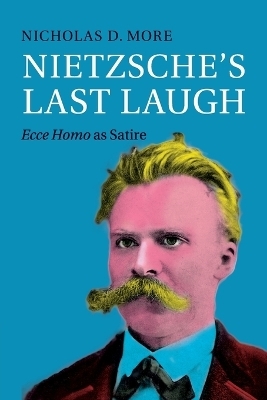
Nietzsche's Last Laugh
Ecce Homo as Satire
Seiten
2017
Cambridge University Press (Verlag)
9781107636866 (ISBN)
Cambridge University Press (Verlag)
9781107636866 (ISBN)
Against scholarly complaints that Nietzsche's Ecce Homo is useless, mad, or merely inscrutable, Nietzsche's Last Laugh provides the first complete analysis of the philosopher's final composition, revealing how the work inhabits an ancient literary form: satire. The book will spark debate among anyone concerned with Nietzsche's self-understanding in his works.
Nietzsche's Ecce Homo was published posthumously in 1908, eight years after his death, and has been variously described ever since as useless, mad, or merely inscrutable. Against this backdrop, Nicholas D. More provides the first complete and compelling analysis of the work, and argues that this so-called autobiography is instead a satire. This form enables Nietzsche to belittle bad philosophy by comic means, attempt reconciliation with his painful past, review and unify his disparate works, insulate himself with humor from the danger of 'looking into abysses', and establish wisdom as a special kind of 'good taste'. After showing how to read this much-maligned book, More argues that Ecce Homo presents the best example of Nietzsche making sense of his own intellectual life, and that its unique and complex parody of traditional philosophy makes a powerful case for reading Nietzsche as a philosophical satirist across his corpus.
Nietzsche's Ecce Homo was published posthumously in 1908, eight years after his death, and has been variously described ever since as useless, mad, or merely inscrutable. Against this backdrop, Nicholas D. More provides the first complete and compelling analysis of the work, and argues that this so-called autobiography is instead a satire. This form enables Nietzsche to belittle bad philosophy by comic means, attempt reconciliation with his painful past, review and unify his disparate works, insulate himself with humor from the danger of 'looking into abysses', and establish wisdom as a special kind of 'good taste'. After showing how to read this much-maligned book, More argues that Ecce Homo presents the best example of Nietzsche making sense of his own intellectual life, and that its unique and complex parody of traditional philosophy makes a powerful case for reading Nietzsche as a philosophical satirist across his corpus.
Nicholas D. More is Professor of Philosophy at Westminster College, Utah.
Prologue; Part I. What is Ecce Homo?: Introduction; 1. Nietzsche deigns to read himself; 2. A question of genre; Part II. What is the Meaning of Ecce Homo?: 3. Ecce Homo as satire: analysis and commentary; Part III. What is the Significance of Ecce Homo?: Conclusion.
| Erscheinungsdatum | 01.03.2017 |
|---|---|
| Verlagsort | Cambridge |
| Sprache | englisch |
| Maße | 153 x 228 mm |
| Gewicht | 360 g |
| Themenwelt | Geisteswissenschaften ► Philosophie ► Geschichte der Philosophie |
| Geisteswissenschaften ► Philosophie ► Philosophie der Neuzeit | |
| Geisteswissenschaften ► Sprach- / Literaturwissenschaft ► Anglistik / Amerikanistik | |
| Geisteswissenschaften ► Sprach- / Literaturwissenschaft ► Literaturwissenschaft | |
| ISBN-13 | 9781107636866 / 9781107636866 |
| Zustand | Neuware |
| Informationen gemäß Produktsicherheitsverordnung (GPSR) | |
| Haben Sie eine Frage zum Produkt? |
Mehr entdecken
aus dem Bereich
aus dem Bereich
Philosophie in Zeiten des Krieges : eine Biographie
Buch | Softcover (2024)
C.H.Beck (Verlag)
CHF 24,90
oder Das Leben Montaignes in einer Frage und zwanzig Antworten
Buch | Softcover (2023)
C.H.Beck (Verlag)
CHF 27,90


