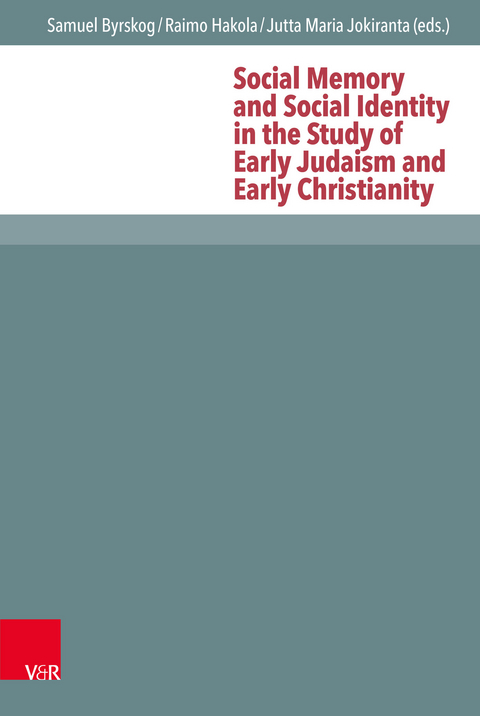
Social Memory and Social Identity in the Study of Early Judaism and Early Christianity (eBook)
312 Seiten
Vandenhoeck & Ruprecht Unipress (Verlag)
9783647593753 (ISBN)
Raimo Hakola has a ThD in Biblical Studies and is Acting University Lecturer in New Testament Studies at the University of Helsinki.
Raimo Hakola has a ThD in Biblical Studies and is Acting University Lecturer in New Testament Studies at the University of Helsinki.
Title Page 4
Copyright 5
Body 8
Raimo Hakola/Samuel Byrskog/Jutta Jokiranta: Introduction 8
Social and Collective Memory 10
Social Identity Approach 12
The Articles of the Book 14
I Social Memory 22
Samuel Byrskog: Philosophical Aspects on Memory: Aristotle, Augustine and Bultmann 24
Memory in Perspective 24
Aristotle, De Memoria et Reminiscentia 28
Augustine, Confessiones 31
Bultmann, Jesus and The Presence of Eternity 38
Conclusions 42
Alan Kirk: The Formation of the Synoptic Tradition: Cognitive and Cultural Approaches to an Old Problem 50
Mental Schemas, Cultural Schemas, and Memory Formation 51
Memory in Communications Media: Genres, Gattungen, Forms 56
From “Collaborative Remembering” to Tradition Artifacts 57
Cognitive-Cultural Coupling: Tradition as Cybernetic Memory 60
Whatever Happened to the Eyewitness Memories? 62
Tradition as an Autonomous Cognitive System 64
Oral and Written Media 65
Making Sense of the Synoptic Tradition 66
Sandra Huebenthal: Reading the Gospel of Mark as Collective Memory 70
Social Memory Theory and the New Testament 71
Reading Mark as Collective Memory, or: what does the Gospel of Mark narrate beyond the story of Jesus? 77
Please join in: How the Gospel invites recipients to become part of it 80
Technical observations, or: how does the narration achieve its goals? 82
Concluding remarks: Was the Markan concept successful? 86
Kari Syreeni: Eyewitness Testimony, First-Person Narration and Authorial Presence as Means of Legitimation in Early Gospel Literature 90
Introduction 90
Mark 92
Matthew 95
Luke 97
John 100
The Gospel of Thomas 104
The Gospel of Peter 105
The Gospel of Mary 106
Jewish Christian Gospels 107
Infancy Gospels 108
Conclusion: “The Mnemonic Trajectory” in a Literary and Socio-Cognitive Perspective 109
Dan Nässelqvist: Dual Conventions: The Oral Delivery of New Testament Writings in Light of First-Century Delivery Practices 112
The Uniform Model: Oral Performance 112
A More Diversified Model: Tellings and Public Readings 115
Distinguishing the Types 116
Oral Performance 116
Public Reading 117
Fitting New Testament Writings into the Picture 118
A Comparison of the Two Types 120
Conclusions 124
II Social Identity 126
Cecilia Wassén: The Importance of Marriage in the Construction of a Sectarian Identity in the Dead Sea Scrolls 128
Introduction 128
General Views on Marriage and Sexual Relations 131
4QMMT 133
Social Identity Approach 138
Key texts in the Damascus Document 141
CD 2:14?3:12 142
CD 4:13?5:11 144
CD 7:4?9 148
Conclusion 149
Jutta Jokiranta: Black Sheep, Outsiders, and the Qumran Movement: Social-Psychological Perspectives on Norm-Deviant Behaviour 152
Introduction 152
Categorization 155
Social Cognition and Social Self 156
Outgroup Homogeneity Effect 157
Black Sheep Effect 157
Deviant Behaviour in the Community Rule: When to Excuse and When not to? 161
People of Injustice in Community Rule: Outgroup, or Ingroup Deviants? 164
Conclusions 172
Elisa Uusimäki: Wisdom, Scripture, and Identity Formation in 4QBeatitudes 176
Introduction 176
Social Identity and Religious Texts 177
Fortunate Ones and the Prospect of Eternal Curses in 4Q525 178
The Acts of Blessing and Cursing 181
The Performative Role of Words in 4Q525 183
Language and Creation of Social Reality in 4Q525 186
Conclusions 187
Rikard Roitto: Forgiveness, Rituals, and Social Identity in Matthew: Obliging Forgiveness 188
Introduction 188
Forgiveness and the Narrative Rationale of the Group 190
Forgiveness and Contrast to Outgroups 193
The Imagination of Sin in Matthew 195
Formation of Social Identity through Rituals of Divine Forgiveness 197
The Lord's Prayer 197
Intercessory Prayers for Sinners 199
The Eucharist 203
Interpersonal Forgiveness and Identity Formation 205
Forgiveness and Non-Retaliation Towards Outsiders 206
Intra-group Forgiveness 208
Integration of Divine and Interpersonal Forgiveness 208
Summary 209
Raimo Hakola: The Johannine Community as a Constructed, Imagined Community 212
No Johannine Community at all? 213
From Sociohistorical Relations to Communities as Imagined Constructions 218
The Origins of the Community 223
The Boundaries of the Community 227
The Symbols of Belonging and the Unity of the Community 230
The Community and the World 236
Conclusion 240
Nina Nikki: Contesting the Past, Competing over the Future: Why is Paul Past-Oriented in Galatians and Romans, but Future-Oriented in Philippians? 242
Introduction 242
Social memory, possible social identities and leadership in inter-group conflict 243
Contesting the past in Galatians 247
Unity through a shared past in Romans 251
Forgetting the past and embracing the future in Philippians 253
Conclusions 256
Martin Wessbrandt: Covenant, Conflict and Collective Identity: The Relationship between Hebrews and 1 Clement 258
Earlier Discussions of the Relationship 258
Collective Identity 260
The Letter to the Hebrews and Collective Identity 263
Hebrews 13 and the Drawing of Boundaries 265
Covenant and the Construction of Community in Hebrews 267
1 Clement and Collective Identity 268
Covenant in 1 Clement 270
The Jerusalem Cult in 1 Clement 272
Collective Identity in 1 Clement 274
Conclusion 275
Bibliography 276
Abbreviations 310
| Erscheint lt. Verlag | 12.9.2016 |
|---|---|
| Reihe/Serie | Novum Testamentum et Orbis Antiquus / Studien zur Umwelt des Neuen Testaments |
| Novum Testamentum et Orbis Antiquus / Studien zur Umwelt des Neuen Testaments | Novum Testamentum et Orbis Antiquus / Studien zur Umwelt des Neuen Testaments. |
| Co-Autor | Samuel Byrskog, Raimo Hakola, Jutta Maria Jokiranta, Sandra Huebenthal |
| Verlagsort | Göttingen |
| Sprache | englisch |
| Themenwelt | Geisteswissenschaften ► Religion / Theologie ► Christentum |
| Schlagworte | Christentum • Exegese • Frühjudentum • Neues Testament |
| ISBN-13 | 9783647593753 / 9783647593753 |
| Informationen gemäß Produktsicherheitsverordnung (GPSR) | |
| Haben Sie eine Frage zum Produkt? |
 PDF (Ohne DRM)
Digital Rights Management: ohne DRM
Dieses eBook enthält kein DRM oder Kopierschutz. Eine Weitergabe an Dritte ist jedoch rechtlich nicht zulässig, weil Sie beim Kauf nur die Rechte an der persönlichen Nutzung erwerben.
Dateiformat: PDF (Portable Document Format)
Mit einem festen Seitenlayout eignet sich die PDF besonders für Fachbücher mit Spalten, Tabellen und Abbildungen. Eine PDF kann auf fast allen Geräten angezeigt werden, ist aber für kleine Displays (Smartphone, eReader) nur eingeschränkt geeignet.
Systemvoraussetzungen:
PC/Mac: Mit einem PC oder Mac können Sie dieses eBook lesen. Sie benötigen dafür einen PDF-Viewer - z.B. den Adobe Reader oder Adobe Digital Editions.
eReader: Dieses eBook kann mit (fast) allen eBook-Readern gelesen werden. Mit dem amazon-Kindle ist es aber nicht kompatibel.
Smartphone/Tablet: Egal ob Apple oder Android, dieses eBook können Sie lesen. Sie benötigen dafür einen PDF-Viewer - z.B. die kostenlose Adobe Digital Editions-App.
Buying eBooks from abroad
For tax law reasons we can sell eBooks just within Germany and Switzerland. Regrettably we cannot fulfill eBook-orders from other countries.
aus dem Bereich