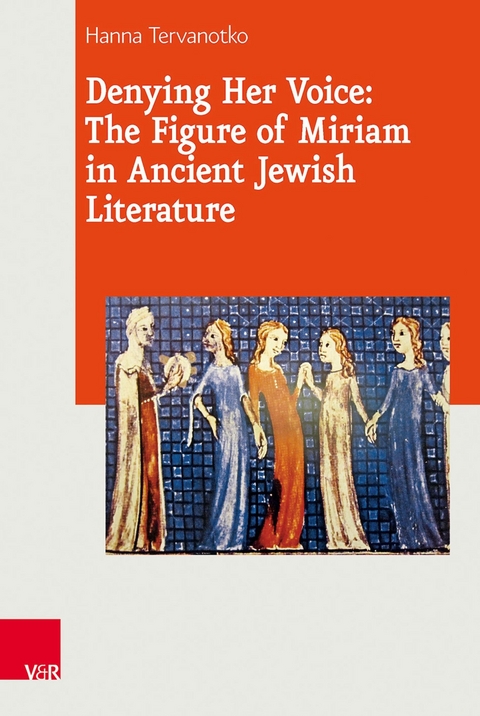
Denying Her Voice: The Figure of Miriam in Ancient Jewish Literature (eBook)
354 Seiten
Vandenhoeck & Ruprecht Unipress (Verlag)
9783647551050 (ISBN)
Hanna Tervanotko, Ph.D, Th.D., is a postdoctoral fellow at the University of Helsinki with a second affiliation at KU Leuven, Belgium.
Hanna Tervanotko, Ph.D, Th.D., is a postdoctoral fellow at the University of Helsinki with a second affiliation at KU Leuven, Belgium.
Title Page 4
Copyright 5
Table of Contents 6
Body 12
Acknowledgements 12
Style and Abbreviations 14
1. Introduction 20
1.1 Background 21
1.2 History of Research 22
1.2.1 Biblical Female Figures 22
1.2.2 The Figure of Miriam 25
1.3 Methods 29
1.3.1 Historical-Critical Approach 29
1.3.2 Literary-Theoretical Approach 32
1.3.2.1 Intertextuality 32
1.3.2.2 Bakhtin’s Concept of Dialogism 35
1.3.3 Feminist Criticism 39
1.4 Aims 40
2. Miriam in the Texts through the Persian Era 44
2.1 Miriam’s Song: Exodus 15:20–21 44
2.1.1 Introduction 44
2.1.2 Text Criticism 47
2.1.3 Vocabulary Analysis 49
2.1.4 Stylistic Analysis 51
2.1.5 Literary Criticism 51
2.1.6 Female Prophecy 53
2.1.6.1 Female Prophecy in the Hebrew Bible 55
2.1.7 Miriam in Exodus 15:20–21 59
2.1.8 Summary 61
2.2 Miriam in Laws: Deuteronomy 24:8–9 62
2.2.1 Introduction 62
2.2.2 Text Criticism 62
2.2.3 Vocabulary Analysis 64
2.2.4 Literary and Redaction Criticism 66
2.2.5 Miriam in Deuteronomy 24:8–9 67
2.2.6 Relationship with the Earlier Texts 68
2.2.7 Summary 69
2.3 Miriam’s Revolt and Punishment: Numbers 12:1–15 69
2.3.1 Introduction 69
2.3.2 Text Criticism 70
2.3.3 Vocabulary Analysis 73
2.3.4 Stylistic Analysis 79
2.3.5 Literary Criticism 80
2.3.6 Miriam in Numbers 12:1–15 84
2.3.7 Redaction Analysis 86
2.3.8 Relationship with the Earlier Texts 89
2.3.9 Summary 90
2.4 Miriam’s Death and Burial: Numbers 20:1 91
2.4.1 Introduction 91
2.4.2 Vocabulary Analysis 93
2.4.3 Death and Burial of Female Figures 95
2.4.4 Literary Criticism 97
2.4.5 Miriam in Numbers 20:1 99
2.4.6 Relationship with the Earlier Texts 99
2.4.7 Summary 100
2.5 Miriam in the Lists I: Numbers 26:59 101
2.5.1 Introduction 101
2.5.2 Women in Numbers 26 103
2.5.3 Literary Criticism 105
2.5.4 Miriam in Numbers 26:59 106
2.5.5 Relationship with the Earlier Texts 108
2.5.6 Summary 109
2.6 Miriam’s Leadership: Micah 6:4 110
2.6.1 Introduction 110
2.6.2 Vocabulary Analysis 112
2.6.3 Miriam in Micah 6:4 113
2.6.4 Relationship with the Earlier Texts 115
2.6.5 Summary 116
2.7 Miriam in the Texts through the Persian Era 116
3. Rereading of Miriam in the Hellenistic Era 120
3.1 Texts from Judea 121
3.1.1 Miriam in Lists II: 1 Chronicles 5:29 121
3.1.1.1 Introduction 121
3.1.1.2 Women in 1 Chronicles 1–9 122
3.1.1.3 Text Criticism 123
3.1.1.4 Miriam in 1 Chronicles 5:29 125
3.1.1.5 Relationship with the Earlier Texts 126
3.1.1.6 Summary 126
3.1.2 Miriam as the Daughter of Amram: The Visions of Amram a,c,d,e,g 127
3.1.2.1 Introduction 127
3.1.2.2 Women in the Visions of Amram 131
3.1.2.3 Miriam’s Marriage (4Q543 1 6 = 4Q545 1 I, 5–6) 132
3.1.2.4 Miriam’s Mystery (4Q546 12 4) 136
3.1.2.5 Miriam’s Birth (4Q547 9 10) 140
3.1.2.6 Miriam in the Family Genealogy (4Q549 2 8) 143
3.1.2.7 Miriam in the Visions of Amram 145
3.1.2.8 Relationship with the Earlier Texts 146
3.1.2.9 Summary 146
3.1.3 The Extended Song of Miriam: The Reworked Pentateuchc (4Q365 6a II + 6c, 1–7) 148
3.1.3.1 Introduction 148
3.1.3.2 The Extended Song of Miriam 150
3.1.3.3 Vocabulary Analysis 151
3.1.3.4 Victory Songs Attributed to Women 152
3.1.3.5 Other Versions of the Song of Miriam 155
3.1.3.6 The Relationship between the Songs of Miriam in the Reworked Pentateuchc and the Pentateuch Targumim 157
3.1.3.7 Miriam in the Reworked Pentateuchc 160
3.1.3.8 Relationship with the Earlier Texts 162
3.1.3.9 Summary 162
3.1.4 Miriam and the Infant Moses I: Jubilees 47:4 163
3.1.4.1 Introduction 163
3.1.4.2 Women in Jubilees 165
3.1.4.3 Analysis of Jubilees 47:4 167
3.1.4.4 Miriam in Jubilees 47:4 169
3.1.4.5 Relationship with the Earlier Texts 171
3.1.4.6 Summary 172
3.1.5 Miriam’s Punishment Renarrated: The Apocryphon Pentateuch B (4Q377 2 I, 9) 173
3.1.5.1 Introduction 173
3.1.5.2 Fragment 2 of 4Q377 176
3.1.5.3 Vocabulary Analysis 176
3.1.5.4 Miriam in the Apocryphon Pentateuch B 179
3.1.5.5 Relationship with the Earlier Texts 180
3.1.5.6 Summary 181
3.1.6 Excursus: The Levites in the Second Temple Period 181
3.1.6.1 The Texts through the Persian Era 181
3.1.6.2 The Texts of the Hellenistic Era 186
3.1.6.3 Miriam as Levite 189
3.1.7 Conclusions Regarding the Hellenistic Texts from Judea 192
3.2 Texts from Egypt 194
3.2.1 The Interpretation of Miriam in the Septuagint 194
3.2.1.1 Introduction 194
3.2.1.2 Exodus 6:20 196
3.2.1.3 Exodus 15:20–21 197
3.2.1.4 Deuteronomy 24:8–9 201
3.2.1.5 Numbers 12:1–15 202
3.2.1.6 Numbers 20:1 205
3.2.1.7 Numbers 26:59 206
3.2.1.8 Micah 6:4 208
3.2.1.9 1 Chronicles 5:29 209
3.2.1.10 Miriam in the Septuagint 209
3.2.1.11 Summary 211
3.2.2 Miriam Referring to Moses’s Marriage: Demetrius the Chronographer, Fragment 3 212
3.2.2.1 Introduction 212
3.2.2.2 Analysis of Fragment 3 214
3.2.2.3 Miriam in Demetrius the Chronographer 216
3.2.2.4 Relationship with the Earlier Texts 217
3.2.2.5 Summary 218
3.2.3 Miriam and the Infant Moses II: Exagoge 18–26 218
3.2.3.1 Introduction 218
3.2.3.2 Analysis of Exagoge 18–26 221
3.2.3.3 Miriam in Exagoge 222
3.2.3.4 Relationship with Earlier Texts 223
3.2.3.5 Summary 224
3.2.4 Conclusions regarding the Hellenistic Texts from Egypt 225
3.3 Miriam in the Texts of the Hellenistic Era 226
4. Rereading of Miriam in the Roman Era 230
4.1 Miriam as Virgin and Woman: Philo of Alexandria 230
4.1.1 Introduction 230
4.1.2 Women in the Texts of Philo 231
4.1.3 Texts Referring to Miriam 234
4.1.4 Miriam in Philo’s Historical Texts 235
4.1.4.1 De vita contemplativa 87 235
4.1.5 Miriam in Philo’s Allegorical Texts 238
4.1.5.1 Legum allegoriae 1.76 238
4.1.5.2 Legum allegoriae 2.66–67 239
4.1.5.3 Legum allegoriae 3.103 241
4.1.5.4 De agricultura 80–81 242
4.1.6 Philo’s Interpretation of Miriam 245
4.1.7 Relationship with the Earlier Texts 247
4.1.8 Summary 249
4.2 Miriam’s Vision and Water from the Well: Liber antiquitatum biblicarum 250
4.2.1 Introduction 250
4.2.2 Women in Liber antiquitatum biblicarum 253
4.2.3 Liber antiquitatum biblicarum 9:10 255
4.2.4 Liber antiquitatum biblicarum 20:8 257
4.2.5 Miriam in Liber antiquitatum biblicarum 258
4.2.6 Relationship with the Earlier Texts 260
4.2.7 Summary 262
4.3 Miriam as Supporter of Moses and Ancestor Mother: Flavius Josephus 263
4.3.1 Introduction 263
4.3.2 Women in the Texts of Josephus 264
4.3.3 Antiquitates judaicae 2.221, 2.226 267
4.3.4 Antiquitates judaicae 3.54 270
4.3.5 Antiquitates judaicae 3.105 271
4.3.6 Antiquitates judaicae 4.78 273
4.3.7 Josephus’s Interpretation of Miriam 276
4.3.8 Relationship with the Earlier Texts 278
4.3.9 Summary 281
4.4 Miriam in the Texts of the Roman Era 282
5. Conclusions 286
5.1 Miriam in Ancient Jewish Literature 286
5.2 Role of Women in Ancient Judaism 290
5.2.1 Marriage Practices 291
5.2.2 Women’s Prophecy 293
5.3 Implications of this Study 294
Bibliography 296
1. Bibles 296
2. Editions and Reference Works 296
3. General Bibliography 298
Index of Ancient Sources 330
Author Index 346
Subject Index 352
| Erscheint lt. Verlag | 12.9.2016 |
|---|---|
| Reihe/Serie | Journal of Ancient Judaism. Supplements |
| Journal of Ancient Judaism. Supplements. | Journal of Ancient Judaism. Supplements. |
| Verlagsort | Göttingen |
| Sprache | englisch |
| Themenwelt | Geisteswissenschaften ► Religion / Theologie ► Christentum |
| Schlagworte | Exegese • Frühjudentum • Judaistik |
| ISBN-13 | 9783647551050 / 9783647551050 |
| Informationen gemäß Produktsicherheitsverordnung (GPSR) | |
| Haben Sie eine Frage zum Produkt? |
 PDF (Ohne DRM)
Digital Rights Management: ohne DRM
Dieses eBook enthält kein DRM oder Kopierschutz. Eine Weitergabe an Dritte ist jedoch rechtlich nicht zulässig, weil Sie beim Kauf nur die Rechte an der persönlichen Nutzung erwerben.
Dateiformat: PDF (Portable Document Format)
Mit einem festen Seitenlayout eignet sich die PDF besonders für Fachbücher mit Spalten, Tabellen und Abbildungen. Eine PDF kann auf fast allen Geräten angezeigt werden, ist aber für kleine Displays (Smartphone, eReader) nur eingeschränkt geeignet.
Systemvoraussetzungen:
PC/Mac: Mit einem PC oder Mac können Sie dieses eBook lesen. Sie benötigen dafür einen PDF-Viewer - z.B. den Adobe Reader oder Adobe Digital Editions.
eReader: Dieses eBook kann mit (fast) allen eBook-Readern gelesen werden. Mit dem amazon-Kindle ist es aber nicht kompatibel.
Smartphone/Tablet: Egal ob Apple oder Android, dieses eBook können Sie lesen. Sie benötigen dafür einen PDF-Viewer - z.B. die kostenlose Adobe Digital Editions-App.
Buying eBooks from abroad
For tax law reasons we can sell eBooks just within Germany and Switzerland. Regrettably we cannot fulfill eBook-orders from other countries.
aus dem Bereich