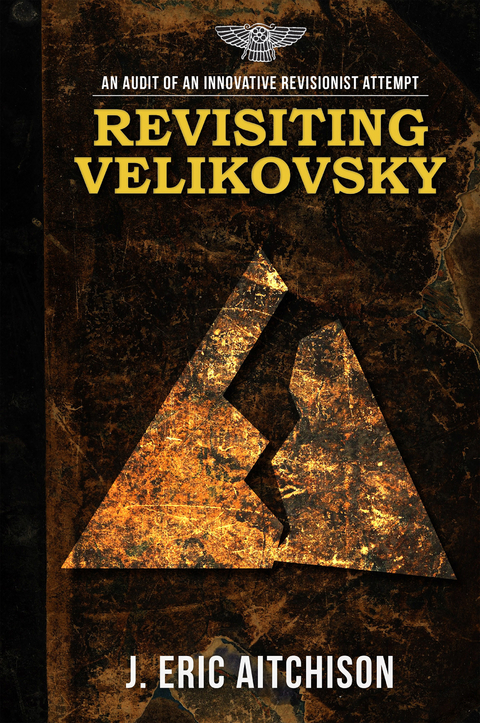
Revisiting Velikovsky (eBook)
200 Seiten
Fontaine Publishing Group (Verlag)
978-1-925515-94-7 (ISBN)
Revised Third Edition. Eric Aitchison's long and in-depth study is basically his way to reconcile the conventional model of ancient history with the 'Ages in Chaos' series of Velikovsky. He has been extremely thorough in his research and came to the conclusion that although Velikovsky used Biblical dates as anchors for his broad-brush realignments and alter egos, a closer analysis of the Biblical parallels was possible and so much so that even the limmu list supported Assyrian King List could be adjusted and re-evaluated in the context of a revision of chronology - such as the actual date for the fall of Samaria. In fact, this e-book makes a number of arguments that strongly refute some of Velikovsky's most famous synchronisms - in fact, quite a lot of them. I can't at the moment think of any other revisionist that has taken on and demolished so many of Velikovsky's arguments - and yet at the same time he remains positively on board the Velikovsky experience. He ends up with a system that is in so many ways pro-Velikovsky and yet at the same time is quite unlike all the major players in revisions of ancient history post-Velikovsky. The Glasgow chronologists dismissed the second and third volumes of 'Ages in Chaos' en bloc. Somewhat later, first James and then Rohl (and cohorts), went on to abandon the first volume of 'Ages in Chaos' - the book that set it all in motion. Another group of revisionists moved in the opposite direction shifting not just dynasties but whole blocks of history forward in time, en-masse. Eric Aitchison, on the other hand, with input from A Montgomery, B Curnock, J Crowe, L Mitcham, J Lascelles and latterly D K Mills has actually remained extraordinarily faithful to the core of 'Ages in Chaos' and they have all of them treated Velikovsky's research with the utmost respect and admiration. In order to bring ancient history, as it was perceived by Velikovsky, in tandem with well-known Biblical synchronisms, Eric Aitchison has compared events from the 16th to the 10th centuries BC with what seem to be a remarkable set of parallels between the 10th and 4th centuries BC. I can understand why he chose to look at ancient history in that way and why he decided to telescope the two periods. He was of course strongly influenced by the radical ideas of Velikovsky, which provided the momentum and the manner to bring the Bible's history excitingly alive. Of course, a modern conventional historian would not have dreamed of adopting such a radical approach, but this book is not addressed as much to them as it is to other revisionists, and in that sense, he is a beacon to be explored as it is full of well-reasoned and objective argumentation. Let's face facts, they might disclaim the fact, but even conventional chronology is based on a series of what is regarded as rock solid Biblical synchronisms. Without the Bible as backup chronology would be shaky no matter how much they plead to the contrary. Eric Aitchison evaluates each of those Biblical interconnections in a clinical and open-minded fashion that I found quite refreshing and I take my hat off to him as the whole exercise comes across as fair-minded and straight speaking. A real Oz attribute. Not only that he is not at all of the opinion he has cracked it and everyone else is wrong - he is not unduly insistent in what he says as he is always prepared to abandon a sometimes cherished point that he has discovered in his deliberations. That is the mark of a true investigator of facts, as each point is examined on its own merits. Indeed, in writing this tome he has been prepared to make adjustments when others such as Mills, Montgomery, Curnock and Crowe had cast some shred of doubt or questioned a particular source that he might have used, or an interpretation of a text. This is not a revision cast in stone to stand or fall as it is presented at this point in time. It is a revision to be explored by other minds and tweaked with and twiddled as must - a most usef
BIBLICAL HISTORY IS SOLID and BELIEVABLE
Introduction1
In dealing with what I eventually perceived as errors on the part of Immanuel Velikovsky2 I found that Biblical History is solid enough to support any major historical revision of Near Eastern Ancient Times as attempted over 50 years ago by that investigator. New readers might be shocked to realise that far from being ignored, his arguments have continued to receive active interest from a wide-ranging group of professional and amateur students of Ancient History, especially that of Biblical History.
My colleague, Alan Montgomery, in a privately circulated article on Philistine Pottery, made this penetrating comment.
“The first problem with this scenario is the failure to synchronize with biblical history. The biblical history of the Israelites, unlike Egyptian history, is written with one generation following another, one ruler following another. From Abraham to the fall of Jerusalem, there is not a single generation of leadership missing. There is no place for gaps.”
In his early 1950’s attempt Velikovsky tried to write a Biblical history that contained parallel Egyptian historical information wedded to the Biblical information. Assyriologists and Egyptologists were able to virtually ignore these chronological writings of Velikovsky because the Astronomic Fraternity had denigrated his first book, “Worlds in Collision”3. Wrong though Velikovsky was in his historical revision that whole subject is still open for debate because anomalous correlations are being found as fine-tuning of history progresses. The recently released (2000) Oxford history has reduced the XVIIIth dynasty from 1575 BC (Gardiner) to 1550 BC but continues to see Shoshenq of Dynasty XXII as the Shishak of the Bible. There are many that still think Velikovsky is correct, others who think he was nearly correct; each argues their case eloquently. There are many scholars from Academia who believe that Velikovsky’s theories have sufficient content that they should be taken seriously. There have been, since the publication of “Ages in Chaos” and “Worlds in Collision”, quite a number of International Conferences that have highlighted errors and correct predictions from the Velikovsky genre. Such is the current enthusiasm for his work and its study that the British contingent (SIS) has issued a CD ROM4 with as much pertinent information as is thought fit to allow meaningful study. Across the world is a dedicated group5 who have continued to look critically at the original historical revision of Velikovsky and its ramifications. The most credible part in my opinion is that area that concentrates on the accuracy and integration of Biblical history into the milieu of the Fertile Crescent. My own research is here presented in the public arena to ensure that my theory of where Velikovsky erred has the widest exposure.
There are many and varied attempts to support or denigrate the historical chronology of the Bible. Those wishing to support the historical content are drawn from the wide spectrum of belief. Some are Biblical Fundamentalists, being those who believe the literal reading of the Bible with no concessions to error. Others are believers in the truth of the Bible for its faith concept but choose to see the history as something to be taken with a grain of salt. This historical approach can best be evidenced by competing chronologies, of which there are many. The one I favour after researching Biblical reign lengths is that by Edwin Thiele. Thiele accepts that there are areas of concern between the Biblical evidence and other evidence that has come down to us from a time before certain sections were written into the Bible. This qualification has to be noted against the interlocking Biblical evidence of kings.
There would appear to be two basic approaches to Biblical History and inerrancy. One approach sees the given kingly reigns in seriatim, no co regencies with cross checks between Judah and Israel. This results in an extended Biblical History and requires, in some cases, periods without kings. Thiele adopted another approach, also claiming inerrancy and saw the cross linkages as the most compelling. This resulted in a shortening of Biblical History. Both approaches claim inerrancy; it is a matter then of choice as to which seems the better. After due consideration, I have adopted a revised Thiele approach.
The major evidence external to the Bible is that from Assyria. There should be evidence pertaining to Biblical history from Egypt, the southern neighbour of Judah, but other than the interludes of Solomon, Rehoboam, Asa and Josiah it is hardly reported.
There is continued evidence of contact between the Divided Monarchies. Such latter evidence is denigrated by later Assyrian contact through Thiele’s cavil to the Assyriologists.
Most of the following articles, and those in Part 2 have been researched with a view of dissecting the pioneering work of Immanuel Velikovsky. In many cases I have discovered major and minor errors within his calendric and historical propositions especially his handling of data from the el-Amarna letters.
As an admirer of Velikovsky’s original insights I feel that quotations from his Forum Address6 taken from “Earth in Upheaval” should precede any discussion and or criticism of his seminal works.
“Don’t be afraid of ridicule; think of the history of all great discoveries. I (Velikovsky) quote Alfred North Whitehead:
“If you have had your attention directed to the novelties of thought in your own lifetime, you will have observed that almost all really new ideas have a certain aspect of foolishness when they are first produced. Therefore, dare.
“All fruitful ideas have been conceived in the minds of the nonconformists, for whom the known was still unknown, and who often went back to begin where others passed by, sure of their way. The truth of to day was the heresy of yesterday.
“Imagination coupled with scepticism and an ability to wonder – if you possess these, bountiful nature will hand you some of the secrets out of her inexhaustible store. The pleasure you will experience in discovering truth will repay you for your work; don’t expect other compensation, because it may not come. Yet, dare.”
For my part I not only dared to think Convention wrong but after a while I began to realise that my hero was also wrong, just a little bit wrong but wrong all the same. This blemish on his part was part of the reason why Convention could largely ignore the thrust of his overall work. The bulk of early criticism of his works was directed against “Worlds in Collision”. In retrospect this was an off-putting title as there were no collisions, rather close encounters in spatial terms. Any criticism of his history thesis was covered by the Conventional arguments that no disruptions to orbits had occurred therefore any re-alignment of history, as per his calendar changes et al, was necessarily incorrect. The astronomers had dealt with the question of current orbital stability so the historians could shelter behind the argument that retro-calculations were proof positive that all was serene in conventional history. Velikovsky’s “alter ego” arguments were also easily disproved. I believe that the astronomers were wrong and hope that my findings in partial support of Velikovsky will be convincing.
Velikovsky’s Basic Hypothesis
Velikovsky identified certain major pillars to support his basic historical revision. There were flow-ons from his alter ego identifications (these require individual attention) as well as errors in approach and use of data that can be dealt with in total. His flow-on theories are at risk if his major points are shown to be in slight misalignment.
His first major point from “Ages in Chaos” was the alignment of Saul with the expulsion of the Hyksos from Egypt under Ahmose. His second was the identification of the Sumur of the el-Amarna letters with Samaria of Israel. His third was the correlation of activities from the el-Amarna letters with Biblical activities and an invasion of Palestine by Assyria under Shalmaneser III. His predilection for identification of his personnel as alter egos of other more or less famous persons has been a legacy from which revisionism must divorce itself.
These, and related facets of his extended theory from “Ramses II and His Time”7 and “Peoples of the Sea”8 will be investigated. In the meantime we wish to see how close Velikovsky was to his faith in the historicity of the Bible and in that examination I hope to show that Biblical History is solid.
My Rationale
This started out to be a few articles defending certain theories of Immanuel Velikovsky but soon turned into a major critique as errors and misuse, or bad handling of data became apparent.
Initially I was worried by the visit of a queen of Sheba to Solomon and Velikovsky’s link between Saul and Ahmose. The time length did not seem proper so I did some scheduling and found that the starting point for “Ages in Chaos” was out of order. This led me to the realization that the other points in the argument were thus denied. The question of whether Sumur of the el-Amarna letters was or was not Samaria of Israel caused great anguish until I realised it just had to be Simurrum as argued by Convention.
During a discussion on matters linked to the calendar with my mentor, Dale Murphie, he advised of a...
| Erscheint lt. Verlag | 6.9.2016 |
|---|---|
| Sprache | englisch |
| Themenwelt | Geschichte ► Allgemeine Geschichte ► Altertum / Antike |
| ISBN-10 | 1-925515-94-X / 192551594X |
| ISBN-13 | 978-1-925515-94-7 / 9781925515947 |
| Informationen gemäß Produktsicherheitsverordnung (GPSR) | |
| Haben Sie eine Frage zum Produkt? |
 EPUB (Adobe DRM)
Größe: 10,8 MB
Kopierschutz: Adobe-DRM
Adobe-DRM ist ein Kopierschutz, der das eBook vor Mißbrauch schützen soll. Dabei wird das eBook bereits beim Download auf Ihre persönliche Adobe-ID autorisiert. Lesen können Sie das eBook dann nur auf den Geräten, welche ebenfalls auf Ihre Adobe-ID registriert sind.
Details zum Adobe-DRM
Dateiformat: EPUB (Electronic Publication)
EPUB ist ein offener Standard für eBooks und eignet sich besonders zur Darstellung von Belletristik und Sachbüchern. Der Fließtext wird dynamisch an die Display- und Schriftgröße angepasst. Auch für mobile Lesegeräte ist EPUB daher gut geeignet.
Systemvoraussetzungen:
PC/Mac: Mit einem PC oder Mac können Sie dieses eBook lesen. Sie benötigen eine
eReader: Dieses eBook kann mit (fast) allen eBook-Readern gelesen werden. Mit dem amazon-Kindle ist es aber nicht kompatibel.
Smartphone/Tablet: Egal ob Apple oder Android, dieses eBook können Sie lesen. Sie benötigen eine
Geräteliste und zusätzliche Hinweise
Buying eBooks from abroad
For tax law reasons we can sell eBooks just within Germany and Switzerland. Regrettably we cannot fulfill eBook-orders from other countries.
aus dem Bereich