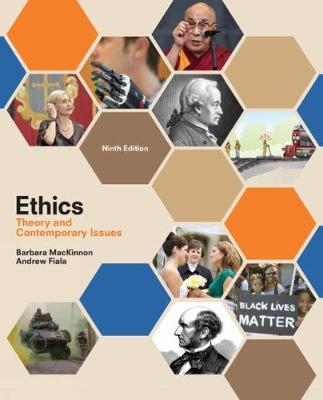
Ethics
Wadsworth Publishing Co Inc (Verlag)
978-1-305-95867-8 (ISBN)
- Titel erscheint in neuer Auflage
- Artikel merken

Barbara MacKinnon is a professor emerita of philosophy at the University of San Francisco. During her 30 years of teaching, her instruction and writing focused primarily on the history of ethics and contemporary ethical issues. She enjoys reading widely, playing the piano, and traveling. Andrew Fiala is a professor of philosophy at Fresno State University and the director of the university's Ethics Center. He is co-author of the textbook ETHICS: THEORY AND CONTEMPORARY ISSUES, 10th EDITION (Cengage), as well as a number of books and articles. His scholarly writing focuses on war and peace, politics, religion and ethics. He also is a columnist for the Fresno Bee.
Part I: ETHICAL THEORY.
1. Ethics and Ethical Reasoning.
Why Study Ethics? What is Ethics? Ethical and Other Types of Evaluation. Sociobiology and the Naturalistic Fallacy. Ethical Terms. Ethics and Reasons. Intuitionism, Emotivism, Subjectivism, Objectivism. Ethical Reasoning and Arguments. The Structure of Ethical Reasoning and Argument. Evaluating and Making Good Arguments. Ethical Theory. Types of Ethical Theory. Can Ethics Be Taught. Readings: David Hume, Ethical Judgments and Matters of Fact (from Treatise); C.L. Stevenson, Emotivism and Ethics. Review Exercises.
2. Religion and Global Ethics.
Freedom, Cosmopolitanism, and the European Enlightenment. Religion, Civic Life, and Civil Disobedience. Ethics, Religion, and Divine Command Theory. Pluralism and the Golden Rule. The Problem of Evil and Free Will. Secular Ethics and Toleration. Criticisms of Secularism and Global Ethics. Readings: Plato, Euthyphro; M.K. Gandhi, Religion and Truth. Review Exercises.
3. Ethical Relativism.
Descriptive vs. Normative Ethical Relativism. Individual vs. Cultural Relativism. Strong and Weak Relativism. Reasons Supporting Ethical Relativism. The Diversity of Moral Views. Tolerance and Open-Mindedness. Moral Uncertainty. Situational Differences. Are these Reasons Convincing? Situational Differences. Is Relativism Self-Contradictory? Moral Realism. Moral Pluralism. Readings: Louis Pojman, Who's to Judge? John Lachs, Relativism and Its Benefits. Review Exercises.
4. Egoism, Altruism, and the Social Contract.
Psychological Egoism. What Is Psychological Egoism? Is Psychological Egoism True? Ethical Egoism. What Is Ethical Egoism? The Moral Point of View. Why be Moral? Readings: Plato, The Ring of Gyges (from Republic); Thomas Hobbes, Self Love (from Leviathan); Steven Pinker, the Social Contract and Altruism (from The Blank Slate). Review Exercises.
5. Utilitarianism and John Stuart Mill.
Weighing Consequences. Historical Background. Jeremy Bentham and John Stuart Mill. The Principle of Utility. Pleasure and Happiness. Calculating the Greatest Amount of Happiness. Quantity vs. Quality of Pleasure. Evaluating Utilitarianism. Application of the Principle. Utilitarianism and Personal Integrity. Ends and Means. The Trolley Problem. Act and Rule Utilitarianism. "Proof" of the Theory. Reading: John Stuart Mill, Utilitarianism. Review Exercises.
6. Deontological Ethics and Immanuel Kant.
Deontology and the Ethics of Duty. Immanuel Kant. What Is the Right Motive? What Is the Right Thing to Do? The Categorical Imperative. The First Form. The Second Form. Evaluating Kant's Moral Theory. The Nature of Moral Obligation. The Application of the Categorical Imperative. Duty. Perfect and Imperfect Duties. Variations on Kant and Deontology. Reading: Immanuel Kant, Fundamental Principles of the Metaphysic of Morals. Review Exercises.
7. Natural Law and Human Rights.
Natural Law Theory. Historical Origins. Evaluating Natural Law Theory. Natural Rights. Evaluating Natural Rights Theory. Is There a Human Nature? Readings. Thomas Aquinas, On Natural Law. John Locke, Second Treatise of Civil Government. Review Exercises.
8. Virtue Ethics.
Virtues and Everyday Life. Aristotle. Virtue as a Mean. Nature, Human Nature, and the Human Good. Cross-Cultural and Contemporary Virtue Ethics. Evaluating Virtue Ethics. Readings: Aristotle, Nicomachean Ethics. Review Exercises.
9. Feminist Thought and the Ethics of Care.
Gender in Moral Reasoning and the Ethics of Care. Is There a Gender Difference in Morality? The Source of Feminine Morality. Evaluating Gender-Specific Approaches to Morality. Feminist Thought. Evaluation of Feminist Thought and the Ethics of Care. Readings: Nel Noddings, Caring; Annette Baier, The Need for More than Justice; Hilde Lindemann, What is Feminist Ethics? Review Exercises.
Part II: ETHICAL ISSUES.
10. Euthanasia.
Euthanasia for Infants and the Disabled. Criteria for Death. Types of Euthanasia. Active and Passive Euthanasia. Voluntary, Nonvoluntary, a
| Erscheinungsdatum | 20.12.2016 |
|---|---|
| Verlagsort | Belmont, CA |
| Sprache | englisch |
| Maße | 185 x 30 mm |
| Gewicht | 1021 g |
| Themenwelt | Geisteswissenschaften ► Philosophie ► Ethik |
| Sozialwissenschaften ► Pädagogik | |
| ISBN-10 | 1-305-95867-5 / 1305958675 |
| ISBN-13 | 978-1-305-95867-8 / 9781305958678 |
| Zustand | Neuware |
| Informationen gemäß Produktsicherheitsverordnung (GPSR) | |
| Haben Sie eine Frage zum Produkt? |
aus dem Bereich