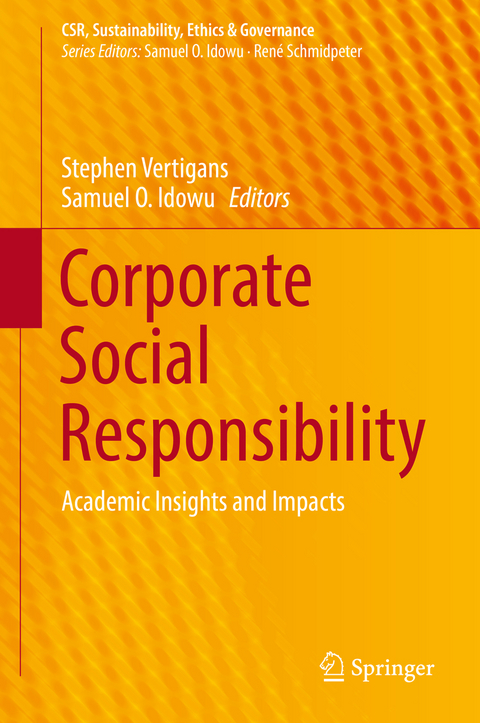
Corporate Social Responsibility (eBook)
XXVII, 244 Seiten
Springer International Publishing (Verlag)
978-3-319-35083-7 (ISBN)
This volume is mainly addressed to any researcher interested in the applications of mathematics, especially in any subject mentioned above. It may be also useful to PhD students in applied mathematics, engineering or experimental sciences.
Stephen Vertigans is Head of School of Applied Social Studies, Robert Gordon University, Aberdeen, UK. His research interests include Corporate Social Responsibility in the energy sector, with particular attention placed upon social impacts in Africa. To this end he has visited numerous African countries to help build capacity and to investigate how CSR approaches can help overcome deep rooted social problems and political tensions. Stephen was instrumental in the introduction of a MSc programme looking at CSR and Energy. He has published widely across a range of fields including Corporate Social Responsibility, African studies and forms of political violence.
Samuel O. Idowu is a Senior Lecturer in Accounting and Corporate Social Responsibility at the London Guildhall Faculty of Business & Law, London Metropolitan University, UK. He researches in the fields of Corporate Social Responsibility (CSR), Corporate Governance, Business Ethics and Accounting and has published in both professional and academic journals since 1989. He is a freeman of the City of London and a Liveryman of the Worshipful Company of Chartered Secretaries and Administrators. Samuel is a Vice President of the Global Corporate Governance Institute. He has led several edited books in CSR and is the Editor-in-Chief of two Springer's reference books - the Encyclopaedia of Corporate Social Responsibility and the Dictionary of Corporate Social Responsibility. He is also a Series Editor for Springer's books on CSR, Sustainability, Ethics and Governance. One of his edited books was ranked 18th in the 2010 Top 40 Sustainability Books by, Cambridge University, Sustainability Leadership Programme. Samuel is a member of the Committee of the Corporate Governance Special Interest Group of the British Academy of Management (BAM). He is on the Editorial Boards of the International Journal of Business Administration, Canada and Amfiteatru Economic Journal, Romania. Samuel has delivered a number of Keynote Speeches at national and international conferences and workshops on CSR and has on two occasions 2008 and 2014 won Emerald's Highly Commended Literati Network Awards for Excellence. To date, Samuel has edited several books in the field of CSR, Sustainability and Governance and has written four forewords to books. Samuel has served as an external examiner to the following UK Universities - Sunderland, Ulster, Anglia Ruskin and Plymouth. He is currently an external examiner at Robert Gordon University, Aberdeen and Teesside University, Middlesbrough and Sheffield Hallam University.
Stephen Vertigans is Head of School of Applied Social Studies, Robert Gordon University, Aberdeen, UK. His research interests include Corporate Social Responsibility in the energy sector, with particular attention placed upon social impacts in Africa. To this end he has visited numerous African countries to help build capacity and to investigate how CSR approaches can help overcome deep rooted social problems and political tensions. Stephen was instrumental in the introduction of a MSc programme looking at CSR and Energy. He has published widely across a range of fields including Corporate Social Responsibility, African studies and forms of political violence.Samuel O. Idowu is a Senior Lecturer in Accounting and Corporate Social Responsibility at the London Guildhall Faculty of Business & Law, London Metropolitan University, UK. He researches in the fields of Corporate Social Responsibility (CSR), Corporate Governance, Business Ethics and Accounting and has published in both professional and academic journals since 1989. He is a freeman of the City of London and a Liveryman of the Worshipful Company of Chartered Secretaries and Administrators. Samuel is a Vice President of the Global Corporate Governance Institute. He has led several edited books in CSR and is the Editor-in-Chief of two Springer’s reference books – the Encyclopaedia of Corporate Social Responsibility and the Dictionary of Corporate Social Responsibility. He is also a Series Editor for Springer’s books on CSR, Sustainability, Ethics and Governance. One of his edited books was ranked 18th in the 2010 Top 40 Sustainability Books by, Cambridge University, Sustainability Leadership Programme. Samuel is a member of the Committee of the Corporate Governance Special Interest Group of the British Academy of Management (BAM). He is on the Editorial Boards of the International Journal of Business Administration, Canada and Amfiteatru Economic Journal, Romania. Samuel has delivered a number of Keynote Speeches at national and international conferences and workshops on CSR and has on two occasions 2008 and 2014 won Emerald’s Highly Commended Literati Network Awards for Excellence. To date, Samuel has edited several books in the field of CSR, Sustainability and Governance and has written four forewords to books. Samuel has served as an external examiner to the following UK Universities – Sunderland, Ulster, Anglia Ruskin and Plymouth. He is currently an external examiner at Robert Gordon University, Aberdeen and Teesside University, Middlesbrough and Sheffield Hallam University.
Foreword 6
Preface 8
Academic Insights and Impacts of Corporate Social Responsibility: An Introduction 10
Acknowledgements 16
Contents 18
About the Editors 20
List of Contributors 22
Part I: Practical Corporate Social Responsibility 29
Chapter 1: Imagined Communities Incorporated: Corporate Social Responsibility and Value Creation in a Globalised World 30
1.1 Introduction: An Outsider Looking In 31
1.2 Corporate Social Responsibility: Good Business, Doing Good or a Power Play? 32
1.3 Imagined Communities Inc. 34
1.4 Corporate Communications: Print Media and Beyond 36
1.5 Back to the Beginning: The Corporate Appropriation and Reinvention of the Past 39
1.6 A Genealogy of Corporate Belonging 42
1.7 Mapping the Moral Terrain 44
1.8 Conclusions 45
References 47
Chapter 2: Financial Capabilities and Poverty Alleviation: The Role of Responsible Financial Decisions 50
2.1 Introduction 51
2.2 Socio-Economic Transformation and Financial Capabilities 54
2.3 Financial Capabilities and Financial Decision Making: The Role of Adaptive Heuristics 56
2.4 Institutional Approach to Building Responsible Financial Decisions 60
2.5 Heuristic-Driven Economic Socialization 62
2.6 Heuristics Driven Financial Education 63
2.7 Heuristic-Driven Financial Product Design 64
2.8 Conclusion 65
References 67
Chapter 3: From Weak to Strong CSR: The Contribution of New Categories in the Account(ing) Ability of EoC Industrial Parks 72
3.1 Introduction 72
3.2 The Theoretical Framework of the Economy of Communion and EoC Enterprises 74
3.3 The Governance of EoC Companies 77
3.4 The Accountability of Communion 79
3.5 The EoC Industrial Poles: A ``New´´ Type of Network 83
3.6 The Italian Industrial Park: The Lionello Bonfanti Pole in Incisa Val d´Arno (Florence) 85
3.7 Conclusions 88
References 89
Chapter 4: Public Interests and Corporate Obligations: The Challenge from Consequentialism 93
4.1 Introduction 93
4.2 Setting the Scene: Stakeholders and Non-Stakeholders 95
4.3 The Proper Valuing of Relationships Argument 96
4.3.1 The Objection from Contractarianism 97
4.3.2 The Objection from Consequentialism 99
4.4 The Different Moral Levels Argument 101
4.5 Consequentialism and the Stakeholder Approach to CSR 104
4.6 Conclusion 106
References 107
Chapter 5: Agribusiness CSR Practices on the Establishment of Underdeveloped Supply Chains: Evidence from Tanzania 109
5.1 Introduction 109
5.2 Transaction Cost Economic Theory 111
5.3 CSR and Food Value Chain in Africa 114
5.4 Methodology 115
5.5 Findings 117
5.5.1 Products Availability 117
5.5.2 Market Linkage 117
5.5.3 Product Safety and Standards 118
5.6 Economic Responsibility 119
5.6.1 Building Capacity of Suppliers 120
5.7 Discussion and Policy Implications 121
5.7.1 Policy Implications 122
References 122
Part II: Sociological Corporate Social Responsibility 127
Chapter 6: A Sociological Approach to the Problem of Competing CSR Agendas 128
6.1 Introduction 129
6.2 Sociological Contributions to Understanding CSR 130
6.3 The Problem of Competing Agendas of Responsibility 131
6.3.1 Researching the Terrain of the Struggle 132
6.4 A Categorisation of CSR Agendas 133
6.4.1 Political 134
6.4.2 Corporate 136
6.4.3 Professional 137
6.4.4 Activist 139
6.5 A Sociological Analysis of CSR Contestation 140
6.6 Conclusion 141
References 142
Chapter 7: New Directions for Corporate Social Responsibility and Health? 144
7.1 Introduction 144
7.2 Models of Health: Why Health Is More than Behaviours, Biology and Biomedicine 146
7.3 Health as Social in Corporate Social Responsibility 150
7.3.1 External CSR and Community Health 150
7.3.2 Internal CSR and Workplace Health 152
7.4 Conclusion 158
References 159
Chapter 8: Business and Social Peace Processes: How Can Insights from Post-conflict Studies Help CSR to Address Peace and Reco... 162
8.1 Introduction 162
8.2 The Changing Context of Business Engagement in (Post-)conflict Zones 165
8.3 `Business for Peace and `Peace Through Commerce´: The Rise of an Agenda and Its Limitations 166
8.4 What Is Peace? Introducing the Concept of Social Peace Processes 170
8.5 How Can Companies´ CSR Strategies Contribute Towards Peace and Social Reconstruction in Post-conflict Settings? 171
8.6 Conclusions 175
References 176
Part III: Theoretical Corporate Social Responsibility 179
Chapter 9: Re-conceiving Corporate Social Responsibility Programmes for Education 180
9.1 Introduction 180
9.2 Corporate Social Responsibility and Human Resources Management 181
9.3 Corporate Social Responsibility and Education 185
9.4 Corporate Social Responsibility and Stakeholder Engagement 188
9.5 Conclusions and Implications 189
9.6 Recommendations 191
References 192
Chapter 10: Developing Corporate Governance with CSR 196
10.1 Introduction 197
10.2 Corporate Governance 197
10.3 The Corporate Social Responsibility and the Paradigm of Corporate Governance 202
10.4 Enlightened Corporate Governance 204
10.5 Conclusions 206
References 207
Chapter 11: Impact of CSR on Economies with Weak Governance 210
11.1 Introduction 211
11.2 CSR in Economies with Weak Governance 212
11.3 Risks and Problems of Countries with Weak Governance 213
11.3.1 Compliance with National Legislation, International Conventions and Declarations 214
11.3.2 Increased Attention to Business Management 214
11.3.3 Involvement in Political Activities 215
11.3.4 Knowing Customers, Business Partners and Other Stakeholders 215
11.3.5 The Role of Companies Within Governance Mechanisms 216
11.3.6 State-Owned Companies 217
11.4 The Effects of CSR Actions on Issues of Poor Governance Countries 217
11.5 Conclusions and Further Research 222
References 223
Part IV: Environmental Corporate Social Responsibility 226
Chapter 12: Responsible Risk-Taking, or How Might CSR Be Responsive to the Nature of Contemporary Risks? Reflections on Sub-se... 227
12.1 Introduction 228
12.2 Risk, Uncertainty and Modern Technology 228
12.2.1 Risk and Society 228
12.2.2 Governance Challenges Raised by New Technology 229
12.2.3 A Note on Data and Methodology 230
12.3 Case Study 1: Sub-seabed Carbon Dioxide Storage in Scotland 231
12.3.1 What Is CCS? 231
12.3.2 What Are the Perceived Risks Around Offshore CCS? 231
12.3.3 How Have Operators Dealt with These Perceived Risks and Uncertainties? 232
12.4 Case Study 2: Marine Radioactive Contamination in Fukushima, Japan 234
12.4.1 What Happened? 234
12.4.2 What Are the Perceived Risks? 235
12.4.3 What Steps Have Been Taken to Deal with Risks and Uncertainties? 235
12.5 Discussion: Responsible Governance of Risks? 237
12.6 Conclusions: Recommendations for Practice 241
References 242
Chapter 13: The Link Between CSR and Sustainable Development in a Global Economy 245
13.1 Introduction 245
13.2 Conceptual Framework 247
13.3 The Link Between Corporate Social Responsibility and Sustainable Development 248
13.4 Issues Arising from CSR Activities in a Global Economy: Drivers of CSR 252
13.4.1 International Organizations 254
13.4.2 The Role of Non-governmental Organizations (NGOs) 255
13.4.3 Multinational Corporations-MNCs 256
13.5 Economic Perspectives on CSR 256
13.6 Conclusion 259
References 259
Index 263
| Erscheint lt. Verlag | 2.8.2016 |
|---|---|
| Reihe/Serie | CSR, Sustainability, Ethics & Governance | CSR, Sustainability, Ethics & Governance |
| Zusatzinfo | XXVII, 244 p. 8 illus. |
| Verlagsort | Cham |
| Sprache | englisch |
| Themenwelt | Geisteswissenschaften ► Philosophie ► Allgemeines / Lexika |
| Sozialwissenschaften ► Politik / Verwaltung | |
| Sozialwissenschaften ► Soziologie | |
| Technik | |
| Wirtschaft ► Betriebswirtschaft / Management ► Marketing / Vertrieb | |
| Wirtschaft ► Betriebswirtschaft / Management ► Unternehmensführung / Management | |
| Schlagworte | academic disciplines and CSR • benefits of CSR • business studies and CSR • capabilities and potential of CSR • Corporate Social Responsibility • investment and scope for CSR • socially responsible initiatives in acdemia |
| ISBN-10 | 3-319-35083-8 / 3319350838 |
| ISBN-13 | 978-3-319-35083-7 / 9783319350837 |
| Informationen gemäß Produktsicherheitsverordnung (GPSR) | |
| Haben Sie eine Frage zum Produkt? |
 PDF (Wasserzeichen)
DRM: Digitales Wasserzeichen
Dieses eBook enthält ein digitales Wasserzeichen und ist damit für Sie personalisiert. Bei einer missbräuchlichen Weitergabe des eBooks an Dritte ist eine Rückverfolgung an die Quelle möglich.
Dateiformat: PDF (Portable Document Format)
Mit einem festen Seitenlayout eignet sich die PDF besonders für Fachbücher mit Spalten, Tabellen und Abbildungen. Eine PDF kann auf fast allen Geräten angezeigt werden, ist aber für kleine Displays (Smartphone, eReader) nur eingeschränkt geeignet.
Systemvoraussetzungen:
PC/Mac: Mit einem PC oder Mac können Sie dieses eBook lesen. Sie benötigen dafür einen PDF-Viewer - z.B. den Adobe Reader oder Adobe Digital Editions.
eReader: Dieses eBook kann mit (fast) allen eBook-Readern gelesen werden. Mit dem amazon-Kindle ist es aber nicht kompatibel.
Smartphone/Tablet: Egal ob Apple oder Android, dieses eBook können Sie lesen. Sie benötigen dafür einen PDF-Viewer - z.B. die kostenlose Adobe Digital Editions-App.
Buying eBooks from abroad
For tax law reasons we can sell eBooks just within Germany and Switzerland. Regrettably we cannot fulfill eBook-orders from other countries.
aus dem Bereich