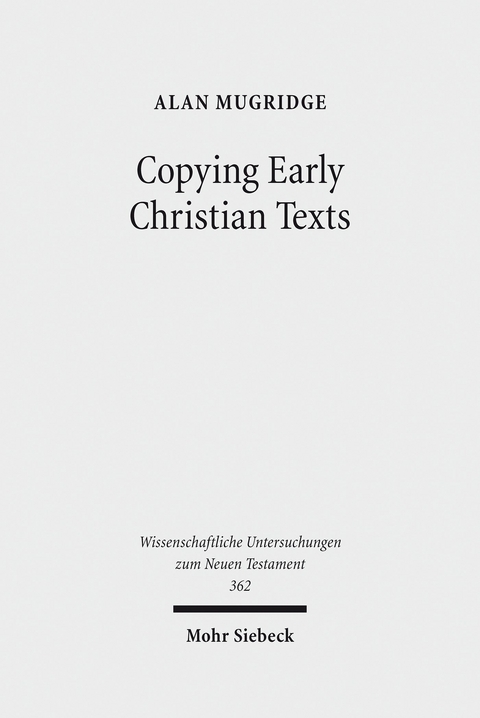
Copying Early Christian Texts (eBook)
578 Seiten
Mohr Siebeck (Verlag)
978-3-16-154760-7 (ISBN)
Born 1952; 1981-84 church minister; 1987-92 lecturer at St. Philip's Theological College, Kongwa, Tanzania (East Africa); 1993-2003 lecturer in New Testament, since 2004 Senior Lecturer in New Testament at Sydney Missionary and Bible College; 2010 PhD.
Cover 1
Preface 8
Contents 12
List of Figures and Graphs 16
Abbreviations & Sigla
Glossary 20
Chapter 1: The papyri and their handwriting 22
1. Purpose and argument of this book 22
a. Purpose 22
b. Argument 23
2. The papyri in this study – Christian papyri and the comparison set 23
a. ‘Christian’ papyri 23
b. The comparison set 26
c. Dates 27
d. Language 28
e. ‘Papyri’ 28
f. Papyri including other Greek texts 29
g. Provenance 30
h. Code numbers 31
3. Writers and writing in the Roman Imperial period 32
a. Writers 32
i. ‘Slow-writers’ 32
ii. ‘Occasional writers’ 33
iii. ‘Scribes’ 34
b. Writing in the early Roman Imperial period 39
4. The writers and writing of the papyri 41
a. Levels of competence 41
b. Classification of the writing and writers of the papyri 42
Chapter 2: Content, material, form and size 47
1. Content 47
a. Textual content 47
b. Other languages 50
2. Material 51
a. Writing surface 52
b. Re-use of a papyrus 54
3. Form 56
4. Size 59
a. Codices 59
i. Papyrus codices 60
ii. Parchment codices 63
b. Rolls 66
c. Sheets 67
d. Wooden ‘tablets’ 69
Conclusion 70
Chapter 3. Page layout 72
1. Rolls 73
a. Column height, upper margin and lower margin 73
b. Column breadth and inter-columnar space 75
2. Codices 78
a. Column height, upper and lower margins 78
b. Column breadth, inner and outer margins 81
c. Inter-columnar space 85
3. Sheets 86
a. Column height, upper and lower margins 86
b. Column breadth, left and right margins 88
c. Column breadth and inter-columnar space 89
4. Wooden tablets 89
Conclusion 90
Chapter 4. Reading aids 92
1. Pagination 93
2. Titles and headings 96
3. Section markers 97
4. Sense lines and stichometric layout 99
5. Punctuation 101
6. Lectional signs 104
a. Diaeresis (trêma) 104
b. Apostrophe 107
c. Breathings 109
d. Accents 110
Conclusion 111
Chapter 5. Writing the text 113
1. Number of writers 113
2. Letter height, interlinear spacing and leading 115
3. Letters per line, even right margin and line-fillers 118
a. Letters per line 118
b. Even right margin and line-fillers 120
4. Lines per column 121
5. Critical signs and corrections 122
a. Critical signs 123
i. Anchor 123
ii. Asterisk 123
iii. Diplê 124
iv. Obelus 124
v. Signs with uncertain meaning 124
b. Corrections 125
i. Omission or correction indicated by a sign 126
ii. Deletion of text 126
iii. Insertion of text 127
6. Marginal notes 129
7. Decorations and illustrations 130
8. Linguistic features 134
a. Phonology and orthography 135
b. Morphology and selected syntactic features 137
9. Abbreviations 138
10. The Tetragrammaton 140
11. Nomina sacra 142
a. .e.. 144
b. ...... 145
c. ...... 145
d. ....t.. 146
e. p.e.µa 147
f. a....p.. 148
g. pat.. 148
h. .... 149
i. ...a.. 149
j. ...a... 149
k. ..t.. 150
l. da..d 150
m. µ.t.. 151
n. .e....a..µ 151
o. .ta...., .ta.... 151
p. Other abbreviations 152
12. Stichometric counts 158
13. Accuracy of textual transmission 159
Conclusion 163
Chapter 6. Conclusion 165
1. Copyists and scribes 168
2. Copyists and faith 172
3. A new model 174
Catalogue of Papyri 176
Excluded papyri 432
Bibliography 435
Tables 466
Concordance 539
Index of Publications of Papyri 558
Index of Ancient Sources in Papyri 567
Index of Authors 575
Index of Subjects 578
| Erscheint lt. Verlag | 1.7.2016 |
|---|---|
| Sprache | englisch |
| Themenwelt | Geschichte ► Allgemeine Geschichte ► Altertum / Antike |
| Geisteswissenschaften ► Religion / Theologie ► Christentum | |
| ISBN-10 | 3-16-154760-8 / 3161547608 |
| ISBN-13 | 978-3-16-154760-7 / 9783161547607 |
| Informationen gemäß Produktsicherheitsverordnung (GPSR) | |
| Haben Sie eine Frage zum Produkt? |
 PDF (Adobe DRM)
Größe: 3,7 MB
Kopierschutz: Adobe-DRM
Adobe-DRM ist ein Kopierschutz, der das eBook vor Mißbrauch schützen soll. Dabei wird das eBook bereits beim Download auf Ihre persönliche Adobe-ID autorisiert. Lesen können Sie das eBook dann nur auf den Geräten, welche ebenfalls auf Ihre Adobe-ID registriert sind.
Details zum Adobe-DRM
Dateiformat: PDF (Portable Document Format)
Mit einem festen Seitenlayout eignet sich die PDF besonders für Fachbücher mit Spalten, Tabellen und Abbildungen. Eine PDF kann auf fast allen Geräten angezeigt werden, ist aber für kleine Displays (Smartphone, eReader) nur eingeschränkt geeignet.
Systemvoraussetzungen:
PC/Mac: Mit einem PC oder Mac können Sie dieses eBook lesen. Sie benötigen eine
eReader: Dieses eBook kann mit (fast) allen eBook-Readern gelesen werden. Mit dem amazon-Kindle ist es aber nicht kompatibel.
Smartphone/Tablet: Egal ob Apple oder Android, dieses eBook können Sie lesen. Sie benötigen eine
Geräteliste und zusätzliche Hinweise
Zusätzliches Feature: Online Lesen
Dieses eBook können Sie zusätzlich zum Download auch online im Webbrowser lesen.
Buying eBooks from abroad
For tax law reasons we can sell eBooks just within Germany and Switzerland. Regrettably we cannot fulfill eBook-orders from other countries.
aus dem Bereich