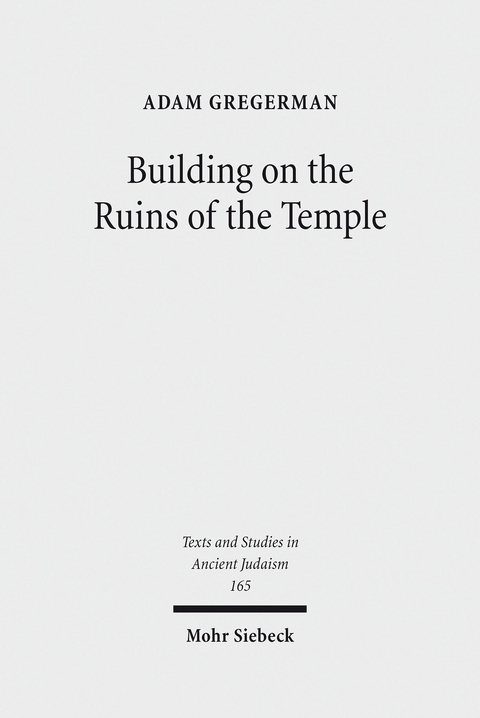
Building on the Ruins of the Temple (eBook)
280 Seiten
Mohr Siebeck (Verlag)
9783161545214 (ISBN)
Born 1973; PhD in Religion at Columbia University; currently Assistant Professor of Theology and Religious Studies and Assistant Director, Institute for Jewish-Catholic Relations, Saint Joseph's University, Philadelphia, PA.
Cover 1
Acknowledgements 6
Table of Contents 8
Abbreviations 14
Chapter 1: Introduction 16
A. The Destruction of the Second Temple 16
B. Methodology and Parameters of This Study 17
C. The Primary Sources Analyzed in This Study 24
I. The Christian Texts 25
II. Lamentations Rabbah 29
D. Organization of the Book 32
Chapter 2: Justin’s Dialogue with Trypho 34
A. Justin the Apologist 34
B. The Audience and Purpose of the Dial 37
C. Scholarship on Justin and the Destruction 39
D. The Period up to 70 CE : Explanations of the Destruction as Punishment for the Crucifixion 41
I. Dial. 109–10: Micah and the Final Rejection of the Jews 45
II. Dial. 52: 70 CE: A New Stage in Jewish History 46
III. Additional Biblical Prophecies of the Destruction 47
E. The Period after 70 CE (Part I) : The Implications of the Destruction for the Law and the Jewish Covenant 49
I. Dial. 16 and 92: Circumcision as Punishment and Mark of Separation for the Jews 51
II. Dial. 40 and 46: The Impossibility of Temple Sacrifice and the Abrogation of the Law 55
III. Dial. 22: Amos’ Critique of Sacrifice and the Destruction 58
F. The Period after 70 CE (Part II) : The Destruction and the New Covenant with the Gentiles 60
I. Dial. 24–26: Third Isaiah and Israel’s Replacement in the Covenant 62
II. Dial. 41 and 117: Malachi and the Transfer of God’s Favor to the Gentiles 65
III. Dial. 139–40: Supersessionist Typology of Noah’s Sons 67
IV. Dial. 80–81: Millenarianism, the Destruction, and the People of God 70
G. Conclusion 72
Chapter 3: Origen’s Contra Celsum 74
A. Origen, Celsus, and Third-Century Caesarea 74
B. The Audience and Purpose of Cels 79
C. Scholarship on Origen and the Destruction 82
D. The Period up to 70 CE : Explanations of the Destruction as Punishment for the Crucifixion 84
I. Tensions in Origen’s Views of the Jews’ Past and Present 86
II. Minimizing the Decades between Crucifixion (ca. 30 CE) and Destruction (70 CE) 88
III. Origen’s Citation of Josephus on the Destruction 89
IV. The Destruction and the End of the Covenant with the Jews 91
V. Cels. 5:31: The Destruction and the End to Divine Forgiveness for Sinful Israel 93
VI. The Jews’ Losses Assessed Comparatively 94
E. The Period after 70 CE: The Implications of the Destruction 95
I. The Destruction and the Abrogation of the Law 95
II. Cels. 4:22: Removing the Barriers in the Law to the Gentile Mission 98
III. Cels. 4:31–32: The Destruction and the Shift from Life under the Law to Freedom from the Law 100
IV. Cels. 7:26: The Law Read Spiritually Aids the Gentile Mission 102
V. The Destruction and the New Covenant with the Gentiles 103
VI. Cels. 2:8: The Destruction as a Proof from History of the Transfer of God’s Favor from Jews to Gentile Christians 104
VII. Cels. 2:78: Jewish Disbelief and Punishment is Part of God’s Plan for All Humanity 106
VIII. Cels. 8:41–43: Jewish Exclusion and Gentile Inclusion 108
F. Conclusion 109
Chapter 4: Eusebius’ Proof of the Gospel 112
A. Eusebius, Caesarea, and Jerusalem 112
B. The Audience and Purpose of Dem. ev 115
C. Scholarship on Eusebius and the Destruction 123
D. The Period up to 70 CE : Explanations of the Destruction as Punishment for the Crucifixion 125
I. Minimizing the Decades between Crucifixion (ca. 30 CE) and Destruction (70 CE) 126
II. Biblical Prophesies of the Destruction 128
1. Amos 8 129
2. Isaiah 1 129
3. Micah 1 130
4. Zechariah 14 and Isaiah 1–2 130
III. The Destruction and the Covenant with the Jews 132
IV. Total Rejection and Total Destruction 134
E. The Period after 70 CE : The Implications of the Destruction 139
I. The Destruction and the Law 139
II. The Abrogation of the Law, the Destruction, and Eusebius’ Tripartite Division of History 141
III. The Destruction and the New Covenant with the Gentiles 146
IV. Rome’s Victories over the Jews and the Providential Appearance of the Pax Augustana 148
F. Conclusion 151
Chapter 5: Rabbinic Challenges to Traditional Theodicy 152
A. The Destruction and Theologies of Jewish Suffering 152
B. Deuteronomistic Theodicy 155
C. Rabbinic Theodicy 159
D. Rabbinic Challenges to Deuteronomistic Theodicy 160
E. Scholarship on Rabbinic Views of Suffering and the Destruction 163
Chapter 6: Apologetic Midrashim in Lamentations Rabbah 172
A. Organization 173
B. Accusations of Divine Injustice (I): God’s Unjust Acts 173
I. Lam. Rab. Pr 3: The Sinful “Merrymakers” 174
II. Lam. Rab. Pr 24: Abraham Defends Israel at Trial 177
III. Lam. Rab. 1:37 b: God Did Not Follow the Law 181
IV. Lam. Rab. 1:41: God Affirms Israel’s Righteousness 184
V. Lam. Rab. 1:56: The Ejected Wife and her Former Companions 187
VI. Lam. Rab. 2:3 b: Striking Down the Sanctified Ones 190
C. Accusations of Divine Injustice (II): God’s Failure to Act 194
I. Lam. Rab. Pr 15: God has Grown Old 194
II. Lam. Rab. Pr 24: God is Like a Failed, Old King 197
III. Lam. Rab. 1:50: The Seven Martyrs 200
IV. Lam. Rab. 5:1 a: The Weaker Gladiator 206
D. Accusations That God Failed to Keep God’s Promises to the People 209
I. Lam. Rab. Pr 24: Abraham Criticizes God for the Destruction 210
II. Lam. Rab. 1:37 c: God did not Bury Israel’s Dead 216
III. Lam. Rab. 3:1: The Ejected Wife and Her Devotion to Her Husband 219
IV. Lam. Rab. 5:1 b: Israel’s Loss is God’s Loss Too 221
E. Antitheodicy and the Collapse of Divine Justice 225
I. Lam. Rab. 3:9: Hadrian Kills Jews Inexplicably 225
II. Lam. Rab. 4:3: Kamtza and Bar Kamtza 228
Chapter 7: Theological Apologetics and Polemics 232
A. Justin, Origen, and Eusebius on the Destruction 232
B. The Rabbis in Lam. Rab. on the Destruction 236
C. The Destruction and the Context of Jewish and Christian Theological Apologetics and Polemics 241
D. Conclusion 245
Bibliography 248
Index of Ancient Sources 264
Hebrew Bible 264
New Testament 267
Apocrypha, Pseudepigrapha, and Second Temple Jewish Literature 268
Classical and Patristic Sources 268
Rabbinic Literature 273
Index of Modern Authors 275
Index of Subjects 279
| Erscheint lt. Verlag | 1.6.2016 |
|---|---|
| Sprache | englisch |
| Themenwelt | Geisteswissenschaften ► Religion / Theologie ► Christentum |
| Geisteswissenschaften ► Religion / Theologie ► Judentum | |
| ISBN-13 | 9783161545214 / 9783161545214 |
| Informationen gemäß Produktsicherheitsverordnung (GPSR) | |
| Haben Sie eine Frage zum Produkt? |
 PDF (Adobe DRM)
Größe: 2,4 MB
Kopierschutz: Adobe-DRM
Adobe-DRM ist ein Kopierschutz, der das eBook vor Mißbrauch schützen soll. Dabei wird das eBook bereits beim Download auf Ihre persönliche Adobe-ID autorisiert. Lesen können Sie das eBook dann nur auf den Geräten, welche ebenfalls auf Ihre Adobe-ID registriert sind.
Details zum Adobe-DRM
Dateiformat: PDF (Portable Document Format)
Mit einem festen Seitenlayout eignet sich die PDF besonders für Fachbücher mit Spalten, Tabellen und Abbildungen. Eine PDF kann auf fast allen Geräten angezeigt werden, ist aber für kleine Displays (Smartphone, eReader) nur eingeschränkt geeignet.
Systemvoraussetzungen:
PC/Mac: Mit einem PC oder Mac können Sie dieses eBook lesen. Sie benötigen eine
eReader: Dieses eBook kann mit (fast) allen eBook-Readern gelesen werden. Mit dem amazon-Kindle ist es aber nicht kompatibel.
Smartphone/Tablet: Egal ob Apple oder Android, dieses eBook können Sie lesen. Sie benötigen eine
Geräteliste und zusätzliche Hinweise
Zusätzliches Feature: Online Lesen
Dieses eBook können Sie zusätzlich zum Download auch online im Webbrowser lesen.
Buying eBooks from abroad
For tax law reasons we can sell eBooks just within Germany and Switzerland. Regrettably we cannot fulfill eBook-orders from other countries.
aus dem Bereich