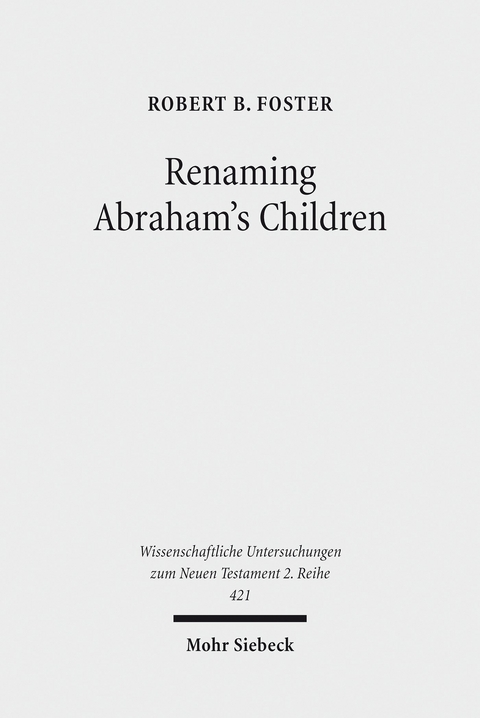
Renaming Abraham's Children (eBook)
345 Seiten
Mohr Siebeck (Verlag)
9783161544842 (ISBN)
Born 1973; received his PhD from Marquette University (2011); has taught at Marquette University, Albion College, and Madonna University; currently an associate book review editor for Reviews of the Enoch Seminar.
Cover 1
Preface 6
Table of Contents 10
List of Abbreviations 16
A Note on Translations 19
Introduction 20
Chapter 1: Story, Text, and Technique: Reading Scripture in Paul 24
1.1. Paul’s Interpretation of Scripture: Story 24
1.1.1. Getting Behind the Text 25
1.1.2. Locating a Pre-Epistolary Story 27
1.1.3. Legitimating a Hypothesis 39
1.1.4. Circumventing the Audience 41
1.2. Paul’s Interpretation of Scripture: Texts 44
1.2.1. Textual Diversity in Second Temple Judaism 45
1.2.2. Determining Paul’s Quotations 47
1.2.3. Excursus: Paul and the Hebrew Scriptures 51
1.3. Paul’s Interpretation of Scripture: Technique 52
1.3.1. Torah and the Prophets 53
1.3.2. Analogy: Gezera Shawa and Heqesh 55
1.3.3. Atomizing Exegesis 59
1.4. Conclusions 60
Chapter 2: The Abrahamic Mythomoteur in Early Judaism and in the Letters of Paul 62
2.1. Abrahamic Identity in Postexilic Texts 62
2.2. The Reconfiguration of Abrahamic Identity in the Letters of Paul 69
2.2.1. Abraham, Isaac, and Israel in Galatians 69
2.2.1.1. Abraham and the Gentiles in Galatia 71
2.2.1.2. Locating Gentiles in Genesis 72
2.2.1.3. Participation in Abraham’s Single Seed 73
2.2.1.4. Overcoming Circumcision with the Prophets 75
2.2.1.5. Paul, Judaism, and the “Israel of God” 79
2.2.1.6. Summary 81
2.2.2. Former Gentiles with Circumcised Hearts 83
2.2.2.1. Former Gentiles in 1 Corinthians 84
2.2.2.2. Circumcised Hearts in Philippians and Romans 92
2.2.2.3. Summary 94
2.2.3. Romans 4 and the Two Branches of Abraham’s Family Tree 94
2.2.3.1. Justification, Circumcision, and Abraham’s Children in Romans 4:9–12 96
2.2.3.2. Torah, Inheritance, and Abraham’s Children in Romans 4:13–17 98
2.3. Conclusions 101
Chapter 3: Ethnic Difference and Epistolary Exigency: Rethinking the Reason for Romans 103
3.1. The Composition of Roman Christianity 104
3.2. The Prehistory of Romans and the Accused Apostle 114
3.3. Apologetic Traces in Romans 119
3.4. Gentile Addressees and Jewish Auditors 123
3.5. Conclusions: Mercenary Motives or Exegetical Breakthrough? 130
Chapter 4: Discriminatory Election and Logical Reversals in Romans 9:6–13 132
4.1. Covenantal Fidelity or Cosmic Farce? Romans 9:6a in Context 133
4.2. Israel and Not Israel: Romans 9:6b in Context 137
4.3. Structure and Argument in Romans 9:7–13 141
4.4. Flesh Does Not Mean Seed: Romans 9:7–9 144
4.4.1. Scriptural Quotation in Romans 9:7–9 144
4.4.2. Sp..µa and S... in Romans 9:7–9 147
4.4.3. Ishmael’s Exclusion: Circumcision and Covenant in Romans 9:7–9 149
4.4.4. Ishmael’s Exclusion: Circumcision and Covenant Behind Romans 9:7–9 151
4.5. Obedience Does Not Mean Election: Romans 9:10–13 155
4.5.1. Scriptural Quotation in Romans 9:10–13 155
4.5.2. Works and Torah in Romans 9:10–13 158
4.5.3. Patriarchs, Prophets, and the “Dynamics of Diselection” in Romans 9:10–13 161
4.5.3.1. Election and Its Opposite in Romans 9:10–13 161
4.5.3.2. Divine Love and Divine Hate in Romans 9:13 164
4.6. Conclusions 167
Chapter 5: Establishing and Intertextual Matrix: Moses and the Prophets in Romans 9 170
5.1. Lexical Connections Discovered by Paul 170
5.1.1. “You Will Be Called” 171
5.1.2. “Seed” 172
5.1.3. “As Numerous as the Sands of the Sea” 172
5.1.4. Inheriting the Land 173
5.1.5. The Remnant 174
5.1.6. Sodom and Gomorrah 176
5.1.7. Edom’s Inheritance 177
5.1.8. Summary 178
5.2. Lexical Connections Forged by Paul 178
5.2.1. Hosea 2:25 (Eng.: 2:23) in Romans 9:25 180
5.2.2. Isaiah 10:22–23 in Romans 9:27–28 184
5.3. Thematic Connections: Election, Exclusion, and Reversals in the Scriptures of Israel 189
5.3.1. The Irony of Election: Favored Sons in Genesis 189
5.3.2. Exiled and Restored Children: Narrative Patterns in Hosea 192
5.3.3. Pruning the Vine: Restricting Election in Isaiah 193
5.3.3.1. The Returning Remnant in Isaiah 10:20–23 193
5.3.3.2. The Survivors of Israel in Isaiah 1:9 199
5.3.4. Summary 201
5.4. Conclusions 202
Chapter 6: Hosea’s Excluded Children: The Inversion of Election in Romans 9:25–26 204
6.1. Power and Providence in Romans 9:14–23 and 9:24 205
6.2. Transformed Children: Abraham’s Gentile Descendants in Hosea 209
6.2.1. Abusing Scripture? Exploiting Children? The Problem of Hosea in Romans 9:25–26 210
6.2.2. Israel and the Nations in Hosea 2:1 and 2:25 214
6.2.2.1. The Mystery of Gentile Inclusion in Hosea 2:1 and 2:25 214
6.2.2.2. Reversing Election 218
6.2.2.3. Esau and the Gentiles in Romans 9 219
6.2.2.4. The Remnant of the House of Judah 220
6.2.2.5. From Etiology to Eschatology: Abraham’s Family Reunited 221
6.2.3. Excursus: A Transgendered Esau? 223
6.2.4. Summary 225
6.3. Promised Land and Restoration Eschatology in Paul 226
6.3.1. Accounting for '..e. 226
6.3.2. Abraham’s Worldwide Patrimony 228
6.3.3. The Theological Geography of Romans 9 and Its Antecedents in Hosea 230
6.3.4. Summary 233
6.4. Conclusions 233
Chapter 7: Reading Isaiah’s Remnant: The Genesis of a Soteriological Transformation in Romans 9:27–29 235
7.1. A Certain and Salvific Word 236
7.1.1. An Indecisive Word? ..... S..te... .a. S..t.µ... in Romans 9:28 236
7.1.2. Word and Salvation in Romans 9:27–29 238
7.2. From Residual Seed to All Israel 241
7.2.1. The Remnant, From Isaiah to Paul 241
7.2.2. The Remnant in Second Temple Polemics 245
7.2.3. Locating the Remnant in Genesis 251
7.2.4. A Remnant by Faith 254
7.3. A Certain Salvation – But Not for All: Reversing Election in Romans 9 255
7.4. Conclusions 257
Chapter 8: Beyond Romans 9: Election and Its Reversal in Romans 258
8.1. God’s Word to “Israel” Has Not Failed – Nor Has His Word to Israel 259
8.2. Trading Places with Esau 263
8.3. The Priority of Israel and the Equality of Gentiles 269
8.4. Conclusions 271
Conclusions 274
1. Summary of This Study 274
2. Genesis and Isaiah in Romans 277
3. The Firstborn of Many Brothers 279
4. Proposal for Further Study 280
Bibliography 282
1. Reference Works and Primary Sources 282
2. Secondary Sources 284
Index of References 314
Old Testament 314
Deuterocanonical Books 322
Pseudepigrapha 323
Dead Sea Scrolls and Related Literature 325
Josephus 325
Philo 326
New Testament 326
Rabbinic Writings 334
Early Christian Writings 335
Greco-Roman Literature 335
Index of Modern Authors 337
Index of Subjects 344
| Erscheint lt. Verlag | 1.7.2016 |
|---|---|
| Sprache | englisch |
| Themenwelt | Geisteswissenschaften ► Religion / Theologie ► Christentum |
| Geisteswissenschaften ► Religion / Theologie ► Judentum | |
| ISBN-13 | 9783161544842 / 9783161544842 |
| Informationen gemäß Produktsicherheitsverordnung (GPSR) | |
| Haben Sie eine Frage zum Produkt? |
 PDF (Adobe DRM)
Größe: 4,6 MB
Kopierschutz: Adobe-DRM
Adobe-DRM ist ein Kopierschutz, der das eBook vor Mißbrauch schützen soll. Dabei wird das eBook bereits beim Download auf Ihre persönliche Adobe-ID autorisiert. Lesen können Sie das eBook dann nur auf den Geräten, welche ebenfalls auf Ihre Adobe-ID registriert sind.
Details zum Adobe-DRM
Dateiformat: PDF (Portable Document Format)
Mit einem festen Seitenlayout eignet sich die PDF besonders für Fachbücher mit Spalten, Tabellen und Abbildungen. Eine PDF kann auf fast allen Geräten angezeigt werden, ist aber für kleine Displays (Smartphone, eReader) nur eingeschränkt geeignet.
Systemvoraussetzungen:
PC/Mac: Mit einem PC oder Mac können Sie dieses eBook lesen. Sie benötigen eine
eReader: Dieses eBook kann mit (fast) allen eBook-Readern gelesen werden. Mit dem amazon-Kindle ist es aber nicht kompatibel.
Smartphone/Tablet: Egal ob Apple oder Android, dieses eBook können Sie lesen. Sie benötigen eine
Geräteliste und zusätzliche Hinweise
Zusätzliches Feature: Online Lesen
Dieses eBook können Sie zusätzlich zum Download auch online im Webbrowser lesen.
Buying eBooks from abroad
For tax law reasons we can sell eBooks just within Germany and Switzerland. Regrettably we cannot fulfill eBook-orders from other countries.
aus dem Bereich