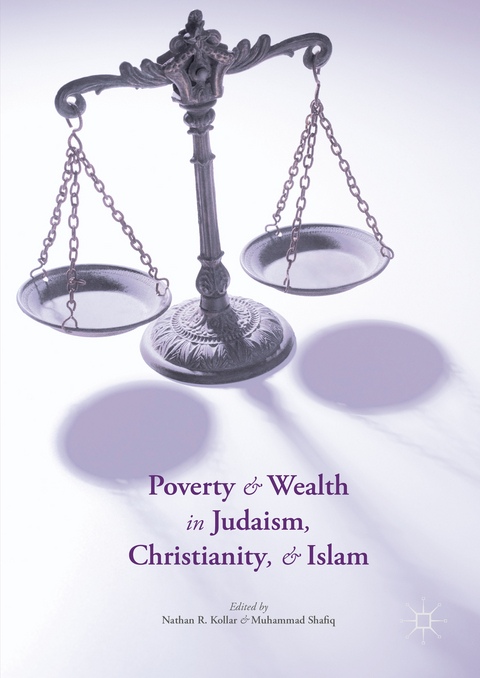
Poverty and Wealth in Judaism, Christianity, and Islam (eBook)
XXXII, 324 Seiten
Palgrave Macmillan US (Verlag)
9781349948505 (ISBN)
This book gathers scholars from the three major monotheistic religions to discuss the issue of poverty and wealth from the varied perspectives of each tradition. It provides a cadre of values inherent to the sacred texts of Jews, Christians, and Muslims and illustrates how these values may be used to deal with current economic inequalities.
Contributors use the methodologies of religious studies to provide descriptions and comparisons of perspectives from Judaism, Christianity, and Islam on poverty and wealth. The book presents citations from the sacred texts of all three religions. The contributors discuss the interpretations of these texts and the necessary contexts, both past and present, for deciphering the stances found there. Poverty and Wealth in Judaism, Christianity, and Islam identifies and details a foundation of common values upon which individual and institutional decisions may be made.
This book gathers scholars from the three major monotheistic religions to discuss the issue of poverty and wealth from the varied perspectives of each tradition. It provides a cadre of values inherent to the sacred texts of Jews, Christians, and Muslims and illustrates how these values may be used to deal with current economic inequalities. Contributors use the methodologies of religious studies to provide descriptions and comparisons of perspectives from Judaism, Christianity, and Islam on poverty and wealth. The book presents citations from the sacred texts of all three religions. The contributors discuss the interpretations of these texts and the necessary contexts, both past and present, for deciphering the stances found there. Poverty and Wealth in Judaism, Christianity, and Islam identifies and details a foundation of common values upon which individual and institutional decisions may be made.
Nathan R. Kollar is Professor Emeritus of Religious Studies at St. John Fisher College, USA, retired Adjunct Professor in the Graduate School of Education, University of Rochester, USA, and Co-founder and Chair of the Board of the Center for Interfaith Studies and Dialogue at Nazareth College, USA. Muhammad Shafiq is Executive Director of the Brian and Jean Hickey Center for Interfaith Studies and Dialogue and Professor of Islamic and Religious Studies at Nazareth College, USA. He holds the IIIT Chair in Interfaith Studies at Nazareth College.
Introduction; Nathan R. Kollar PART I: Personifications of Poverty and Wealth1. Reading Job 19:2-22: A Symbolic-Interactionist View of Poverty; Thomas Decker2. The Story of Qarun (Korah) in the Qur’an and Its Importance for our Times; Zeki Saritoprak3. Mughal Munificence: Care and Concern for the Poor in Islamic Hindustan from Tuladan to the Taj; Michael D.Calabria4. Mary’s Magnificat: the Anawim and Church on the Margins; C. Denise YarbroughPart II Doctrines about Poverty and Wealth5. Socioeconomic and Gender Justice in the Qur’an: Modern Challenges; Zainab Alwani6. Gospel Readings on Poverty and Affluence in Most Eastern and Western Churches; Regina Boisclair 7. Orthodox Christianity and Islam on Economic Justice: Universal Ideals and Contextual Challenges in Russia; Andrii KrawchukPART III. Spiritual Traditions about Poverty and Wealth8. From Possessio to Paupertas: The Emergence of Religious Poverty as a Critical Spiritual Component of Medieval Christianity; Michael Cusato9. Poverty, Wealth and the Doctrine of Al-Fana’ in the Qur’an; Hussam S. Timani10. Prophetic Ethics As Monotheistic Spirituality; Steven Kepnes11. Christian Ethics: the “Non-Person” and the Insights of Liberation Theology for a Twentieth-First Century World; Curt Cadorette12. A Spirituality for Rich and Poor: Contemporary Catholic Ideals for Economic Justice; Marvin L. Krier MichPART IV. Sharing Our Wealth13. Geography-Based Giving in Jewish Tradition; Malka Zeiger Simkovich14. Poverty and Wealth in Islam’s Sacred Texts; Abdullah F. Al Lheedan15. Overflowing Riches: Generosity, Divine and Human; Clare AmosConclusion; Nathan R. Kollar
| Erscheint lt. Verlag | 27.7.2016 |
|---|---|
| Zusatzinfo | XXXII, 324 p. 6 illus., 4 illus. in color. |
| Verlagsort | New York |
| Sprache | englisch |
| Themenwelt | Religion / Theologie ► Christentum ► Kirchengeschichte |
| Geisteswissenschaften ► Religion / Theologie ► Judentum | |
| Geisteswissenschaften ► Religion / Theologie ► Islam | |
| Sozialwissenschaften ► Politik / Verwaltung | |
| Sozialwissenschaften ► Soziologie | |
| Schlagworte | Bible • Christianity • Economics • Ecumenism • Interfaith • interreligious • MONEY • Poverty • Qumâran • Qum’ran • Religion and money • Torah • Wealth |
| ISBN-13 | 9781349948505 / 9781349948505 |
| Informationen gemäß Produktsicherheitsverordnung (GPSR) | |
| Haben Sie eine Frage zum Produkt? |
 PDF (Wasserzeichen)
DRM: Digitales Wasserzeichen
Dieses eBook enthält ein digitales Wasserzeichen und ist damit für Sie personalisiert. Bei einer missbräuchlichen Weitergabe des eBooks an Dritte ist eine Rückverfolgung an die Quelle möglich.
Dateiformat: PDF (Portable Document Format)
Mit einem festen Seitenlayout eignet sich die PDF besonders für Fachbücher mit Spalten, Tabellen und Abbildungen. Eine PDF kann auf fast allen Geräten angezeigt werden, ist aber für kleine Displays (Smartphone, eReader) nur eingeschränkt geeignet.
Systemvoraussetzungen:
PC/Mac: Mit einem PC oder Mac können Sie dieses eBook lesen. Sie benötigen dafür einen PDF-Viewer - z.B. den Adobe Reader oder Adobe Digital Editions.
eReader: Dieses eBook kann mit (fast) allen eBook-Readern gelesen werden. Mit dem amazon-Kindle ist es aber nicht kompatibel.
Smartphone/Tablet: Egal ob Apple oder Android, dieses eBook können Sie lesen. Sie benötigen dafür einen PDF-Viewer - z.B. die kostenlose Adobe Digital Editions-App.
Buying eBooks from abroad
For tax law reasons we can sell eBooks just within Germany and Switzerland. Regrettably we cannot fulfill eBook-orders from other countries.
aus dem Bereich