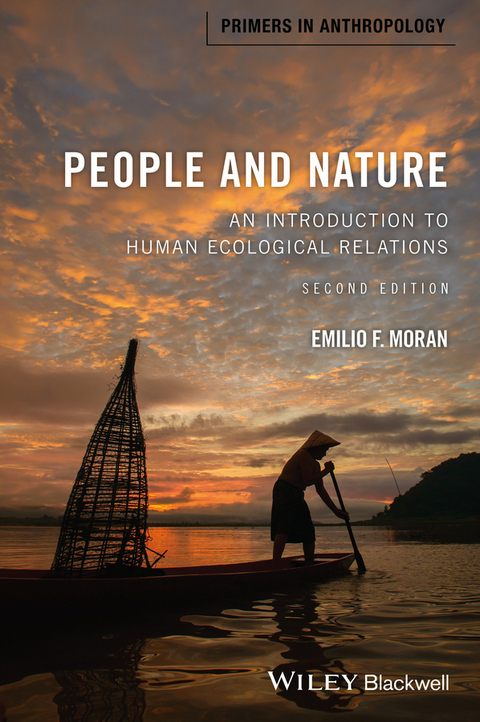
People and Nature (eBook)
Wiley (Verlag)
978-1-118-87741-8 (ISBN)
Now updated and expanded, People and Nature is a lively, accessible introduction to environmental anthropology that focuses on the interactions between people, culture, and nature around the world.
- Written by a respected scholar in environmental anthropology with a multi-disciplinary focus that also draws from geography, ecology, and environmental studies
- Addresses new issues of importance, including climate change, population change, the rise of the slow food and farm-to-table movements, and consumer-driven shifts in sustainability
- Explains key theoretical issues in the field, as well as the most important research, at a level appropriate for readers coming to the topic for the first time
- Discusses the challenges in ensuring a livable future for generations to come and explores solutions for correcting the damage already done to the environment
- Offers a powerful, hopeful future vision for improved relations between humans and nature that embraces the idea of community needs rather than consumption wants, and the importance of building trust as a foundation for a sustainable future
Emilio F. Moran is John A. Hannah Distinguished Professor at the Center for Global Change and Earth Observations, the Center for System Integration and Sustainability, and the Department of Geography at Michigan State University, USA. Until 2012, he was Distinguished Professor and the James H. Rudy Professor of Anthropology at Indiana University, USA. He is the author of ten books, fifteen edited volumes, and more than 190 journal articles and book chapters, which address human interaction with the environment under conditions of change. Most recently, he is the author of Environmental Social Science: Human-Environment Interactions and Sustainability(Wiley Blackwell, 2010). He is a Fellow of the Linnean Society of London, the American Anthropological Association, the Society for Applied Anthropology, and the American Association for the Advancement of Science. He was elected to the National Academy of Sciences in 2010.
Now updated and expanded, People and Nature is a lively, accessible introduction to environmental anthropology that focuses on the interactions between people, culture, and nature around the world. Written by a respected scholar in environmental anthropology with a multi-disciplinary focus that also draws from geography, ecology, and environmental studies Addresses new issues of importance, including climate change, population change, the rise of the slow food and farm-to-table movements, and consumer-driven shifts in sustainability Explains key theoretical issues in the field, as well as the most important research, at a level appropriate for readers coming to the topic for the first time Discusses the challenges in ensuring a livable future for generations to come and explores solutions for correcting the damage already done to the environment Offers a powerful, hopeful future vision for improved relations between humans and nature that embraces the idea of community needs rather than consumption wants, and the importance of building trust as a foundation for a sustainable future
Emilio F. Moran is John A. Hannah Distinguished Professor at the Center for Global Change and Earth Observations, the Center for System Integration and Sustainability, and the Department of Geography at Michigan State University, USA. Until 2012, he was Distinguished Professor and the James H. Rudy Professor of Anthropology at Indiana University, USA. He is the author of ten books, fifteen edited volumes, and more than 190 journal articles and book chapters, which address human interaction with the environment under conditions of change. Most recently, he is the author of Environmental Social Science: Human-Environment Interactions and Sustainability(Wiley Blackwell, 2010). He is a Fellow of the Linnean Society of London, the American Anthropological Association, the Society for Applied Anthropology, and the American Association for the Advancement of Science. He was elected to the National Academy of Sciences in 2010.
Preface to the Second Edition x
Acknowledgments xiii
1 Human Agency and the State of the Earth 1
Introduction 1
Can One Conceive of Ecosystems Without Human Agents? 11
Human Agency: Individuals Making a Difference 14
Overwhelming Evidence for Concern with the Condition of the Earth System 17
Looking Back and Looking Forward 26
Additional Resources 27
References 28
2 A Reminder: How Things Were... 33
The Study of Human Ecological Relations 33
The Contemporary Study of Environmental Issues: The Rise of Cross?-Disciplinary Team?-Based Approaches 39
The Evolution of Human-Environment Interactions 47
Hunter?-Gatherers: Setting Our Preferences 52
How Did We Decide to Become Farmers? 56
Herding and Farming: An Uneasy Relationship 59
More Food for the Masses 61
Additional Resources 64
References 64
3 The Great Forgetting 75
Earth Transformations in Prehistory 75
The Archeology of Environmental Change 83
The Urban-Industrial Revolution and the Unleashing of Prometheus 86
The Contemporary Situation: Human?-Dominated Ecosystems 89
Additional Resources 91
References 92
4 The Web of Life: Are We in it? 96
The Web of Life and Trophic Relations: Thinking Ecologically 96
Ecosystem Productivity and Net Primary Production 103
Land Use and Long?-Term Disturbance 105
Additional Resources 117
References 117
5 What Makes People Do That? 122
Learning, Adaptation, and Information 122
Mitigation and the Cautionary Principle 135
Transforming the Face of the Earth: Making Better Decisions 136
Additional Resources 139
References 140
6 Population and Environment 145
Theories about Population 146
The Demographic Transition 147
Aging and International Flows of Labor 150
Addressing the Needs of 10 Billion People 153
Changing the Population and Environment Nexus 159
Additional Resources 162
References 163
7 Rebuilding Communities and Institutions 166
Community in Human Evolution 166
What is Sacred in Human Evolution? 169
Tragedies of the Commons 172
Institutions and Self?]Organization 176
Bioregionalism, Deep Ecology, and Embedding People in Nature 180
Additional Resources 182
References 183
8 Can We Learn When We Have Enough? 188
Material Boys and Material Girls 188
Patterns of Consumption in Developed Countries 189
Patterns of Consumption in Developing Countries 196
A Feeding Frenzy and a Crisis in Public Health 200
Burning Fossil Fuels instead of Calories 202
Do We Have Enough Material Goods Now? 205
Additional Resources 207
References 208
9 Quality of Life: When Less is More 210
Resource Abundance versus Resource Scarcity 210
When Less is More 220
The Scale of the Problem and the Scale of the Solution 229
Restoring Our Balance: Valuing Community and Trust 233
Are We Happier When We Have More? 238
References 241
Index 244
1
Human Agency and the State of the Earth
Introduction
Each year, a well‐known non‐governmental organization publishes a State‐of‐the‐Earth report. The story told in this report has not changed much in the past 30 years: the Earth continues to be treated with little thought for the future. More and more species are going extinct. Wetlands are disappearing, endangering the migration routes of birds. Unprecedented levels of carbon dioxide threaten our climate system, coral reefs, and the Antarctic ice sheets. Our closest ape relatives are finding less and less of their habitat left standing to ensure their survival. The story goes on, giving cause for considerable alarm. Even with the rise of a discourse about sustainability in recent years (e.g. Christen and Schmidt 2012; National Research Council 2014), there is little evidence that governments are succeeding in implementing concrete strategic policies which ensure a sustainable Earth system as a practical objective. The Kyoto Protocol and subsequent targets fail to be reached time after time. Without effective action to ensure the sustainability of the world’s ecological systems, our days on this planet may be counted. A recent article in the New York Times, by an astrobiologist, thoughtfully pointed out that there have probably been other planets where populations may have failed to act in time and became uninhabitable. Are we on our way to that fate? Or will we act to ensure that the state of the Earth will be more promising than it looks now?
We have in the past 60 years, changed nearly every aspect of our relationship with nature. Yes, the Industrial Revolution began some 300 years ago and we have been gradually increasing our impacts on the Earth over that period (Turner et al. 1990). In the past 10,000 years, in various times and places, we have had impacts that were considerable at local scale (Redman 1999; Redman et al. 2004). But never before has our impact been at planetary scale, and that is what we are having trouble understanding. As a species we think and act locally. That has been our hallmark and the reason for our success spreading over the face of the Earth – except that we have for the first time in human evolution begun to have a cumulative impact that is not just local but global (Wilbanks and Kates 1999).
Our impact in the past 60 years has no analogue. We have no equivalent experience in our entire history or prehistory as a species, for what we are currently doing to the Earth. Throughout this book I use the term “we” most often in referring to our species. However, in terms of current impact, this “we” does not apply evenly across all members of the human family. Many ethnic populations throughout the world have a much lighter impact on the planet than members of urban–industrial societies, and have very different conceptualizations of how to treat nature (Descola 1994; Descola and Palsson 1996; Rappaport 1968). I trust readers will be able to distinguish what I mean throughout the book.
The burden on the planet today is coming from urban–industrial societies and this “we” has to step forward now and take responsibility for solving the problem it has created. We must lead by example and we can see examples all over the world of actions contrarian to the choices that got us into this crisis. While still only incipient, there is strong evidence of local but globally connected feedback: a growing movement to eat not fast food but slow food (local food grown organically with care for agro‐ecosystem integrity); a growing recycling movement; rapidly developing solar power installation (in homes and corporations) growing fast enough to worry the utility companies; and a host of other sustainability efforts that are beginning to make a difference at local scale and perhaps in due time at global scale. For example, the local food movement accounts for about 5 percent of current food supply. An increasing number of farmers are learning no‐till methods, even in the highly mechanized US farming context (Goode 2015), which already account for 35 percent of cropland in the United States. For some crops, no‐tillage acreage has nearly doubled in the last 15 years. For soybeans, it rose to 30 million acres in 2012 from 16.5 million acres in 1996. The planting of cover crops – legumes and other species rotated with cash crops to blanket the soil year round and act as a green manure – has also risen in acreage about 30 percent a year according to surveys (Goode 2015). These practices increase organic matter in the soil, provide nitrogen and other nutrients, and increase yields – especially by adding to soil moisture retention. “Each one percent increase in soil organic matter helps soil hold 20,000 gallons more water per acre” said Claire O’Connor (Goode 2015). This is particularly important in drought‐prone areas and regions facing the specter of future water deficits from extreme climate events. This is the sort of paradigm shift we are beginning to see across any number of domains, and which shows that conservation and a healthier environment can go hand in hand with increased profitability.
While governments bicker over how they might meet the challenge of climate change, industry and corporations are beginning to lead. Joe Kaeser, the Chief Executive Officer of Siemens, a global manufacturing company of considerable influence, has gone on record to cut its global carbon footprint in half by 2020 and to be carbon neutral by 2030 (Kaeser 2015). To do this they plan to invest more than $110 million to improve efficiency in their facilities worldwide. They will increase use of solar and gas with smart grid and energy storage solutions and they will buy clean power. They expect these changes will allow them to recover their $110 million investment in just five years and to produce $20 million in savings thereafter. These are the sorts of decisive actions that if followed by other large industries could have cumulative global results, and break the political gridlock that prevents even more pervasive policy‐driven solutions. It shows that the crisis is solvable if only every one acted to protect our planet.
These positive developments, encouraging as they may be that we can turn things around, should not lead to complacency. The evidence tells us of unabated exponential increase in carbon dioxide, exponential rates of ozone depletion and nitrous oxide concentrations in the atmosphere, rapid and continuing losses of tropical rainforests, increases in the frequency of natural disasters, and in the rate of species extinctions (see Figure 1.3 later in this chapter). The same can be said for fertilizer consumption, damming of rivers, water use, paper consumption, the number of people living in cities, and the continuing increase in the number of motor vehicles. There has also been a steady increase in the last 60 years in the incidence of armed conflict worldwide (Kates and Parris 2003: 8062). In 1992, one‐third of the world’s countries were involved in such conflicts, and in that year 40 million refugees and displaced persons were affected by armed conflicts (ibid.). These figures do not include the growing globalization of both terror and crime beyond state borders. Some have described this growing conflict in terms of “the coming anarchy” and as a “clash of civilizations” (ibid.). This growing terror has only increased further in the decade since the first edition of this book appeared. Disparities in income and access to resources have an important influence on these conflicts, since the lives of so many have been impoverished by loss of land, displacement, and declining economic opportunity.
The exponential increase in all these measurable phenomena is tied most fundamentally to two factors: the increase in the human population and our consumption habits (Curran and de Sherbinin 2004). Indeed, one must think of these two factors in tandem. One Euro‐American citizen consumes 32 times the resources than one average citizen from Malawi, Guatemala, or another less‐developed country does (Diamond 2008; Redclift 1996; Wernick 1997). While we worry about obesity in many developed countries, other nations worry about inadequate food security or access to clean water. Dependence on fossil fuels is but a reflection of these differences (see Figure 1.1). While birth rates have steadily declined to replacement level or even below in developed countries, these populations continue to impact the Earth’s resources at least as much as the larger populations in developing countries. Both “the North” (i.e., developed countries) and “the South” (i.e., developing countries) have a huge impact on nature, the former through consumption, and the latter through population increases. If we want to leave an Earth worth living in to our children, both the North and South will need to change how they go about their business (Rosales 2008). Yet, changing business‐as‐usual, i.e., our “culture,” world‐view, and values, is easier said than done.
Figure 1.1 Highway gridlock, Kansas City traffic.
Source: https://www.flickr.com/photos/thomanication/6216702247, used under CC BY ND 2.0 https://creativecommons.org/licenses/by‐nd/2.0/.
Whether in the North or South, specific societies have deeply held cultural and historical traditions that have both positive and negative elements that facilitate and hinder our capacity to...
| Erscheint lt. Verlag | 28.7.2016 |
|---|---|
| Reihe/Serie | Primers in Anthropology |
| Primers in Anthropology | Primers in Anthropology |
| Sprache | englisch |
| Themenwelt | Geisteswissenschaften ► Archäologie |
| Geschichte ► Allgemeine Geschichte ► Vor- und Frühgeschichte | |
| Naturwissenschaften ► Biologie ► Ökologie / Naturschutz | |
| Sozialwissenschaften ► Ethnologie | |
| Sozialwissenschaften ► Politik / Verwaltung | |
| Sozialwissenschaften ► Soziologie | |
| Schlagworte | Anthropogeographie • Anthropologie • Anthropology • biodiversity • climate change • conservation • consumption • Demography • ecosystem science and policy • Environmental Studies • Food Systems • Geographie • Geography • human ecology • Human geography • natural resource management • Population • sustainable development • Umweltforschung |
| ISBN-10 | 1-118-87741-1 / 1118877411 |
| ISBN-13 | 978-1-118-87741-8 / 9781118877418 |
| Informationen gemäß Produktsicherheitsverordnung (GPSR) | |
| Haben Sie eine Frage zum Produkt? |
 EPUB (Adobe DRM)
Kopierschutz: Adobe-DRM
Adobe-DRM ist ein Kopierschutz, der das eBook vor Mißbrauch schützen soll. Dabei wird das eBook bereits beim Download auf Ihre persönliche Adobe-ID autorisiert. Lesen können Sie das eBook dann nur auf den Geräten, welche ebenfalls auf Ihre Adobe-ID registriert sind.
Details zum Adobe-DRM
Dateiformat: EPUB (Electronic Publication)
EPUB ist ein offener Standard für eBooks und eignet sich besonders zur Darstellung von Belletristik und Sachbüchern. Der Fließtext wird dynamisch an die Display- und Schriftgröße angepasst. Auch für mobile Lesegeräte ist EPUB daher gut geeignet.
Systemvoraussetzungen:
PC/Mac: Mit einem PC oder Mac können Sie dieses eBook lesen. Sie benötigen eine
eReader: Dieses eBook kann mit (fast) allen eBook-Readern gelesen werden. Mit dem amazon-Kindle ist es aber nicht kompatibel.
Smartphone/Tablet: Egal ob Apple oder Android, dieses eBook können Sie lesen. Sie benötigen eine
Geräteliste und zusätzliche Hinweise
Buying eBooks from abroad
For tax law reasons we can sell eBooks just within Germany and Switzerland. Regrettably we cannot fulfill eBook-orders from other countries.
aus dem Bereich