


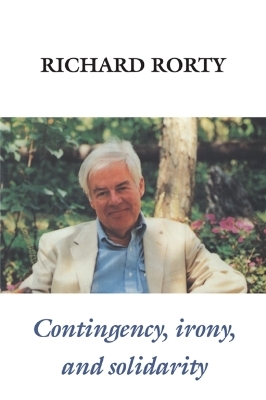
Contingency, Irony, and Solidarity
Seiten
1989
Cambridge University Press (Verlag)
9780521367813 (ISBN)
Cambridge University Press (Verlag)
9780521367813 (ISBN)
To understand what liberalism and human solidarity mean in terms of the human contingency and condition, Rorty examines literature, philosophy, social theory and literary criticism. This 1989 book confirms Rorty's status as a uniquely subtle theorist, whose writing will prove absorbing to academic and nonacademic readers alike.
In this 1989 book Rorty argues that thinkers such as Nietzsche, Freud, and Wittgenstein have enabled societies to see themselves as historical contingencies, rather than as expressions of underlying, ahistorical human nature or as realizations of suprahistorical goals. This ironic perspective on the human condition is valuable on a private level, although it cannot advance the social or political goals of liberalism. In fact Rorty believes that it is literature not philosophy that can do this, by promoting a genuine sense of human solidarity. A truly liberal culture, acutely aware of its own historical contingency, would fuse the private, individual freedom of the ironic, philosophical perspective with the public project of human solidarity as it is engendered through the insights and sensibilities of great writers. The book has a characteristically wide range of reference from philosophy through social theory to literary criticism. It confirms Rorty's status as a uniquely subtle theorist, whose writing will prove absorbing to academic and nonacademic readers alike.
In this 1989 book Rorty argues that thinkers such as Nietzsche, Freud, and Wittgenstein have enabled societies to see themselves as historical contingencies, rather than as expressions of underlying, ahistorical human nature or as realizations of suprahistorical goals. This ironic perspective on the human condition is valuable on a private level, although it cannot advance the social or political goals of liberalism. In fact Rorty believes that it is literature not philosophy that can do this, by promoting a genuine sense of human solidarity. A truly liberal culture, acutely aware of its own historical contingency, would fuse the private, individual freedom of the ironic, philosophical perspective with the public project of human solidarity as it is engendered through the insights and sensibilities of great writers. The book has a characteristically wide range of reference from philosophy through social theory to literary criticism. It confirms Rorty's status as a uniquely subtle theorist, whose writing will prove absorbing to academic and nonacademic readers alike.
Preface; Introduction; Part I. Contingency: 1. The contingency of language; 2. The contingency of selfhood; 3. The contingency of a liberal community; Part II. Ironism and Theory: 4. Private irony and liberal hope; 5. Self-creation and affiliation: Proust, Nietzsche, and Heidegger; 6. From ironist theory to private allusions: Derrida; Part III. Cruelty and Solidarity: 7. The barber of Kasbeam: Nabokov on cruelty; 8. The last intellectual in Europe: Orwell on cruelty; 9. Solidarity; Index of names.
| Erscheint lt. Verlag | 24.2.1989 |
|---|---|
| Zusatzinfo | Worked examples or Exercises |
| Verlagsort | Cambridge |
| Sprache | englisch |
| Maße | 150 x 229 mm |
| Gewicht | 340 g |
| Themenwelt | Geisteswissenschaften ► Philosophie |
| ISBN-13 | 9780521367813 / 9780521367813 |
| Zustand | Neuware |
| Informationen gemäß Produktsicherheitsverordnung (GPSR) | |
| Haben Sie eine Frage zum Produkt? |
Mehr entdecken
aus dem Bereich


aus dem Bereich
wie Tiere den Tod verstehen
Buch | Hardcover (2025)
Insel Verlag
CHF 42,90
eine Ethik des Verzichts
Buch | Softcover (2025)
Reclam (Verlag)
CHF 9,80


