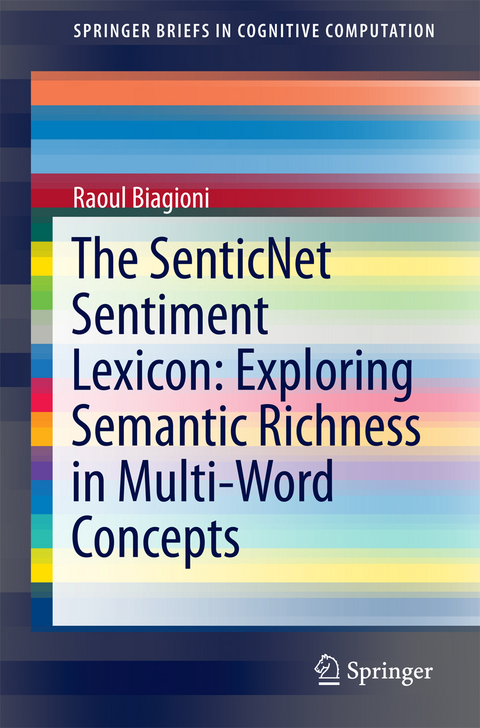
The SenticNet Sentiment Lexicon: Exploring Semantic Richness in Multi-Word Concepts (eBook)
55 Seiten
Springer International Publishing (Verlag)
978-3-319-38971-4 (ISBN)
In 6 chapters the book sheds light on the comparison of sentiment classification accuracy between single-word and multi-word concepts, for which a bespoke sentiment analysis system developed by the author was used.
This book will be of interest to students, educators and researchers in the field of Sentic Computing.
1. Introduction 1.1 Sentiment in Opinionated Text 1.2 Background 1.3 Research Problem2. Sentiment Analysis 2.1 Sentiment Analysis Challenges 2.2 Levels of Analysis 2.3 Supervised vs. Unsupervised Sentiment Analysis 2.4 Linguistics-based Sentiment Analysis 2.5 Lexicon-based Sentiment Analysis 2.6 Conclusion3. SenticNet 3.1 The Common Sense Nature of SenticNet Knowledge 3.2 A Seminal Approach to Concept-based Sentiment Analysis 3.3 Producing SenticNet 3.4 SenticNet Processes 3.5 SenticNet Knowledge: Encoding 3.6 SenticNet Access Methods 3.7 SenticNet in Numbers3.7.1 Concept Types: Number of Words 3.7.2 Analysis of Polarity Values: Single-Word vs. Multi-Word Concepts 3.8 Conclusion 4. Unsupervised Sentiment Classification 4.1 Datasets 4.2 Classification Design and Implementation 4.2.1 Overview 4.2.2 Sentiment Classification Process 4.2.3 Polarity Value Thresholds 4.2.4 Implementation 4.3 Conclusion5. Evaluation 5.1 Classification Performance 5.1.1 Research Question 5.1.2 Qualitative Differences Between the Datasets 5.1.3 SenticNet 5.1.4 Sentiment Analysis System 5.1.5 Sentiment Classification Design 5.2 Limitations 5.3 Conclusions6. Conclusion 6.1 Future Work 6.2 Final Remarks Index
| Erscheint lt. Verlag | 28.5.2016 |
|---|---|
| Reihe/Serie | SpringerBriefs in Cognitive Computation | SpringerBriefs in Cognitive Computation |
| Zusatzinfo | VI, 55 p. 13 illus., 8 illus. in color. |
| Verlagsort | Cham |
| Sprache | englisch |
| Themenwelt | Geisteswissenschaften ► Sprach- / Literaturwissenschaft ► Literaturwissenschaft |
| Mathematik / Informatik ► Informatik | |
| Medizin / Pharmazie ► Studium | |
| Technik | |
| Schlagworte | Concepts • Polarity • semantic richness • sentiment analysis • sentiment lexicon |
| ISBN-10 | 3-319-38971-8 / 3319389718 |
| ISBN-13 | 978-3-319-38971-4 / 9783319389714 |
| Informationen gemäß Produktsicherheitsverordnung (GPSR) | |
| Haben Sie eine Frage zum Produkt? |
 PDF (Wasserzeichen)
DRM: Digitales Wasserzeichen
Dieses eBook enthält ein digitales Wasserzeichen und ist damit für Sie personalisiert. Bei einer missbräuchlichen Weitergabe des eBooks an Dritte ist eine Rückverfolgung an die Quelle möglich.
Dateiformat: PDF (Portable Document Format)
Mit einem festen Seitenlayout eignet sich die PDF besonders für Fachbücher mit Spalten, Tabellen und Abbildungen. Eine PDF kann auf fast allen Geräten angezeigt werden, ist aber für kleine Displays (Smartphone, eReader) nur eingeschränkt geeignet.
Systemvoraussetzungen:
PC/Mac: Mit einem PC oder Mac können Sie dieses eBook lesen. Sie benötigen dafür einen PDF-Viewer - z.B. den Adobe Reader oder Adobe Digital Editions.
eReader: Dieses eBook kann mit (fast) allen eBook-Readern gelesen werden. Mit dem amazon-Kindle ist es aber nicht kompatibel.
Smartphone/Tablet: Egal ob Apple oder Android, dieses eBook können Sie lesen. Sie benötigen dafür einen PDF-Viewer - z.B. die kostenlose Adobe Digital Editions-App.
Buying eBooks from abroad
For tax law reasons we can sell eBooks just within Germany and Switzerland. Regrettably we cannot fulfill eBook-orders from other countries.
aus dem Bereich