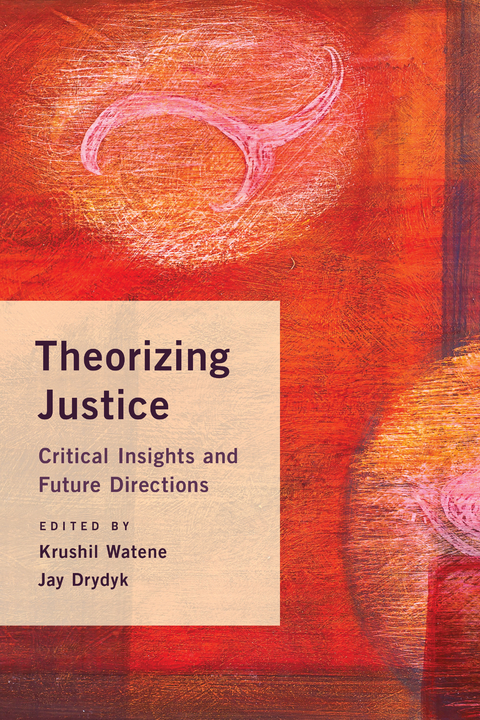
Theorizing Justice (eBook)
224 Seiten
Rowman & Littlefield International (Verlag)
978-1-78348-406-5 (ISBN)
One of the most important contributions to contemporary political philosophy, Rawls's A Theory of Justice, re-ignited political philosophy and revolutionized how we theorize about justice. Rawls's approach to justice advanced political philosophy in important and valuable ways - most significantly in the way that it showed that political philosophy remained relevant for our lives and our world.Unsurprisingly, over forty years later, social and global realities present theories of justice with new challenges. This volume examines what these new challenges are, and whether contemporary theories are in a position to respond to them. The collection brings together essays that push the boundaries of justice theorizing in new directions, and that begin to construct a new paradigm. The collection contributes to the creation of a platform from which new ideas and new conversations, about the challenges and opportunities for justice in our world, can be further explored and developed.
lt;span>Krushil Watene is Lecturer in Philosophy at Massey University, New Zealand. She is of Ngāti Manu, Te Hikutu, Ngāti Whātua Ōrākei, and Tongan descent.
Jay Drydyk is Professor of Philosophy at Carleton University, a former President of the International Development Ethics Association, and a Fellow of the Human Development and Capability Association. He is the co-author of Displacement by Development (CUP, 2011).
Contributors:
Tim Mulgan, Professor of Philosophy, University of Auckland, New Zealand, and University of St Andrews, UK; Colleen Murphy, Associate Professor of Philosophy, University of Illinois at Urbana-Champaign, USA; Amartya Sen, Thomas W. Lamont University Professor, and Professor of Economics and Philosophy, Harvard University, USA; Mozaffar Qizilbash, Professor of Economics and Philosophy, University of York, UK; Jay Drydyk, Professor of Philosophy, Carleton University, Canada; Thom Brooks, Professor of Law and Government, University of Durham, UK; Krushil Watene, Lecturer in Philosophy, Massey University, New Zealand; Rutger Claassen, Associate Professor of Ethics and Political Philosophy, University of Utrecht, Netherlands; Stacy J. Kosko Assistant Director MIDCM, University of Maryland, USA
Acknowledgements / Preface, Jay Drydyk / Introduction, Krushil Watene / Part I: Critical Insights / 1. Theorizing about Justice for a Broken World, Tim Mulgan / 2. Transitional Justice: A Conceptual Map, Colleen Murphy / 3. What do we want from a Theory of Justice?, Amartya Sen / 4. Utilitarianism and Some of Its Critics: On Some Alternative ‘Incomplete’ Theories of, and Approaches to, Morality and Justice, Mozaffar Qizilbash / Part II: Future Directions / 5. Justice as a Virtue: What can we Expect of our Allies?, Jay Drydyk / 6. Justice as Stakeholding, Thom Brooks / 7. Indigenous Peoples and Justice, Krushil Watene / 8. Justice in Regulation: Towards a Liberal Account, Rutger Claassen / 9. The Recognition Gap: Why Labels Matter in Human Rights Protection, Stacy Kosko / Notes on Contributors / Index
| Erscheint lt. Verlag | 11.7.2016 |
|---|---|
| Zusatzinfo | 1 Illustrations including: - 1 Tables. |
| Verlagsort | London |
| Sprache | englisch |
| Themenwelt | Geisteswissenschaften ► Philosophie ► Allgemeines / Lexika |
| Geisteswissenschaften ► Philosophie ► Ethik | |
| Schlagworte | Applied Philosophy • Ethics and moral philosophy • Global Justice • political theory • Social and political philosophy |
| ISBN-10 | 1-78348-406-3 / 1783484063 |
| ISBN-13 | 978-1-78348-406-5 / 9781783484065 |
| Informationen gemäß Produktsicherheitsverordnung (GPSR) | |
| Haben Sie eine Frage zum Produkt? |
 EPUB (Adobe DRM)
Kopierschutz: Adobe-DRM
Adobe-DRM ist ein Kopierschutz, der das eBook vor Mißbrauch schützen soll. Dabei wird das eBook bereits beim Download auf Ihre persönliche Adobe-ID autorisiert. Lesen können Sie das eBook dann nur auf den Geräten, welche ebenfalls auf Ihre Adobe-ID registriert sind.
Details zum Adobe-DRM
Dateiformat: EPUB (Electronic Publication)
EPUB ist ein offener Standard für eBooks und eignet sich besonders zur Darstellung von Belletristik und Sachbüchern. Der Fließtext wird dynamisch an die Display- und Schriftgröße angepasst. Auch für mobile Lesegeräte ist EPUB daher gut geeignet.
Systemvoraussetzungen:
PC/Mac: Mit einem PC oder Mac können Sie dieses eBook lesen. Sie benötigen eine
eReader: Dieses eBook kann mit (fast) allen eBook-Readern gelesen werden. Mit dem amazon-Kindle ist es aber nicht kompatibel.
Smartphone/Tablet: Egal ob Apple oder Android, dieses eBook können Sie lesen. Sie benötigen eine
Geräteliste und zusätzliche Hinweise
Buying eBooks from abroad
For tax law reasons we can sell eBooks just within Germany and Switzerland. Regrettably we cannot fulfill eBook-orders from other countries.
aus dem Bereich