


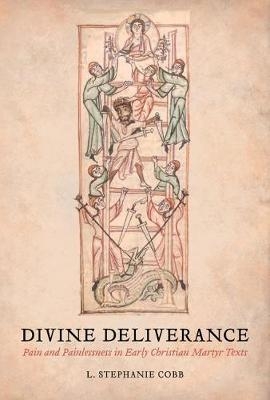
Divine Deliverance
Pain and Painlessness in Early Christian Martyr Texts
Seiten
2016
University of California Press (Verlag)
978-0-520-29335-9 (ISBN)
University of California Press (Verlag)
978-0-520-29335-9 (ISBN)
- Lieferbar (Termin unbekannt)
- Versandkostenfrei
- Auch auf Rechnung
- Artikel merken
Does martyrdom hurt? The obvious answer to this question is "yes." In this book, the author examines the original martyr texts of the second through fifth centuries, concluding that these narratives in fact seek to demonstrate the Christian martyrs' imperviousness to pain.
Does martyrdom hurt? The obvious answer to this question is "yes." L. Stephanie Cobb, asserts, however, that early Christian martyr texts respond to this question with an emphatic "no!" Divine Deliverance examines the original martyr texts of the second through fifth centuries, concluding that these narratives in fact seek to demonstrate the Christian martyrs' imperviousness to pain. For these martyrs, God was present with, and within, the martyrs, delivering them from pain. These martyrs' claims not to feel pain define and redefine Christianity in the ancient world: whereas Christians did not deny the reality of their subjection to state violence, they argued that they were not ultimately vulnerable to its painful effects.
Does martyrdom hurt? The obvious answer to this question is "yes." L. Stephanie Cobb, asserts, however, that early Christian martyr texts respond to this question with an emphatic "no!" Divine Deliverance examines the original martyr texts of the second through fifth centuries, concluding that these narratives in fact seek to demonstrate the Christian martyrs' imperviousness to pain. For these martyrs, God was present with, and within, the martyrs, delivering them from pain. These martyrs' claims not to feel pain define and redefine Christianity in the ancient world: whereas Christians did not deny the reality of their subjection to state violence, they argued that they were not ultimately vulnerable to its painful effects.
L. Stephanie Cobb is the George and Sallie Cutchin Camp Professor of Bible in the Department of Religious Studies at the University of Richmond. She is also author of Dying to Be Men: Gender and Language in Early Christian Martyr Texts.
Preface Acknowledgments Abbreviations Introduction 1. Bodies in Pain: Ancient and Modern Horizons of Expectation 2. Text and Audience: Activating and Obstructing Expectations 3. Divine Analgesia: Painlessness in a Pain-Filled World 4. Whose Pain? Pain as a Locus of Meaning in Christian Martyr Texts 5. Narratives and Counternarratives: Discourse and Early Christian Martyr Texts Conclusion Notes Bibliography Index
| Erscheinungsdatum | 26.01.2017 |
|---|---|
| Verlagsort | Berkerley |
| Sprache | englisch |
| Maße | 152 x 229 mm |
| Gewicht | 544 g |
| Themenwelt | Geschichte ► Allgemeine Geschichte ► Vor- und Frühgeschichte |
| Geschichte ► Allgemeine Geschichte ► Altertum / Antike | |
| Geschichte ► Teilgebiete der Geschichte ► Religionsgeschichte | |
| Religion / Theologie ► Christentum ► Kirchengeschichte | |
| ISBN-10 | 0-520-29335-5 / 0520293355 |
| ISBN-13 | 978-0-520-29335-9 / 9780520293359 |
| Zustand | Neuware |
| Informationen gemäß Produktsicherheitsverordnung (GPSR) | |
| Haben Sie eine Frage zum Produkt? |
Mehr entdecken
aus dem Bereich

aus dem Bereich
Konzepte – Methoden – Theorien
Buch | Softcover (2024)
UTB (Verlag)
CHF 55,85
auf den Spuren der frühen Zivilisationen
Buch | Hardcover (2023)
C.H.Beck (Verlag)
CHF 27,95


