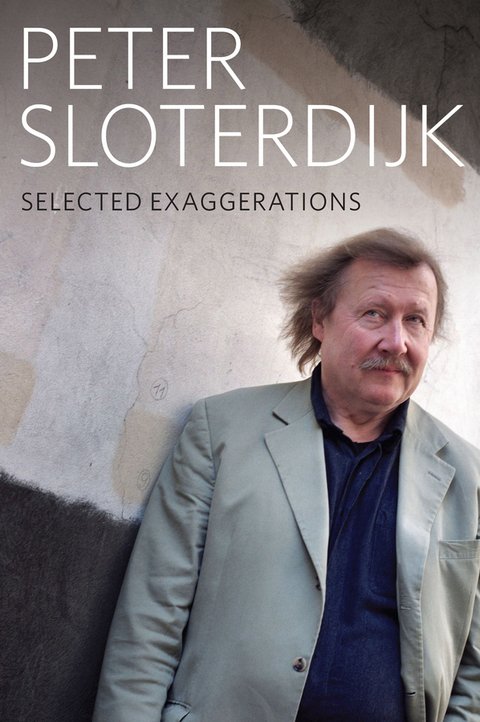
Selected Exaggerations (eBook)
John Wiley & Sons (Verlag)
978-0-7456-9169-5 (ISBN)
Peter Sloterdijk's reputation as one of the most original thinkers of our time has grown steadily since the early 1980s. This volume of over thirty conversations and interviews spanning two decades illuminates the multiple interconnections of his life and work.
In these wide-ranging dialogues Sloterdijk gives his views on a variety of topics, from doping to doxa, design to dogma, media to mobility and the financial crisis to football. Here we encounter Sloterdijk from every angle: as he expounds his ideas on the philosophical tradition and the latest strands of contemporary thought, as he analyses the problems of our age and as he provides a new and startling perspective on everyday events. Through exaggeration, Sloterdijk draws our attention to crucial issues and controversies and makes us aware of their implications for society and the individual. Always eager to share his knowledge and erudition, he reveals himself equally at home in ancient Babylon, in the channels of the mass media and on the ethical and moral terrain of religion, education or genetic engineering.
Appealing both to the seasoned reader of Sloterdijk and to the curious newcomer, these dialogues offer fresh insight into the intellectual and political events of recent decades. They also give us glimpses of Sloterdijk's own life story, from his early passionate love of reading and writing to his journeys in East and West, his commitment to Europe and his acceptance and enjoyment of the role of a public intellectual and philosopher in the twenty-first century.
Peter Sloterdijk is Professor of Philosophy and Aesthetics at the Karlsruhe School of Design and the author of many works, including You Must Change Your Life.
Peter Sloterdijk s reputation as one of the most original thinkers of our time has grown steadily since the early 1980s. This volume of over thirty conversations and interviews spanning two decades illuminates the multiple interconnections of his life and work. In these wide-ranging dialogues Sloterdijk gives his views on a variety of topics, from doping to doxa, design to dogma, media to mobility and the financial crisis to football. Here we encounter Sloterdijk from every angle: as he expounds his ideas on the philosophical tradition and the latest strands of contemporary thought, as he analyses the problems of our age and as he provides a new and startling perspective on everyday events. Through exaggeration, Sloterdijk draws our attention to crucial issues and controversies and makes us aware of their implications for society and the individual. Always eager to share his knowledge and erudition, he reveals himself equally at home in ancient Babylon, in the channels of the mass media and on the ethical and moral terrain of religion, education or genetic engineering. Appealing both to the seasoned reader of Sloterdijk and to the curious newcomer, these dialogues offer fresh insight into the intellectual and political events of recent decades. They also give us glimpses of Sloterdijk s own life story, from his early passionate love of reading and writing to his journeys in East and West, his commitment to Europe and his acceptance and enjoyment of the role of a public intellectual and philosopher in the twenty-first century.
Peter Sloterdijk is Professor of Philosophy and Aesthetics at the Karlsruhe School of Design and the author of many works, including You Must Change Your Life.
1. In Place of a Preface
2. The Half-Moon Man
3. Why are People Media?
4. World Estrangement and Diagnosis of our Times
5. Uterus on Wheels
6. Fire your Shrink!
7. Philosophical Retuning
8. We're Always Riding Down Maternity Drive
9. Tackling the Unspoken Things in Culture
10. On Wealth and Self-Respect
11. Learning Is Joyful Anticipation of Oneself
12. Postmen and Fallen Towers
13. Raising our Heads: Pampering Spaces and Time Drifts
14. Good Theory Doesn't Complain
15. There Are No Individuals
16. Confused People Spread Confusion
17. Germans Want to Be Compelled: Theory for the Year's End
18. Comparatists of Happiness
19. Image and Perspective. An Experiment in Atmospheric Seeing
20. On Progress. The Holy Fire of Dissatisfaction
21. A Team of Hermaphrodites
22. Under a Brighter Sky
23. Making the Effort: The Reader
24. Thus Spoke Sloterdijk
25. Fathers Should Be Kept Away from Brothels and Pubs
26. The Athletics of Dying
27. Do Your Duty to Enjoy!
28. Even a God Can't Save Us
29. A Plug for Higher Energies
30. Mortgaging the Air: The Financial Crisis
31. Is There a Way Out of the Crisis of Western Culture?
32. Questions of Fate: A Novel About Thought
33. Humans in Repetition / The 21st Century will be Acrobatic
34. With the Babble of Babylon in the Background
Editorial Note
Appendix
'Selected Exaggerations presents a blow-by-blow chronicle of an intellectual journey, one of the most remarkable of our time. In it, we follow Sloterdijk as he comments on his work in progress and current affairs over a twenty-year period. Often mischievous, sometimes maddening, always thought-provoking, Sloterdijk is a force to be reckoned with. With this publication, the English-speaking world finally has a one-volume introduction to this extraordinary thinker.?
Brian Massumi, University of Montreal
IN PLACE OF A PREFACE1
Bernhard Klein in conversation with Peter Sloterdijk
Karlsruhe, 17 December 2012
KLEIN: Mr Sloterdijk, after extensive research I have compiled a selection of your interviews over the past two decades, a very compact selection from an enormous wealth of material, but still a weighty volume. I am aware that interviews are only a small part of your publishing activity – the phrase ‘tip of the iceberg’ is very apt here. You have more than forty books to your name, and have also written a large number of essays for a wide range of newspapers, periodicals and anthologies. You have held professorships in Karlsruhe and Vienna for the past twenty years, and you only resigned from the position in Austria quite recently. Aside from this you have had a full timetable as a speaker at all kinds of events, and you have participated in numerous conferences, conventions and symposia. You have given readings from your latest books, and held seminars, ceremonial addresses and after-dinner speeches. You have done interviews in many media and for over ten years you moderated your own TV programme.
According to the general wisdom, ‘less is more’. Why, in your case, is more more? Does your almost frantic creative energy express something of the powerlessness every writer feels when faced with the silence of the library?
SLOTERDIJK: I think the real answer to the question of the main impetus for my work is connected more to an inner state rather than an actual motive. Looking back over the years these interviews cover, my first impression of myself is defencelessness, or the ability to be enticed. The cliché of the born writer’s endogenous, ebullient productivity certainly doesn’t apply to me, and nor does the model of committed literature. What people see as productivity in my case is usually only my inability to defend myself against suggestions from other people. It starts from a degree of over-compliance. This is ultimately responsible for the constant transition from passivity to production. But this state would not be sustainable without some cockiness. If I took on an additional task, it meant I was prepared to say I could manage that. In the process I sometimes got exhausted, of course, but that was superseded by an incredibly reckless trust in my powers of regeneration. That, incidentally, is the only difference worth mentioning between my earlier life and the present: for a while now, I have noticed that regeneration demands its own time.
KLEIN: Take us into your creative workshop. Can you describe your working technique and explain how you organize your library? How do you remember things?
SLOTERDIJK: Nobody can really know how his memory works. I only know I must have a well-organized internal archive even if it might seem chaotic to other people. My inner archivist finds access to the important files fairly regularly. He is one collaborator who has never disappointed me. He fortuitously retrieves documents I didn’t even know had been filed ready for reference. Sometimes he unwittingly discovers nearly finished pieces of writing that I only have to copy up.
KLEIN: To what extent does your relation to language enhance your zest for writing and publishing?
SLOTERDIJK: Language is generally seen as a medium for understanding – an assumption that writers shouldn’t accept unquestioningly. A critical minority sees language as the starting point of all misunderstandings. Wittgenstein even thought that philosophical problems arose when language goes on holiday – although he didn’t reveal to us what he meant by ‘going on holiday’. Does it mean being nonsensical? Or poring over pseudo-problems, firing excessive volleys into the air? Anyway, he toyed with the idea that one could just as well do without language; the deflationary tendency is clearly evident. Reading that, I can imagine a wrinkled janitor entering the scene who wants to put an end to the silliness of youth. Statements like that seem narrow to me. You really don’t know what might happen if you get involved in going on holiday. I prefer the opinion of Wittgenstein’s fellow Austrian, Egon Friedell, who said: ‘Culture is a wealth of problems.’ We can try to economise on everything, but not on problems.
KLEIN: So far I have managed to trace around 300 of your interviews in various newspaper archives and on the Internet. Staying with the iceberg image, if we present over thirty selected pieces in this book, this is indeed only the part of the iceberg visible above water. What role do the interviews play in your work as a writer and media personality? Are they there to promote the ‘management of your own name’, as you yourself once expressed it?
SLOTERDIJK: You know, some highly reputable authors never gave interviews, and some did so only rarely. But there are others who accept interview proposals easily. I count myself among the latter. It involves brand-name management, and that is an offshoot one accepts. With most interviews the reader will notice that even if I thought about that aspect beforehand, I forgot it after a minute at most. The interview is one form of literary production among others, and I see it as a subgenus of the essay. I have practised it frequently since the time I overcame my reluctance and accepted the role of public intellectual that ensued from my first publications. As you can see, I enjoy formulating things and making propositions, and once I am immersed in the flow of speech I stop worrying about the effect. My worries only become acute in the reworking phase. I’m sensitive about failed expressions.
KLEIN: True, your interviews are not one-to-one live publications. You always check them over.
SLOTERDIJK: Let’s say they are a mixed form composed of improvisation and edited work. In some cases the editing is limited to just one or two slight touches, but others involve a completely new version.
KLEIN: Over the years, the young, shy Sloterdijk we see in old videotapes has become a star. To me he is like a colossus of expressive force, verbally and in writing. This creative energy, it seems to me, can’t be explained by normal standards. It is still a mystery how you have managed this.
SLOTERDIJK: I admit that I have felt many things blowing through me. Now and then I enjoy the powerful cross-draughts, but by no means always. My basic feeling, as I have said, is not of excessive productivity but of receptiveness to evidence from all directions, what I just called defencelessness. In the early stage I usually like the things I am doing, but I quickly lose sight of them. It might sound odd, but if a major work is in the making I only have brief feelings of achievement, and they only happen rarely. I am incapable of developing such emotions, or of holding on to them. I am always faced with the blank sheet of paper that shows I haven’t done anything yet. So I put out my feelers and start from scratch. It may sound absurd, but I usually suspect myself of not doing enough. This probably shows I am lacking in hindsight intelligence. As I don’t see my past, I have no choice but to keep moving. Maybe that would be the next lesson: slowing down and returning to the moment. But I’m still wary of such suggestions and dismiss them scornfully as ideas for retired folk.
KLEIN: I have heard you shared a communal apartment when you were younger. How did you manage to be creative in the midst of the chaos? Many people would say in that kind of environment they could never put anything down on paper.
SLOTERDIJK: I didn’t actually live in that apartment in Munich but I visited it every day. What I noticed about myself then was the ability not to let anything put me off course. I always had intense relationships, I had close ties to women and male friends, and we went out a lot and travelled frequently. For the past twenty years the family has been my main form of life, and that’s not pure solitude either. I can well remember the time when a boisterous toddler ran around my study. It was entertaining for me – I couldn’t be disturbed. Today I find it odd that I get irritated more easily. In the past the telephone didn’t disturb me, nor did workmen or Jehovah’s Witnesses. I saw everything as inspiration, not interruption. A miraculous superstition was at work: whatever happened would immediately be transformed into part of the production. In that middle phase I seemed to be living in a protective shell; I was sure of my own topics, or the topics were sure of me. Nothing could distract me.
KLEIN: When you say ‘defencelessness’, it suggests being tired and giving up. Evidently you have constantly used the creativity of writing to banish this eventuality.
SLOTERDIJK: Old working animals know that even tiredness can become a motive force if it activates regeneration. Once you have really rested, let’s say for a whole day, it feels as if you have gained the energy for three new lives. In the past I used to emphasize the difference between regeneration and a vacation. I saw the latter as illegitimate and thought it had no reason to exist. To put it arrogantly, I used to think you only need a vacation from the wrong life. Today I have changed my mind. Gradually I am coming round to admitting that vacations are justified.
KLEIN: Let me return to your interviews again. At the moment, Suhrkamp Verlag, which has been your publishing house since your first book thirty years ago, is in the...
| Erscheint lt. Verlag | 7.6.2016 |
|---|---|
| Sprache | englisch |
| Themenwelt | Geisteswissenschaften ► Philosophie ► Allgemeines / Lexika |
| Geisteswissenschaften ► Philosophie ► Geschichte der Philosophie | |
| Geisteswissenschaften ► Philosophie ► Philosophie der Neuzeit | |
| Schlagworte | Aesthetics • Ästhetik • Ãsthetik • Dialogues • interviews</p> • <p>Sloterdijk • Philosophie • Philosophy • Religion • Religion & Culture • Religion & Theology • Religion u. Kultur • Religion u. Theologie • Social Philosophy • Sozialphilosophie |
| ISBN-10 | 0-7456-9169-2 / 0745691692 |
| ISBN-13 | 978-0-7456-9169-5 / 9780745691695 |
| Informationen gemäß Produktsicherheitsverordnung (GPSR) | |
| Haben Sie eine Frage zum Produkt? |
 EPUB (Adobe DRM)
Kopierschutz: Adobe-DRM
Adobe-DRM ist ein Kopierschutz, der das eBook vor Mißbrauch schützen soll. Dabei wird das eBook bereits beim Download auf Ihre persönliche Adobe-ID autorisiert. Lesen können Sie das eBook dann nur auf den Geräten, welche ebenfalls auf Ihre Adobe-ID registriert sind.
Details zum Adobe-DRM
Dateiformat: EPUB (Electronic Publication)
EPUB ist ein offener Standard für eBooks und eignet sich besonders zur Darstellung von Belletristik und Sachbüchern. Der Fließtext wird dynamisch an die Display- und Schriftgröße angepasst. Auch für mobile Lesegeräte ist EPUB daher gut geeignet.
Systemvoraussetzungen:
PC/Mac: Mit einem PC oder Mac können Sie dieses eBook lesen. Sie benötigen eine
eReader: Dieses eBook kann mit (fast) allen eBook-Readern gelesen werden. Mit dem amazon-Kindle ist es aber nicht kompatibel.
Smartphone/Tablet: Egal ob Apple oder Android, dieses eBook können Sie lesen. Sie benötigen eine
Geräteliste und zusätzliche Hinweise
Buying eBooks from abroad
For tax law reasons we can sell eBooks just within Germany and Switzerland. Regrettably we cannot fulfill eBook-orders from other countries.
aus dem Bereich