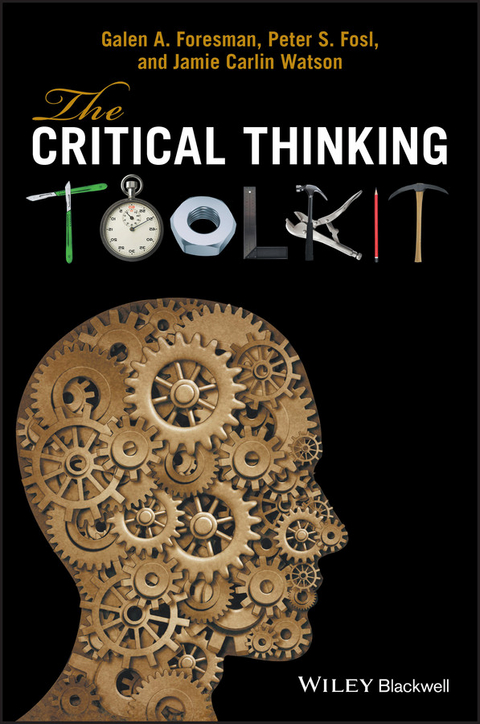
The Critical Thinking Toolkit (eBook)
John Wiley & Sons (Verlag)
978-1-118-98199-3 (ISBN)

The Critical Thinking Toolkit is a comprehensive compendium that equips readers with the essential knowledge and methods for clear, analytical, logical thinking and critique in a range of scholarly contexts and everyday situations.
- Takes an expansive approach to critical thinking by exploring concepts from other disciplines, including evidence and justification from philosophy, cognitive biases and errors from psychology, race and gender from sociology and political science, and tropes and symbols from rhetoric
- Follows the proven format of The Philosopher's Toolkit and The Ethics Toolkit with concise, easily digestible entries, 'see also' recommendations that connect topics, and recommended reading lists
- Allows readers to apply new critical thinking and reasoning skills with exercises and real life examples at the end of each chapter
- Written in an accessible way, it leads readers through terrain too often cluttered with jargon
- Ideal for beginning to advanced students, as well as general readers, looking for a sophisticated yet accessible introduction to critical thinking
Galen Foresman is Associate Professor of Philosophy at North Carolina Agricultural and Technical State University, USA. His research interests include ethics, philosophy of punishment, philosophy of religion, and philosophy as it applies to pop culture. He is the author of several book chapters and the editor of Supernatural and Philosophy (Wiley Blackwell, 2013).
Peter S. Fosl is Professor and Chair of Philosophy and Chair of Philosophy, Politics, and Economics at Transylvania University, USA. A David Hume Fellow at the University of Edinburgh, his research interests include skepticism and the history of philosophy, as well as topics in politics and religion. He is author or editor of many books, including The Big Lebowski and Philosophy (Wiley Blackwell, 2012), The Philosopher's Toolkit, 2nd ed. (Wiley Blackwell, 2010), and The Ethics Toolkit (Wiley Blackwell, 2007). He is also Editor-in-Chief of the Open Access academic journal Cogent OA: Arts & Humanities.
Jamie Carlin Watson is Assistant Professor of Philosophy at Broward College, USA. His primary research is in the social epistemology of epistemic advantage and expertise, especially as they influence testimony in practical fields such as medicine and business. He has published articles in journals such as Episteme and Journal of Applied Philosophy, and is the co-author of Critical Thinking: An Introduction to Reasoning Well, 2nd ed. (2015), What's Good on TV? Understanding Ethics through Television (Wiley Blackwell, 2011), and Philosophy Demystified (2011).
Galen Foresman is Associate Professor of Philosophy at North Carolina Agricultural and Technical State University, USA. His research interests include ethics, philosophy of punishment, philosophy of religion, and philosophy as it applies to pop culture. He is the author of several book chapters and the editor of Supernatural and Philosophy (Wiley Blackwell, 2013). Peter S. Fosl is Professor and Chair of Philosophy and Chair of Philosophy, Politics, and Economics at Transylvania University, USA. A David Hume Fellow at the University of Edinburgh, his research interests include skepticism and the history of philosophy, as well as topics in politics and religion. He is author or editor of many books, including The Big Lebowski and Philosophy (Wiley Blackwell, 2012), The Philosopher's Toolkit, 2nd ed. (Wiley Blackwell, 2010), and The Ethics Toolkit (Wiley Blackwell, 2007). He is also Editor-in-Chief of the Open Access academic journal Cogent OA: Arts & Humanities. Jamie Carlin Watson is Assistant Professor of Philosophy at Broward College, USA. His primary research is in the social epistemology of epistemic advantage and expertise, especially as they influence testimony in practical fields such as medicine and business. He has published articles in journals such as Episteme and Journal of Applied Philosophy, and is the co-author of Critical Thinking: An Introduction to Reasoning Well, 2nd ed. (2015), What's Good on TV? Understanding Ethics through Television (Wiley Blackwell, 2011), and Philosophy Demystified (2011).
Acknowledgments xv
Introduction 1
The Very Idea of Critical Thinking 1
Critical thinking in the formal and empirical sciences 2
Critical thinking, critical theory, and critical politics 4
Critical thinking, finitude, and self-understanding 5
Using this book 5
1 Basic Tools for Critical Thinking about Arguments 7
1.1 Claims 7
1.2 Arguments 11
1.3 Premises 13
1.4 Conclusions 16
2 More Tools for Critical Thinking about Arguments 19
2.1 Deductive and Inductive Arguments 19
2.2 Conditional Claims 22
2.3 Classifying and Comparing Claims 26
2.4 Claims and Definitions 29
2.5 The Critical Thinker's "Two Step": Validity and Soundness/Cogency and Strength 32
2.6 Showing Invalidity by Counterexample 35
3 Tools for Deductive Reasoning with Categories 39
3.1 Thinking Categorically 39
3.2 Categorical Logic 40
3.3 Translating English Claims to Standard Form 46
3.4 Formal Deduction with Categories: Immediate Inferences 50
3.5 Formal Deduction with Categories: Syllogisms 63
4 Tools for Deductive Reasoning with Claims 72
4.1 Propositional vs. Categorical Logics 72
4.2 Common Deductively Valid Forms 83
4.3 Equivalences 90
4.4 Formal Deduction with Forms and Equivalences 96
4.5 Common Formal Fallacies 101
5 Tools for Detecting Informal Fallacies 107
5.1 Critical Thinking, Critical Deceiving, and the "Two Step" 107
5.2 Subjectivist Fallacy 109
5.3 Genetic Fallacies 112
5.4 Ad Hominem Fallacies: Direct, Circumstantial, and Tu Quoque 113
5.5 Appeal to Emotions or Appeal to the Heart (argumentum ad passiones) 120
5.6 Appeal to Force (argumentum ad baculum) 124
5.7 Appeal to Ignorance (argumentum ad ignorantiam) 125
5.8 Appeal to Novelty (argumentum ad novitatem) 127
5.9 Appeal to the People (argumentum ad populum) 128
5.10 Appeal to Unqualified Authority (argumentum ad verecundiam) 132
5.11 Fallacy of Accident 135
5.12 False Dilemma 137
5.13 Semantic and Syntactic Fallacies 138
5.14 Begging the Question (petitio principii) 143
5.15 Question-Begging Sentences 144
5.16 Missing the Point (ignoratio elenchi) 145
5.17 Fallacy of Composition 146
5.18 Fallacy of Division 148
5.19 Is-Ought Fallacy 149
5.20 Appeal to Tradition 152
5.21 Quoting Out of Context 153
5.22 Red Herring 158
5.23 Straw Man and Fidelity 159
5.24 Hasty Fallacization 161
5.25 A Brief Argument Clinic 162
6 Tools for Critical Thinking about Induction 166
6.1 Inductive vs. Deductive Arguments Again 166
6.2 Analogies and Arguments from Analogy 167
6.3 Fallacies about Causation 170
6.4 Inductive Statistical Reasoning 177
6.5 Base Rate Fallacy 182
6.6 Slippery Slope and Reductio ad Absurdum 184
6.7 Hasty Generalization 188
6.8 Mill's Five Methods 189
7 Tools for Critical Thinking about Experience and Error 195
7.1 Error Theory 195
7.2 Cognitive Errors 197
7.3 Environment and Error 206
7.4 Background and Ignorance 209
7.5 Misleading Language 210
7.6 Standpoint and Disagreement 211
8 Tools for Critical Thinking about Justification 215
8.1 Knowledge: The Basics 215
8.2 Feelings as Evidence 219
8.3 Skepticism and Sensory Experience 223
8.4 Emotions and Evidence 229
8.5 Justifying Values 237
8.6 Justification: The Basics 242
8.7 Truth and Responsible Belief 246
8.8 How Does JustificationWork? 248
8.9 A Problem for Responsible Belief 251
8.10 Evidence:Weak and Strong 256
8.11 Justification: Conclusions 266
9 Tools for Critical Thinking about Science 271
9.1 Science and the Value of Scientific Reasoning 271
9.2 The Purview of Science 273
9.3 Varieties of Possibility and Impossibility 280
9.4 Scientific Method 283
9.5 Unfalsifiability and Falsification Resistance 289
9.6 Experiments and Other Tests 293
9.7 Six Criteria for Abduction 298
9.8 Bad Science 302
10 Tools from Rhetoric, Critical Theory, and Politics 305
10.1 Meta-Narratives 305
10.2 Governing Tropes 308
10.3 The Medium Is the Message 311
10.4 Voice 313
10.5 Semiotics: Critically Reading Signs 316
10.6 Deconstruction 319
10.7 Foucault's Critique of Power 322
10.8 The Frankfurt School: Culture Critique 326
10.9 Class Critiques 328
10.10 Feminist and Gender Critiques 332
10.11 Critiques of Race and Racism 338
10.12 Traditionalist and Historicist Critiques 341
10.13 Ecological Critiques 345
Appendix: RecommendedWeb Sites 349
Index 351
Introduction
The Very Idea of Critical Thinking
Critical thinking sometimes seems as if it needs an apology, or rather it seems itself to be a kind of apology, an apology for the humanities and the liberal arts and sciences generally. Having failed to convince many people that the liberal arts are simply good in themselves or in their own terms, academics sometimes seem as though they have concocted the meretricious idea of “critical thinking” in order to help higher education sell itself to the worlds of commerce, law, and politics. Instead of arguing that the liberal arts comprise some of the very best ways to spend a human life, period (and that we ought, therefore, to support them enthusiastically and share them as widely as possible), academics seem inclined to wave the flag of critical thinking to convince governments, parents, students, and donors that the liberal arts offer something that's “useful” or “profitable” in the “real” world.
Critical thinking also seems to appeal to administrators and the administratively inclined because it poses as something testable, as composed of skills that produce “measurable outcomes” readily subject to “metrics” and “assessment.” Yielding measurable, quantifiable outcomes is important not only for demonstrating to those outside the academy the value of critical thinking and the liberal arts but also for “accountability,” for oversight, for ranking and managing, and perhaps for policing liberal arts faculties.
There is truth in all this, embarrassingly so. But it's not the whole story about critical thinking (or the liberal arts), not by a long shot. The authors of this book are convinced that the family of practices collected under the rubric of “critical thinking” does indeed include some of the best and most important activities human beings have forged and re-forged, shaped and refined over the last three millennia. It's not too much to say, in our view, that critical thinking distills some of the very best of that inheritance. In the development of our sciences, our political institutions, and our very self-understandings, critical thinking has played a central role, and it's simply fine and good to pass on that treasure to future generations. What has been true of our history remains true today: strong critical thinking is not only useful for commerce, the law, and technology, it's absolutely crucial to a dynamic and thriving culture, and it defines an essential component of any solid education.
But what is critical thinking? What composes it? In this volume, we've taken a broad, interdisciplinary, and relatively comprehensive approach to critical thinking. While many critical thinking texts focus almost exclusively on logical topics, we've also compiled critical insights and practices that have been cultivated by the natural and social sciences, notably psychology, by literature and literary criticism as well as by the fine arts, and by political and social theories. We treat literature, rhetoric, and the arts not simply as obstructions or distractions that get in the way of clear, analytical, and logical thinking — though they sometimes can do that. We recognize in addition that the visual, literary, and generally rhetorical arts possess distinctive tools to enhance and deepen critical thinking. While the critical tools developed by philosophers, logicians, mathematicians, and empirical scientists are extremely important to good critical thinking, the critical instruments honed by theorists in literary, political, and social theory have been profound. No account of the possible methods of critical thinking available today would be respectable or even roughly complete without them. Arguments are, indeed, terribly important, but they're not by any means the whole story of critical thinking. We encourage readers, therefore, to take a similarly broad, interdisciplinary, and inclusive approach and to consider the diverse ways critical thinking has been cultivated across the spectrum of reflective human thought.
Critical thinking in the formal and empirical sciences
Considering the structure of this book, we begin with logic, since logic is basic and essential to critical thinking. Chapters 1—4 of this ten-chapter volume are accordingly devoted to explaining some of the most important critical tools logicians have crafted, especially for the practices of what they call deductive reasoning. These techniques can seem a bit daunting to beginners, but because logic is so important we encourage you to press on through them. Logicians have studied the formal qualities of deductive inferences over thousands of years, and they've produced several logical systems that critical thinkers can use to test arguments. Those tests are not only indispensible tools for critical thinking. They also share the virtue of producing definite answers about good and bad reasoning using procedures that are clear, reliable, and not terribly difficult to use.
The oldest of these systems we'll address (Chapter 3) was systematized first by Aristotle in fourth-century BCE Greece. It's come to be called categorical logic since it's a logic that's based upon categories of things. We'll map out seven tests for the validity of arguments using categorical logic. Those seven by themselves will provide critical thinkers with a rich and powerful set of tools to interpret and assess vast regions of human reasoning.
Yes, humans seem to possess a natural capacity for recognizing good reasoning even without studying critical thinking in a formal way, but the systems we present are important to master because they make it possible for skilled critical thinkers to build on that natural capacity and employ proven and useful rules in expansive ways — including articulating proper explanations and definitions, determining logical equivalences, and identifying contraries and contradictions, as well as a variety of other logical relationships. We'll explain and demonstrate the use of helpful pictographic tests using Venn diagrams and Gensler stars, and after setting out some basic logical theory we'll show you how to apply a number of simple procedures for reliably identifying valid and invalid arguments almost in a snap.
The second principal kind of formal logic we'll address (Chapter 4) has come to be called propositional or sentential logic — because, yes, it's the logic of propositions or whole sentences. These sections will present you with additional ways to test arguments, especially through what logicians call truth tables, common forms of valid argument, and tried-and-true rules of inference. Truth tables are attractive to people because they offer a graphical way of testing arguments, and one that's simplicity is perhaps even more exhaustive and direct than Venn diagrams. Learning the formal structures of the most common valid as well as invalid arguments together with what we think is an essential collection of other inference rules will help you sharpen the focus of your reasoning detectors so that the success or failure of arguments becomes much more easily recognizable.
Chapter 5 sets out a substantial list of some of the most common ways people go wrong in their daily reasoning. These common informal fallacies aren't failures of the formal or structural dimensions of arguments (the stuff of Chapters 3—4), but rather failures of another kind. Sometimes what goes wrong in reasoning isn't a matter of argument form at all but instead often involves psychological factors that yield quasi-inferences that pose as good reasoning but simply aren't. Sometimes, alternatively, the problem lies with the underlying concepts and assumptions behind a claim. Those concepts and assumptions can be irrelevant, confused, or simply false, and as we'll see they can really mess up your reasoning. Good critical thinking skills of the sort described in Chapter 5 have been designed to detect them, and there are many of them. Because some informal fallacies are particularly related to scientific thinking, we'll broach additional informal fallacies across the remaining text, especially in those chapters devoted more directly to inductive reasoning and the empirical sciences.
There are sadly, then, a lot of ways that reasoning can go wrong. The modern natural and social sciences were born from a struggle to deal with many of these kinds of error while simultaneously trying both to understand the world and to answer the philosophical challenge of skepticism — the idea that knowledge itself might not be possible. As a result of those challenges, scientists and philosophers of science developed important ideas regarding what counts in terms of empirical inquiry as good explanation and solid justification. We'll therefore examine what makes scientific forms of inquiry so strong, and we'll also look at how science can go wrong. Chapters 6—9 will draw lessons in critical thinking from the natural and social sciences as well as from ongoing philosophical confrontations with skepticism. We'll examine how best to confront the epistemological challenges of skepticism, how to think well and critically about causal explanations and statistical claims, how to enlist scientific principles critically, how to think critically even about science itself, and we'll consider what science has...
| Erscheint lt. Verlag | 2.6.2016 |
|---|---|
| Sprache | englisch |
| Themenwelt | Geisteswissenschaften ► Philosophie ► Allgemeines / Lexika |
| Geisteswissenschaften ► Philosophie ► Logik | |
| Schlagworte | categorical logic • Critical theory • critical thinking • Deductive Reasoning • Einführungen in die Philosophie • Einführungen in die Philosophie • empirical science • inductive reasoning • informal fallacies • Introductions to Philosophy • Kritische Theorie • Logik • Philosophical Logic • Philosophie • Philosophische Logik • Philosophy • propositional logic • Pseudoscience • Reasoning skills • rhetoric • skepticism • syllogisms |
| ISBN-10 | 1-118-98199-5 / 1118981995 |
| ISBN-13 | 978-1-118-98199-3 / 9781118981993 |
| Informationen gemäß Produktsicherheitsverordnung (GPSR) | |
| Haben Sie eine Frage zum Produkt? |
 EPUB (Adobe DRM)
Kopierschutz: Adobe-DRM
Adobe-DRM ist ein Kopierschutz, der das eBook vor Mißbrauch schützen soll. Dabei wird das eBook bereits beim Download auf Ihre persönliche Adobe-ID autorisiert. Lesen können Sie das eBook dann nur auf den Geräten, welche ebenfalls auf Ihre Adobe-ID registriert sind.
Details zum Adobe-DRM
Dateiformat: EPUB (Electronic Publication)
EPUB ist ein offener Standard für eBooks und eignet sich besonders zur Darstellung von Belletristik und Sachbüchern. Der Fließtext wird dynamisch an die Display- und Schriftgröße angepasst. Auch für mobile Lesegeräte ist EPUB daher gut geeignet.
Systemvoraussetzungen:
PC/Mac: Mit einem PC oder Mac können Sie dieses eBook lesen. Sie benötigen eine
eReader: Dieses eBook kann mit (fast) allen eBook-Readern gelesen werden. Mit dem amazon-Kindle ist es aber nicht kompatibel.
Smartphone/Tablet: Egal ob Apple oder Android, dieses eBook können Sie lesen. Sie benötigen eine
Geräteliste und zusätzliche Hinweise
Buying eBooks from abroad
For tax law reasons we can sell eBooks just within Germany and Switzerland. Regrettably we cannot fulfill eBook-orders from other countries.
aus dem Bereich