


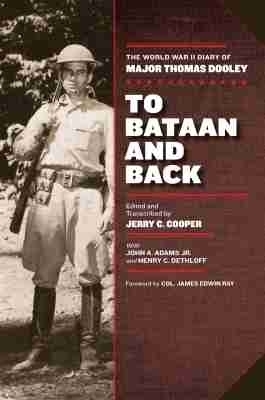
To Bataan and Back
The World War II Diary of Major Thomas Dooley
Seiten
2016
Texas A & M University Press (Verlag)
978-1-62349-433-9 (ISBN)
Texas A & M University Press (Verlag)
978-1-62349-433-9 (ISBN)
- Titel z.Zt. nicht lieferbar
- Versandkostenfrei
- Auch auf Rechnung
- Artikel merken
On the day of the Japanese attack on Pearl Harbor, Maj. Thomas Dooley began the first of six handwritten journals that he continued to update throughout the war. His journals reveal the inside story of the battles of Bataan and Corregidor and with it the capture, imprisonment, and struggle for survival of tens of thousands of American prisoners of war.
The Aggie tradition of Muster stretches back to the earliest days of the college. But an extraordinary Muster took place during World War II that would change and further hallow the service thereafter. In the spring of 1942, with Japanese forces poised to overrun the Allies on the Philippine island of Corregidor, Maj. Thomas Dooley, class of 1935, and Maj. Gen. George F. Moore, class of 1908, compiled a list of twenty-five other Aggies under their command, which constituted a “roll call” in the midst of the bombardment. Dooley later told a journalist about the list, and the resulting article spread rapidly throughout the United States, forever connecting Dooley to this enduring Aggie tradition.
The breadth of Dooley’s wartime experiences, however, goes far beyond this single Muster. On the day of the Japanese attack on Pearl Harbor, Dooley began the first of six handwritten journals—more than 500 pages—that he continued to update throughout the war. As aide-de-camp to Gen. Jonathan Wainwright, the new commander of the Allied forces aft er Gen. Douglas MacArthur was ordered to Australia, Dooley had regular contact with various commanders and headquarters throughout Bataan and Corregidor.
His journals reveal the inside story of the battles of Bataan and Corregidor and with it the capture, imprisonment, and struggle for survival of tens of thousands of American prisoners of war. Dooley’s journals—dutifully maintained even as he was a prisoner—are at once witty, articulate, stark, and often reflective.
Dooley died in 2006, and his journals now reside in the Texas A&M University archives. Jerry C. Cooper has painstakingly transcribed, edited, and annotated these remarkable documents, shedding new light on daily life in the storied history of the war in the Pacific.
The Aggie tradition of Muster stretches back to the earliest days of the college. But an extraordinary Muster took place during World War II that would change and further hallow the service thereafter. In the spring of 1942, with Japanese forces poised to overrun the Allies on the Philippine island of Corregidor, Maj. Thomas Dooley, class of 1935, and Maj. Gen. George F. Moore, class of 1908, compiled a list of twenty-five other Aggies under their command, which constituted a “roll call” in the midst of the bombardment. Dooley later told a journalist about the list, and the resulting article spread rapidly throughout the United States, forever connecting Dooley to this enduring Aggie tradition.
The breadth of Dooley’s wartime experiences, however, goes far beyond this single Muster. On the day of the Japanese attack on Pearl Harbor, Dooley began the first of six handwritten journals—more than 500 pages—that he continued to update throughout the war. As aide-de-camp to Gen. Jonathan Wainwright, the new commander of the Allied forces aft er Gen. Douglas MacArthur was ordered to Australia, Dooley had regular contact with various commanders and headquarters throughout Bataan and Corregidor.
His journals reveal the inside story of the battles of Bataan and Corregidor and with it the capture, imprisonment, and struggle for survival of tens of thousands of American prisoners of war. Dooley’s journals—dutifully maintained even as he was a prisoner—are at once witty, articulate, stark, and often reflective.
Dooley died in 2006, and his journals now reside in the Texas A&M University archives. Jerry C. Cooper has painstakingly transcribed, edited, and annotated these remarkable documents, shedding new light on daily life in the storied history of the war in the Pacific.
Jerry C. Cooper ’63 was editor of the Texas A&M University alumni magazine, Texas Aggie, from 1971 to 2002. He is the coauthor of Footsteps: A Guided Tour of the Texas A&M University Campus .
| Erscheinungsdatum | 11.11.2016 |
|---|---|
| Zusatzinfo | 37 black & white photographs, 4 maps |
| Verlagsort | College Station |
| Sprache | englisch |
| Maße | 157 x 241 mm |
| Gewicht | 593 g |
| Themenwelt | Literatur ► Biografien / Erfahrungsberichte |
| Literatur ► Briefe / Tagebücher | |
| Geschichte ► Allgemeine Geschichte ► 1918 bis 1945 | |
| Geisteswissenschaften ► Geschichte ► Regional- / Ländergeschichte | |
| Geschichte ► Teilgebiete der Geschichte ► Kulturgeschichte | |
| Geschichte ► Teilgebiete der Geschichte ► Militärgeschichte | |
| Sozialwissenschaften ► Politik / Verwaltung ► Staat / Verwaltung | |
| ISBN-10 | 1-62349-433-8 / 1623494338 |
| ISBN-13 | 978-1-62349-433-9 / 9781623494339 |
| Zustand | Neuware |
| Informationen gemäß Produktsicherheitsverordnung (GPSR) | |
| Haben Sie eine Frage zum Produkt? |
Mehr entdecken
aus dem Bereich



aus dem Bereich
Deutschland 1933 bis 1945
Buch | Hardcover (2025)
S. Fischer (Verlag)
CHF 47,60
ein Psychologe erlebt das Konzentrationslager
Buch | Hardcover (2024)
Kösel (Verlag)
CHF 30,80


