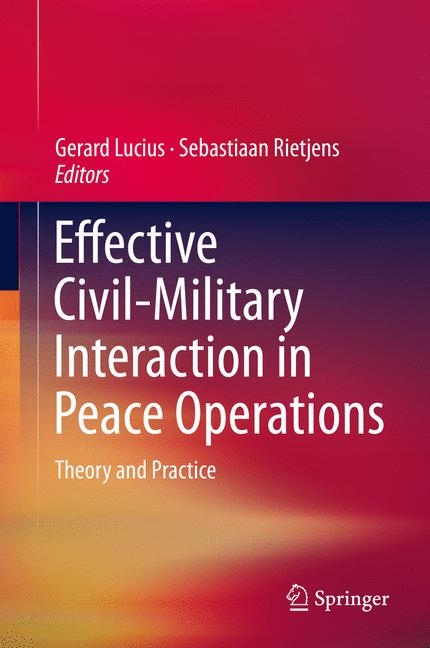
Effective Civil-Military Interaction in Peace Operations (eBook)
XXVII, 295 Seiten
Springer International Publishing (Verlag)
978-3-319-26806-4 (ISBN)
Gerard Lucius joined the Diplomatic Service of the Netherlands in 1997 and civil-military interaction has been a constant in his career. He was the Liaison Officer to the Netherlands Ministry of Defence during various operations in the Former Yugoslavia and a Development Adviser to the Commander of Task Force Uruzgan, the Dutch contribution to ISAF. As a consultant to the United Nations Mission in Sudan (UNMIS) before the indepence of South Sudan, he coordinated donor support to the Joint Integrated Units of Sudanese Army and SPLM. He also worked as Political Secretary and Economic Secretary in Zambia and Qatar, respectively. Since 2002, Gerard spends a number of weeks annually as an active reserve officer in 1 (NL) Civil-Military Interaction Command, where he is a Senior Consultant in the Command's Political Network. Gerard was Counselor and Deputy Head of Mission of his country's embassy in Baghdad from 2012-2014. He currently works on Antiterrorism and National Security issues at the Dutch Ministry of Foreign Affairs in The Hague.
Dr. Sebastiaan Rietjens, an engineer by training, is an associate professor at the Netherlands Defense Academy, and a reserve major in the Netherlands army. He has done extensive fieldwork in military operations and has published accordingly in international journals and books. His main focus of interest is on civil-military interaction, effectiveness of military operations as well as logistics and information management. He co-edited volumes on civil-military cooperation (Ashgate, 2008) and research methods in studies (Routledge, forthcoming) and a special issue on defense logistics (International Journal of Physical Distribution and Logistics Management, 2013). Sebastiaan is a regular speaker at the Cimic Centre of Excellence and the NATO School and has given presentations at numerous institutions and (academic) conferences including the Australian Defence Forces Academy, the European Committee on Security and Development and the US Marine Corps University.
Gerard Lucius joined the Diplomatic Service of the Netherlands in 1997 and civil-military interaction has been a constant in his career. He was the Liaison Officer to the Netherlands Ministry of Defence during various operations in the Former Yugoslavia and a Development Adviser to the Commander of Task Force Uruzgan, the Dutch contribution to ISAF. As a consultant to the United Nations Mission in Sudan (UNMIS) before the indepence of South Sudan, he coordinated donor support to the Joint Integrated Units of Sudanese Army and SPLM. He also worked as Political Secretary and Economic Secretary in Zambia and Qatar, respectively. Since 2002, Gerard spends a number of weeks annually as an active reserve officer in 1 (NL) Civil-Military Interaction Command, where he is a Senior Consultant in the Command’s Political Network. Gerard was Counselor and Deputy Head of Mission of his country's embassy in Baghdad from 2012-2014. He currently works on Antiterrorism and National Security issues at the Dutch Ministry of Foreign Affairs in The Hague. Dr. Sebastiaan Rietjens, an engineer by training, is an associate professor at the Netherlands Defense Academy, and a reserve major in the Netherlands army. He has done extensive fieldwork in military operations and has published accordingly in international journals and books. His main focus of interest is on civil-military interaction, effectiveness of military operations as well as logistics and information management. He co-edited volumes on civil-military cooperation (Ashgate, 2008) and research methods in studies (Routledge, forthcoming) and a special issue on defense logistics (International Journal of Physical Distribution and Logistics Management, 2013). Sebastiaan is a regular speaker at the Cimic Centre of Excellence and the NATO School and has given presentations at numerous institutions and (academic) conferences including the Australian Defence Forces Academy, the European Committee on Security and Development and the US Marine Corps University.
Chapter 1. Getting Better at Civil-Military Interaction; Sebastiaan Rietjens and Gerard Lucius.- Chapter 2. Civil-military Interaction: Rationale, Possibilities and Limitations; Cedric de Coning.- Chapter 3. Who are they? – Encountering International and Local Civilians in Civil-Military Interaction; Georg Frerks.- Chapter 4. Civilians in Military Operations: Blue on Blue; Jeannette Seppen and Gerard Lucius.- Chapter 5: Preparation Starts at Home: Education and Training for Civil-Military Interaction Kelisiana Thynne and Gwen Cherne.- Chapter 6. Obtaining Population Centric Intelligence: Experience of the Netherlands Military Presence in South Afghanistan; Martijn Kitzen and Willem Vogelsang.- Chapter 7. Civil-Military Planning; Philip Shetler-Jones.- Chapter 8. Just in time: Civil-Military Logistics; Maggie Heraty.- Chapter 9. Reconstructing the Infrastructure of Damaged Societies; Garland H. Williams.- Chapter 10. Civil-Military Interaction during Infantry Operations; John Melkon, James Embrey, Harry Bader and Brian Mennes.- Chapter 11. Military’s Engagement in Civilian Healthcare; Sebastiaan Rietjens and Myriame Bollen.- Chapter 12. CIMIC Projects: Divergent Interests, Convergent Action; Gerard Lucius.- Chapter 13. Dealing with Cultural Differences; Paula Holmes-Eber.- Chapter 14. Fighting Corruption in Conflict Areas; Saad Mustafa, Tobias Bock and Mark Pyman.- Chapter 15. Human Rights and Refugee Protection: The Interface with Humanitarian Actors; Christine Mougne and Fedde Groot.- Chapter 16. Leadership and the Comprehensive Approach; Peter Olsthoorn and Joseph Soeters.- Chapters 17. Civil-Military Interaction, CIMIC and Interacting with Gender; Gunhild Hoogensen Gjorv anf Toiko Tönisson Kleppe.- Chapter 18. Improving Evaluation of Civil-Military Cooperation; Peter Essens and Thom de Vries.- Chapter 19. Civil-Military Interaction: From Practice to Theory; Sebastiaan Rietjens.
| Erscheint lt. Verlag | 24.3.2016 |
|---|---|
| Zusatzinfo | XXVII, 295 p. 51 illus. in color. |
| Verlagsort | Cham |
| Sprache | englisch |
| Themenwelt | Geschichte ► Allgemeine Geschichte ► Altertum / Antike |
| Sozialwissenschaften ► Politik / Verwaltung | |
| Sozialwissenschaften ► Soziologie | |
| Schlagworte | Civil-military Interaction Process • Civil-Military Logistics • Cultural Differences • Effective Civil-Military Interaction • Integrating Approaches of Civilian and Military Actors • International Civilians • Mission Effectiveness • NATO-led Operations • Population Centric Intelligence • Segurity Challenges • UN Integrated Missions |
| ISBN-10 | 3-319-26806-6 / 3319268066 |
| ISBN-13 | 978-3-319-26806-4 / 9783319268064 |
| Informationen gemäß Produktsicherheitsverordnung (GPSR) | |
| Haben Sie eine Frage zum Produkt? |
 PDF (Wasserzeichen)
DRM: Digitales Wasserzeichen
Dieses eBook enthält ein digitales Wasserzeichen und ist damit für Sie personalisiert. Bei einer missbräuchlichen Weitergabe des eBooks an Dritte ist eine Rückverfolgung an die Quelle möglich.
Dateiformat: PDF (Portable Document Format)
Mit einem festen Seitenlayout eignet sich die PDF besonders für Fachbücher mit Spalten, Tabellen und Abbildungen. Eine PDF kann auf fast allen Geräten angezeigt werden, ist aber für kleine Displays (Smartphone, eReader) nur eingeschränkt geeignet.
Systemvoraussetzungen:
PC/Mac: Mit einem PC oder Mac können Sie dieses eBook lesen. Sie benötigen dafür einen PDF-Viewer - z.B. den Adobe Reader oder Adobe Digital Editions.
eReader: Dieses eBook kann mit (fast) allen eBook-Readern gelesen werden. Mit dem amazon-Kindle ist es aber nicht kompatibel.
Smartphone/Tablet: Egal ob Apple oder Android, dieses eBook können Sie lesen. Sie benötigen dafür einen PDF-Viewer - z.B. die kostenlose Adobe Digital Editions-App.
Buying eBooks from abroad
For tax law reasons we can sell eBooks just within Germany and Switzerland. Regrettably we cannot fulfill eBook-orders from other countries.
aus dem Bereich