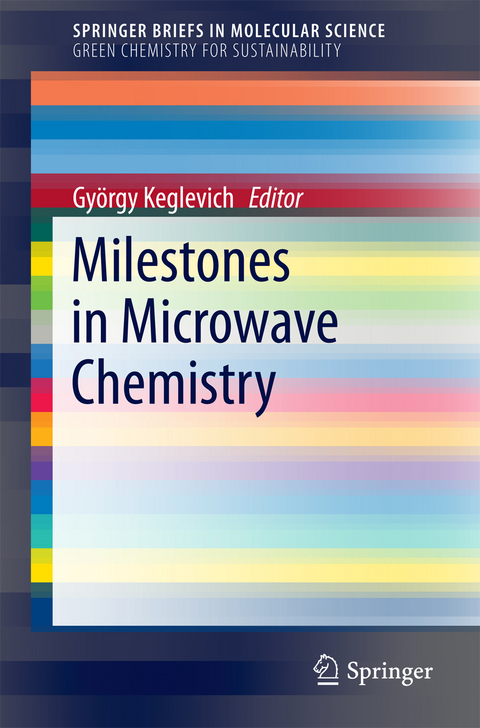
Milestones in Microwave Chemistry (eBook)
IX, 110 Seiten
Springer International Publishing (Verlag)
9783319306322 (ISBN)
This book looks back on thirty-five years of microwave (MW) chemistry and explains how the application of the MW technique became an integral part of R&D, eventually becoming recognized in industry. Further, it details how MW chemistry has undergone a dynamic development in the past three decades, one driven by the advent of increasingly sophisticated professional MW reactors in place of the kitchen MW ovens used in earlier years. A major part of the book shows how substitutions, esterifications, amidations, hydrolyses, alkylations, eliminations, dehydrations, condensations, cyclizations, C-C couplings and the modification of heterocycles can be performed advantageously under MW irradiation, as the reaction times are shorter, while the selectivity and yields are higher; it also explains why in most cases, the reactions can be performed under solvent-free conditions. MW irradiation within the sphere of organophosphorus chemistry is showcased and typical reactions, such as the direct derivatization of phosphinic acids, alkylating esterifications, Diels-Alder reactions, the inverse Wittig-type reaction, fragmentations, the Arbuzov reaction, the synthesis of α-hydroxyphosphonates and α-aminophosphonates (the Kabachnik-Fields condensation), deoxygenations and P-C coupling reactions are described under MW conditions. In closing, the advantages of MW chemistry such as faster reactions and the possibility of simplifying the catalytic systems are addressed.
Prof. György Keglevich was born in Budapest (Hungary) in 1957 and graduated from the Technical University of Budapest in 1981 as a chemical engineer. He completed his PhD in 1984 and his 'Doctor of Chemical Science' degree in 1994, both in the subject of organophosphorus chemistry. He received his 'Dr. Habil.' degree in 1995 and his DSc in 1994. He served as a Research Associate at Duke University (Durham, North Carolina) for more than a year with Professor Louis D. Quin. On two occasions, he was also a Visiting Associate Professor at the University of Massachusetts.
Affiliations:
Prof. Keglevich has worked at the Department of Organic Chemical Technology since 1981, first as a research employee of the Chinoin Pharmaceutical and Chemical Works Ltd and from 1982 as a member of the teaching staff as an Assistant Professor. In 1993, he was appointed Associate Professor. Since 1996, he has been a Full Professor at the Department of Organic Chemical Technology. He has headed said department (renamed the Department of Organic Chemistry and Technology in 2007) since 1999.
Fields of expertise:
Prof. Keglevich has pursued P-heterocyclic research on the subject of ring enlargement of five-membered P-heterocycles and on the utilization of the products so obtained. He has also elaborated the synthesis of a number of families of compounds. Bridged P-heterocycles, precursors of low-coordinated fragments, were synthesized and utilized in phosphorylations. The study on the synthesis and reactivity of aromatic phospholes forms another relevant part of his research. His additional research interests include Diels-Alder reactions, low-coordinated P-fragments, phosphine-transition metal complexes, selective reductions, phosphine-boranes, azacrown ethers with phosphonoalkyl side chains and selective reductions. Recently, he has turned his attention to environmentally friendly syntheses, and environmentally friendly chemistry (green chemistry) now informs his research, which encompasses MW chemistry, the synergism of MW and phase transfer catalysis, ionic liquids, and the development of new catalysts and monitoring reactions using in situ methods.
He has also taken part in industrial projects involving the synthesis of pharmaceutical intermediates and products. He has authored or co-authored ca. 350 papers, the majority of which appeared in international journals.Prof. György Keglevich was born in Budapest (Hungary) in 1957 and graduated from the Technical University of Budapest in 1981 as a chemical engineer. He completed his PhD in 1984 and his “Doctor of Chemical Science” degree in 1994, both in the subject of organophosphorus chemistry. He received his “Dr. Habil.” degree in 1995 and his DSc in 1994. He served as a Research Associate at Duke University (Durham, North Carolina) for more than a year with Professor Louis D. Quin. On two occasions, he was also a Visiting Associate Professor at the University of Massachusetts. Affiliations: Prof. Keglevich has worked at the Department of Organic Chemical Technology since 1981, first as a research employee of the Chinoin Pharmaceutical and Chemical Works Ltd and from 1982 as a member of the teaching staff as an Assistant Professor. In 1993, he was appointed Associate Professor. Since 1996, he has been a Full Professor at the Department of Organic Chemical Technology. He has headed said department (renamed the Department of Organic Chemistry and Technology in 2007) since 1999. Fields of expertise: Prof. Keglevich has pursued P-heterocyclic research on the subject of ring enlargement of five-membered P-heterocycles and on the utilization of the products so obtained. He has also elaborated the synthesis of a number of families of compounds. Bridged P-heterocycles, precursors of low-coordinated fragments, were synthesized and utilized in phosphorylations. The study on the synthesis and reactivity of aromatic phospholes forms another relevant part of his research. His additional research interests include Diels–Alder reactions, low-coordinated P-fragments, phosphine-transition metal complexes, selective reductions, phosphine-boranes, azacrown ethers with phosphonoalkyl side chains and selective reductions. Recently, he has turned his attention to environmentally friendly syntheses, and environmentally friendly chemistry (green chemistry) now informs his research, which encompasses MW chemistry, the synergism of MW and phase transfer catalysis, ionic liquids, and the development of new catalysts and monitoring reactions using in situ methods. He has also taken part in industrial projects involving the synthesis of pharmaceutical intermediates and products. He has authored or co-authored ca. 350 papers, the majority of which appeared in international journals.
The Spread of the Application of the Microwave Technique in
Organic Synthesis.- Microwave-Assisted Sytheses in Organic Chemistry.- The Use
of MW in Organophosphorus Chemistry.- Interpretation of the Effects of Microwaves.
| Erscheint lt. Verlag | 22.3.2016 |
|---|---|
| Reihe/Serie | SpringerBriefs in Green Chemistry for Sustainability |
| SpringerBriefs in Green Chemistry for Sustainability | |
| SpringerBriefs in Molecular Science | SpringerBriefs in Molecular Science |
| Zusatzinfo | IX, 110 p. 144 illus., 4 illus. in color. |
| Verlagsort | Cham |
| Sprache | englisch |
| Themenwelt | Geisteswissenschaften ► Geschichte |
| Naturwissenschaften ► Chemie ► Organische Chemie | |
| Technik | |
| Schlagworte | Green Chemistry Microwaves • Green Synthesis Microwaves • History of Microwave Chemistry • Introduction to Microwave Chemistry • Microwave Chemistry • Microwave Reactors • Organic Reactions Microwaves • Organic Synthesis Microwaves • organophosphorus chemistry • Thermal and Nonthermal Effects |
| ISBN-13 | 9783319306322 / 9783319306322 |
| Informationen gemäß Produktsicherheitsverordnung (GPSR) | |
| Haben Sie eine Frage zum Produkt? |
 PDF (Wasserzeichen)
DRM: Digitales Wasserzeichen
Dieses eBook enthält ein digitales Wasserzeichen und ist damit für Sie personalisiert. Bei einer missbräuchlichen Weitergabe des eBooks an Dritte ist eine Rückverfolgung an die Quelle möglich.
Dateiformat: PDF (Portable Document Format)
Mit einem festen Seitenlayout eignet sich die PDF besonders für Fachbücher mit Spalten, Tabellen und Abbildungen. Eine PDF kann auf fast allen Geräten angezeigt werden, ist aber für kleine Displays (Smartphone, eReader) nur eingeschränkt geeignet.
Systemvoraussetzungen:
PC/Mac: Mit einem PC oder Mac können Sie dieses eBook lesen. Sie benötigen dafür einen PDF-Viewer - z.B. den Adobe Reader oder Adobe Digital Editions.
eReader: Dieses eBook kann mit (fast) allen eBook-Readern gelesen werden. Mit dem amazon-Kindle ist es aber nicht kompatibel.
Smartphone/Tablet: Egal ob Apple oder Android, dieses eBook können Sie lesen. Sie benötigen dafür einen PDF-Viewer - z.B. die kostenlose Adobe Digital Editions-App.
Buying eBooks from abroad
For tax law reasons we can sell eBooks just within Germany and Switzerland. Regrettably we cannot fulfill eBook-orders from other countries.
aus dem Bereich