Stone Tools in Human Evolution
Cambridge University Press (Verlag)
978-1-107-12309-0 (ISBN)
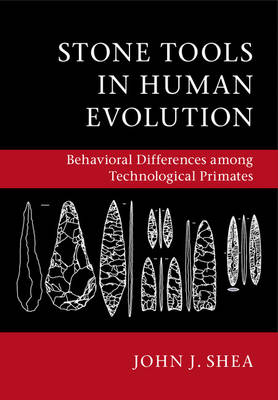
In Stone Tools in Human Evolution, John J. Shea argues that over the last three million years hominins' technological strategies shifted from occasional tool use, much like that seen among living non-human primates, to a uniquely human pattern of obligatory tool use. Examining how the lithic archaeological record changed over the course of human evolution, he compares tool use by living humans and non-human primates and predicts how the archaeological stone tool evidence should have changed as distinctively human behaviors evolved. Those behaviors include using cutting tools, logistical mobility (carrying things), language and symbolic artifacts, geographic dispersal and diaspora, and residential sedentism (living in the same place for prolonged periods). Shea then tests those predictions by analyzing the archaeological lithic record from 6,500 years ago to 3.5 million years ago.
John J. Shea is Professor of Anthropology at State University of New York, Stony Brook. He is the author of Stone Tools in the Paleolithic and Neolithic Near East: A Guide (2013) and co-editor of Out of Africa 1: The First Hominin Colonization of Eurasia (2010). Shea is also an expert flintknapper whose demonstrations of stone tool production and other ancestral technology skills appear in numerous television documentaries and in the National Museum of Natural History, Washington DC, as well as in the American Museum of Natural History, New York City.
List of figures; List of tables; List of boxes; Preface; Acknowledgments; Introduction. Little questions vs big questions; 1. Why archaeologists misunderstand stone tools; 2. How we know what we think we know about stone tools; 3. Describing stone tools; 4. Stone cutting tools; 5. Logistical mobility; 6. Language and symbolic artifacts; 7. Dispersal and diaspora; 8. Residential sedentism; 9. Conclusion; Appendix 1. Traditional age-stages and industries; Glossary; Bibliography; Index.
| Erscheinungsdatum | 05.01.2017 |
|---|---|
| Zusatzinfo | 26 Tables, black and white; 2 Halftones, black and white; 49 Line drawings, black and white |
| Verlagsort | Cambridge |
| Sprache | englisch |
| Maße | 182 x 260 mm |
| Gewicht | 710 g |
| Themenwelt | Geisteswissenschaften ► Archäologie |
| Geschichte ► Allgemeine Geschichte ► Vor- und Frühgeschichte | |
| ISBN-10 | 1-107-12309-7 / 1107123097 |
| ISBN-13 | 978-1-107-12309-0 / 9781107123090 |
| Zustand | Neuware |
| Informationen gemäß Produktsicherheitsverordnung (GPSR) | |
| Haben Sie eine Frage zum Produkt? |
aus dem Bereich