


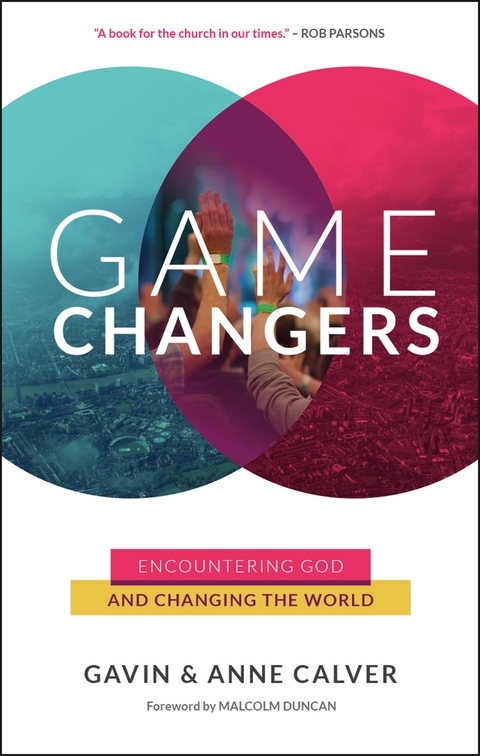
Game Changers (eBook)
224 Seiten
Lion Hudson (Verlag)
978-0-85721-725-7 (ISBN)
Have you ever wanted to change the world? Authors Gavin and Anne Calver examine our culture and consider where we stand as the Church within it. Drawing on the narrative of Moses, they show how we can be Game Changers. The book is presented in five, provoking sections: - Encounter: like Moses at the burning bush, we must make time to encounter God. - Engage: like Moses with Pharaoh we must engage with our communities and the issues at hand. - Ensemble: We the body of Christ, and everyone plays a vital part. Like Hur, Aaron, Moses and Joshua we will minister most effectively when we do it together. - Equip: how do we hear and respond to what the Lord is doing; listen, see and respond to what the Spirit is saying, and be equipped to go with others, to make a difference. - Empower: Like Moses and Joshua we need to pass on the vision and empower the next generation; who knows, we may never see what we dream of in our generation alone. God is very much at work in the world; He is doing new and different things by the power of His Spirit. The question is; do we want to join Him? If so, it's time to become Game Changers.
Introduction
“The future is not something we enter. The future is something we create.”
LEONARD SWEET
A NEW KIND OF LANDSCAPE
We were both born in 1979, which, incidentally, was also the year that Spring Harvest began. For the UK church an awful lot has changed in the time since. Back then the idea of widespread and affordable personal computers would have been like something from a sci-fi film. Phone boxes were the way to communicate on the move, yet, if you see one now, it stands as a memorial to a bygone era. Coffee was a basic item for drinking at home – not a luxury and trendy café option costing the same as a pint of beer. Everything has sped up and we now find ourselves in a world of tablets and smartphones, where the previously unthinkable internet is all that generations of teenagers have ever known. We find ourselves living in the middle of a cultural revolution.
This time, though, it’s change like never before, for we are living in the “Digital Revolution”. In short this is “the advancement of technology from analog electronic and mechanical devices to the digital technology available today. The era started during the 1980s and is ongoing. The Digital Revolution also marks the beginning of the Information Era.”1 This time is often referred to as the third industrial revolution. All of this has had a profound impact on church. As a body of people we have been far from immune from all that is going on.
As a direct result we are working with a different type of person. The theologian Leonard Sweet describes this new world as a TGIF world; a rising generation whose social interactions and medium of choice are built around Twitter, Google, iPhones and Facebook. He articulates it this way: “If the unit of the premodern world was the family, and the unit of the Gutenberg world was the individual, the unit of the TGIF world is the network. At its best, this means a rediscovery of our being-in-common, the sense of the village square or town commons.”2 Within this context we need to fight for community in an increasingly “virtual” world. This doesn’t mean genuine relationships can’t be built and maintained virtually; however, it does require that we don’t simply have a virtual existence and that we also engage face to face. There are many other sociological changes going on around us and to be truthful you can never understand a revolution fully when you’re living in the middle of it.
THE PLACE OF CHRISTIANITY?
In our new-found world it can so often feel like Christianity is marginalized. This has not always been the case. For many hundreds of years, the church in Britain was the very epicentre of the community. Every town and village had a church and a school as two basic necessities for any community. There was real social capital and gravitas to be gained from being part of a local church too. Whether we like it or not the church does not hold this position anymore. The school remains, but often the church building is now used for selling carpets or as an art deco wine bar instead. Where these buildings are in operation still you’ll often find a congregation smaller than the number of people needed for a football team.
In June 2015, Premier Christianity magazine published some research from the Pew Research Center claiming that, at the going rate of decline, by the year 2050 Christianity will lose its place as the majority religion in Britain.3 Clearly things are not going well and we need to see real change in this land. However, spirituality is not seen as in any way irrelevant. It is considered central to one’s humanity and is massively popular within our culture. There is seemingly a growing spiritual hunger within our society and yet an increasing diffidence towards Christianity. Anything seen as mystical is often pursued whilst the spirituality of the church is not even considered as it is so often perceived as outdated, irrelevant, and past it. The comedian Frank Skinner puts it this way in his autobiography: “In a society where all manner of once smirked upon behavior like wearing crystals and Feng Shui has become acceptable, only Christian belief can definitely guarantee you the label ‘weird’.”4
Such a label may be perplexing when we consider Britain’s Christian heritage. When did Christianity become a “weird” religion? What was once seen as true is now false; what many once considered bizarre is now normal. This has all happened in a relatively short space of time. That in itself gives us hope that a reversal of current trends might prove equally rapid.
There has also been a dramatic rise in credibility, acceptance, and indeed promotion of militant atheism. Spearheaded by Richard Dawkins, increasingly many famous voices have added their weight to the atheist camp. Within our society there is also an intellectual bias towards atheism. It is often seen as intellectually superior, whilst in order to be a Christian you can just leave your brain at the door.
Staunch atheist Stephen Fry was asked by Irish journalist Gay Byrne what he would say to God at the pearly gates if it turned out it was all true his answer was arresting. Part of his response was to say, “Why should I respect a capricious, mean-minded, stupid God who creates a world that is so full of injustice and pain. That’s what I would say.”5 Such views are growing and Fry’s comments were well received by the secularists and responded to with an often ludicrous sense of insecurity from Christians. Increasingly our faith can feel marginalized.
However we don’t believe in the God that Fry and many others describe in such ways either! What they are drawing out is a mistaken view of who He is. Fry’s comment does speak to difficult questions surrounding suffering that we all grapple with. As Christians, however, our view of God is more complex than that of the “capricious, mean-minded” one that Fry describes. Where does Jesus figure into his argument? What of the God of compassion, who sacrificed His own Son for the betterment of humanity? And we cannot discount the role of human free will that is exercised, for good and for evil, in the world. Our triune God cannot be reduced to a “stupid”, pain-loving deity. With respect to Fry he is an atheist and his views on a God he doesn’t believe exists are therefore shallow in places.
In our current context it is not all bad news. Many are still seeking God in the midst of cultural confusion. In his book Revolution, Russell Brand seeks to engage with a generation that he believes to be disenfranchised in postmodern Britain. He writes with long words and passion and his book is highly engaging throughout, though in truth not all of his conclusions are entirely thought through. Nonetheless many of his views on God are profound. We were particularly moved by his view that “All desires are the inappropriate substitute for the desire to be at one with God.”6 You don’t need to know a lot about Brand to know that he is fairly experienced when it comes to indulging in desires that are, shall we say, “inappropriate”. However, as he says in the book, these have all proved to be empty and fruitless once the buzz wears off. It is fun in the moment but none of this brings any sense of fulfilment, meaning or hope in the long term. The world tells us to pursue hedonism but in the end, when the party is over, what are you left with? A headache the next morning and an emptiness in the soul.
We are not the first people to face a difficult landscape. The central biblical character in this book, Moses, didn’t have it all easy either. The great theologian Alec Motyer points out that in his context he faced “a task of unparalleled magnitude and difficulty in which he would have to face demands never experienced before”.7 We all face deep cultural challenges and opposition in our own time and have to cling on to God and take on the world in His name. Regardless of what’s going on around us, following Jesus remains the only way to know what it is to live. No matter what the cultural climate you can only fully live once you’ve met the Author of Life. Truth is not relative to the environment that it finds itself in, but it does need to be clung onto whilst the waves of an indifferent society seek to drag us under!
STEP UP CHURCH
So we can be in little doubt that we find ourselves living in interesting times. There is a growing temptation for us to fit in with the society of which we are a part. There’s this word so many love to use as if it’s the hallmark of a perfect society: we need to be “inclusive”. Yet today this word seems to mean that you can’t have a view on anything or any opinions. We Christians are instead called to be tolerant. Tolerance means learning to live in harmony alongside those that disagree with us – not all having to sign up to the same “McDonaldized” ideologies on everything. Looking to Jesus in His time, He was the most inclusive figure in human history, yet He carried the most exclusive message if you were to follow Him. Just look at the Greeks in John 12. They wanted to “see” Jesus, not fully live for Him with everything they had. As such this is not enough. If you want to follow Jesus then it needs to be all in!
The church was never intended to fit in with no differentiation between...
| Erscheint lt. Verlag | 18.3.2016 |
|---|---|
| Illustrationen | Anne Calver |
| Sprache | englisch |
| Themenwelt | Religion / Theologie ► Christentum ► Moraltheologie / Sozialethik |
| ISBN-10 | 0-85721-725-9 / 0857217259 |
| ISBN-13 | 978-0-85721-725-7 / 9780857217257 |
| Informationen gemäß Produktsicherheitsverordnung (GPSR) | |
| Haben Sie eine Frage zum Produkt? |
 EPUB (Adobe DRM)
Kopierschutz: Adobe-DRM
Adobe-DRM ist ein Kopierschutz, der das eBook vor Mißbrauch schützen soll. Dabei wird das eBook bereits beim Download auf Ihre persönliche Adobe-ID autorisiert. Lesen können Sie das eBook dann nur auf den Geräten, welche ebenfalls auf Ihre Adobe-ID registriert sind.
Details zum Adobe-DRM
Dateiformat: EPUB (Electronic Publication)
EPUB ist ein offener Standard für eBooks und eignet sich besonders zur Darstellung von Belletristik und Sachbüchern. Der Fließtext wird dynamisch an die Display- und Schriftgröße angepasst. Auch für mobile Lesegeräte ist EPUB daher gut geeignet.
Systemvoraussetzungen:
PC/Mac: Mit einem PC oder Mac können Sie dieses eBook lesen. Sie benötigen eine
eReader: Dieses eBook kann mit (fast) allen eBook-Readern gelesen werden. Mit dem amazon-Kindle ist es aber nicht kompatibel.
Smartphone/Tablet: Egal ob Apple oder Android, dieses eBook können Sie lesen. Sie benötigen eine
Geräteliste und zusätzliche Hinweise
Buying eBooks from abroad
For tax law reasons we can sell eBooks just within Germany and Switzerland. Regrettably we cannot fulfill eBook-orders from other countries.
aus dem Bereich


