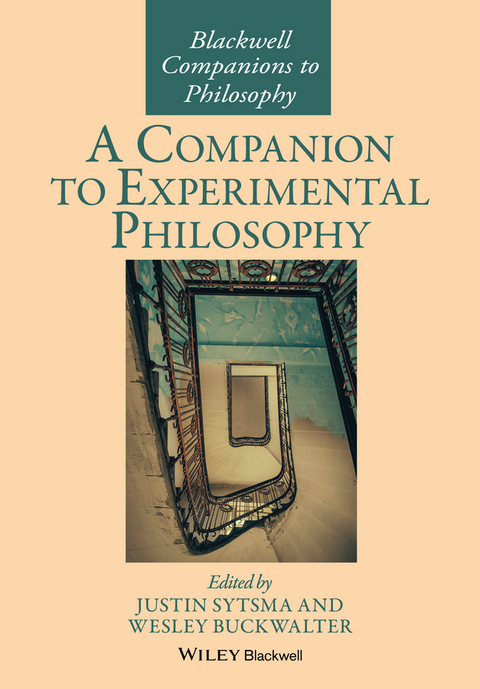
A Companion to Experimental Philosophy (eBook)
John Wiley & Sons (Verlag)
978-1-118-66169-7 (ISBN)
This is a comprehensive collection of essays that explores cutting-edge work in experimental philosophy, a radical new movement that applies quantitative and empirical methods to traditional topics of philosophical inquiry.
- Situates the discipline within Western philosophy and then surveys the work of experimental philosophers by sub-discipline
- Contains insights for a diverse range of fields, including linguistics, cognitive science, anthropology, economics, and psychology, as well as almost every area of professional philosophy today
- Edited by two rising scholars who take a broad and inclusive approach to the field
- Offers a complete introduction for non-specialists and students to the central approaches, findings, challenges, and controversies in experimental philosophy
Justin Sytsma is Senior Lecturer in Philosophy at Victoria University of Wellington, New Zealand. As a practitioner of experimental philosophy, he uses empirical methods to conduct his research into the areas of the philosophy of psychology and the philosophy of mind. He is co-author of The Theory and Practice of Experimental Philosophy(2016) and editor of Advances in Experimental Philosophy of Mind (2014). He has also published in a variety of peer reviewed journals, including Australasian Journal of Philosophy, Philosophical Studies, Philosophy of Science, Journal of Consciousness Studies, and Philosophy Compass.
Wesley Buckwalter is Banting Postdoctoral Fellow in the Department of Philosophy and the Philosophical Science Laat the University of Waterloo, Canada. He completed his PhD in Philosophy at the City University of New York Graduat Center, USA. He has published dozens of articles in epistemology, philosophy of mind, and cognitive science on a wide range of topics including knowledge, belief, assertion, luck, intuition, methodology, functionalism, consciousness, emotion, and fiction.
This is a comprehensive collection of essays that explores cutting-edge work in experimental philosophy, a radical new movement that applies quantitative and empirical methods to traditional topics of philosophical inquiry. Situates the discipline within Western philosophy and then surveys the work of experimental philosophers by sub-discipline Contains insights for a diverse range of fields, including linguistics, cognitive science, anthropology, economics, and psychology, as well as almost every area of professional philosophy today Edited by two rising scholars who take a broad and inclusive approach to the field Offers a complete introduction for non-specialists and students to the central approaches, findings, challenges, and controversies in experimental philosophy
Justin Sytsma is Senior Lecturer in Philosophy at Victoria University of Wellington, New Zealand. As a practitioner of experimental philosophy, he uses empirical methods to conduct his research into the areas of the philosophy of psychology and the philosophy of mind. He is co-author of The Theory and Practice of Experimental Philosophy(2016) and editor of Advances in Experimental Philosophy of Mind (2014). He has also published in a variety of peer reviewed journals, including Australasian Journal of Philosophy, Philosophical Studies, Philosophy of Science, Journal of Consciousness Studies, and Philosophy Compass. Wesley Buckwalter is Banting Postdoctoral Fellow in the Department of Philosophy and the Philosophical Science Laat the University of Waterloo, Canada. He completed his PhD in Philosophy at the City University of New York Graduat Center, USA. He has published dozens of articles in epistemology, philosophy of mind, and cognitive science on a wide range of topics including knowledge, belief, assertion, luck, intuition, methodology, functionalism, consciousness, emotion, and fiction.
Notes on Contributors
Joshua Alexander is Associate Professor of Philosophy at Siena College, where he also directs the cognitive science program. His work focuses primarily on the nature of philosophical cognition and intellectual disagreement. He is the author of Experimental Philosophy – An Introduction (Polity, 2012).
Peter R. Anstey is ARC Future Fellow and Professor of Philosophy at the University of Sydney. He specializes in early modern philosophy and is the author of John Locke and Natural Philosophy (Oxford, 2011).
James R. Beebe is Associate Professor of Philosophy at the University at Buffalo and Director of the Experimental Epistemology Research Group.
Gunnar Björnsson is Professor of Philosophy in the Department of Historical, Philosophical and Religious Studies at Umeå University and Coordinator of the Moral Responsibility Research Initiative at the University of Gothenburg. His research focuses on issues in metaethics, moral psychology, and moral responsibility.
Berit Brogaard is Professor of Philosophy at University of Miami, Director of the Brogaard Lab for Multisensory Research and Professor II at University of Oslo.
Wesley Buckwalter is Banting Postdoctoral Fellow in the Department of Philosophy at the University of Waterloo.
Hoi-yee Chan is a graduate student in philosophy at the University of Arizona.
Edward T. Cokely is Presidential Research Professor and Associate Professor of Psychology at the University of Oklahoma, specializing in the Psychology of Skilled and Informed Decision Making. He also serves as research faculty at the MaPlanck Institute for Human Development (DE) and the National Institute for Risk and Resilience (USA), and is co-managing director of RiskLiteracy.org.
Florian Cova is a postdoctoral researcher at the Swiss Centre for Affective Sciences at the University of Geneva
Fiery Cushman is Assistant Professor of Psychology at Harvard University.
Mike Dacey is a graduate student in the Philosophy-Neuroscience-Psychology Program at Washington University in St. Louis.
David Danks is Professor of Philosophy & Psychology at Carnegie Mellon University. His main areas of research are computational cognitive science, philosophy of cognitive science, and machine learning. He is the author of Unifying the Mind: Cognitive Representations as Graphical Models (MIT Press) and articles in numerous journals.
Max Deutsch is Associate Professor of Philosophy at the University of Hong Kong.
Igor Douven is Director of Research at the French National Centre for Scientific Research.
Matt L. Drabek is Content Specialist at ACT, Inc. and Visiting Assistant Professor of Philosophy at The University of Iowa. He is the author of Classify and Label: The Unintended Marginalization of Social Groups (Lexington Books, 2014).
Adam Feltz is Assistant Professor of Psychology and Applied Ethics at Michigan Technological University where he directs the Ethical Decision-Making and Ethical Naturalism Laboratory and is co-managing director of RiskLiteracy.org.
Carrie Figdor is Associate Professor of Philosophy and core faculty in the Interdisciplinary Graduate Program in Neuroscience at the University of Iowa. Her primary research is in philosophy of psychology and neuroscience, philosophy of science, and philosophy of mind. She is also coauthor, with Molly Paxton and Valerie Tiberius, of ‘Quantifying the Gender Gap: An Empirical Study of the Underrepresentation of Women in Philosophy’ (Hypatia, 2012).
Ori Friedman is Associate Professor of Psychology at the University of Waterloo.
Joshua D. Greene is Professor of Psychology at Harvard University.
Nicole Hassoun is Associate Professor of Philosophy at Binghamton University. She has published widely in journals such as American Philosophical Quarterly, Journal of Development Economics, Australasian Journal of Philosophy, and Philosophy and Economics. Her book Globalization and Global Justice: Shrinking Distance, Expanding Obligations was published with Cambridge University Press in 2012 and her manuscript Global Health Impact: Extending Access on Essential Medicines for the Poor is under contract with Oxford University Press.
Bryce Huebner is Associate Professor of Philosophy at Georgetown University.
Joshua Knobe is Professor of Cognitive Science and Philosophy at Yale University.
Brian Leiter is Karl N. Llewellyn Professor of Jurisprudence and Director of the Center for Law, Philosophy, and Human Values at the University of Chicago.
Adam Lerner is a graduate student in Philosophy at Princeton University.
Sarah-Jane Leslie is Class of 1943 Professor of Philosophy, Director of the Program in Linguistics, and Founding Director of the Program in Cognitive Science at Princeton University. She is also affiliated with the Department of Psychology, the University Center for Human Values, and the Program in Gender and Sexuality Studies.
Jonathan Livengood is Assistant Professor of Philosophy and Director of the Psychology of Philosophy Laboratory at the University of Illinois, Urbana-Champaign. He is coauthor of The Theory and Practice of Experimental Philosophy (Broadview, 2016), with Justin Sytsma, in addition to numerous articles.
Tania Lombrozo is Associate Professor of Psychology at the University of California, Berkeley, as well as an affiliate of the Department of Philosophy and a member of the Institute for Cognitive and Brain Sciences. Her research focuses on explanation, abductive inference, causal reasoning, learning, conceptual representation, and social cognition.
Edouard Machery is Professor in the Department of History and Philosophy of Science at the University of Pittsburgh, Associate Director of the Center for Philosophy of Science at the University of Pittsburgh, a member of the Center for the Neural Basis of Cognition (University of Pittsburgh-Carnegie Mellon University), and Adjunct Research Professor, Institute for Social Research at the University of Michigan. He is the author of Doing without Concepts (OUP, 2009) as well as the editor of The Oxford Handbook of Compositionality (OUP, 2012), La Philosophie Expérimentale (Vuibert, 2012), Arguing about Human Nature (Routledge, 2013), and Current Controversies in Experimental Philosophy (Routledge, 2014). He has been the editor of the Naturalistic Philosophy section of Philosophy Compass since 2012.
Ron Mallon is Associate Professor of Philosophy and Director of the Philosophy-Neuroscience-Psychology Program at Washington University in St. Louis.
Justin W. Martin is a graduate student in psychology at Harvard University.
Charles J. Millar is a law student at the University of Toronto.
Kaija Mortensen is Assistant Professor of Philosophy at Randolph College. Her work focuses on intuitions, thought experiments, and the nature of philosophical expertise.
Jennifer Nagel is Associate Professor of Philosophy at the University of Toronto.
Shaylene E. Nancekivell is a graduate student in psychology at the University of Waterloo.
Shaun Nichols is Professor of Philosophy at the University of Arizona.
Juhwa Park is Research Fellow at Korea Institute for National Unification.
L.A. Paul is Professor of Philosophy at the University of North Carolina, Chapel Hill and Professorial Fellow at Arche, the University of St. Andrews. She is the author of Transformative Experience (OUP, 2014) and coauthor, with Ned Hall, of Causation: A User’s Guide (OUP, 2013).
Elliot Samuel Paul is Assistant Professor of Philosophy at Barnard College, Columbia University. He is coeditor of The Philosophy of Creativity: New Essays (Oxford University Press, 2014) and cofounder of The Creativity Post (creativitypost.com).
Derk Pereboom is Professor of Philosophy at Cornell University.
Mark Phelan is Assistant Professor of Philosophy at Lawrence University.
Ángel Pinillos is Associate Professor of Philosophy at Arizona State University.
Alexandra Plakias is Assistant Professor of Philosophy at Hamilton College.
David Ripley is Assistant Professor of Philosophy at the University of Connecticut.
David Rose is a graduate student in philosophy at Rutgers University.
Joshua Rust is Associate Professor of Philosophy at Stetson University.
Richard Samuels is Professor of Philosophy at The Ohio State University.
Hagop Sarkissian is Associate Professor of Philosophy at The City University of New York, Baruch College. His research spans topics in ethics, moral psychology, classical Chinese philosophy, and comparative philosophy. His work has been translated into Chinese and Korean.
Jonah N. Schupbach is Assistant Professor of Philosophy at the University of Utah. His research interests include epistemology (formal and mainstream), logic, and the psychology of human reasoning. He has published numerous articles in top journals, including The British Journal for the Philosophy of Science, Philosophical Studies, Philosophy and Phenomenological Research, and Philosophy of Science.
Eric Schwitzgebel is Professor of Philosophy at...
| Erscheint lt. Verlag | 28.3.2016 |
|---|---|
| Reihe/Serie | Blackwell Companions to Philosophy |
| Blackwell Companions to Philosophy | Blackwell Companions to Philosophy |
| Sprache | englisch |
| Themenwelt | Geisteswissenschaften ► Philosophie ► Allgemeines / Lexika |
| Schlagworte | Empirical Methods • Experimentalphilosophie • History of Philosophy • Logic • Metaphilosophy • Metaphysics • philosophical research • philosophical tradition • Philosophie • Philosophy • Philosophy of action • Quantitative Methods • Reasoning • x-phi |
| ISBN-10 | 1-118-66169-9 / 1118661699 |
| ISBN-13 | 978-1-118-66169-7 / 9781118661697 |
| Informationen gemäß Produktsicherheitsverordnung (GPSR) | |
| Haben Sie eine Frage zum Produkt? |
 EPUB (Adobe DRM)
Kopierschutz: Adobe-DRM
Adobe-DRM ist ein Kopierschutz, der das eBook vor Mißbrauch schützen soll. Dabei wird das eBook bereits beim Download auf Ihre persönliche Adobe-ID autorisiert. Lesen können Sie das eBook dann nur auf den Geräten, welche ebenfalls auf Ihre Adobe-ID registriert sind.
Details zum Adobe-DRM
Dateiformat: EPUB (Electronic Publication)
EPUB ist ein offener Standard für eBooks und eignet sich besonders zur Darstellung von Belletristik und Sachbüchern. Der Fließtext wird dynamisch an die Display- und Schriftgröße angepasst. Auch für mobile Lesegeräte ist EPUB daher gut geeignet.
Systemvoraussetzungen:
PC/Mac: Mit einem PC oder Mac können Sie dieses eBook lesen. Sie benötigen eine
eReader: Dieses eBook kann mit (fast) allen eBook-Readern gelesen werden. Mit dem amazon-Kindle ist es aber nicht kompatibel.
Smartphone/Tablet: Egal ob Apple oder Android, dieses eBook können Sie lesen. Sie benötigen eine
Geräteliste und zusätzliche Hinweise
Buying eBooks from abroad
For tax law reasons we can sell eBooks just within Germany and Switzerland. Regrettably we cannot fulfill eBook-orders from other countries.
aus dem Bereich