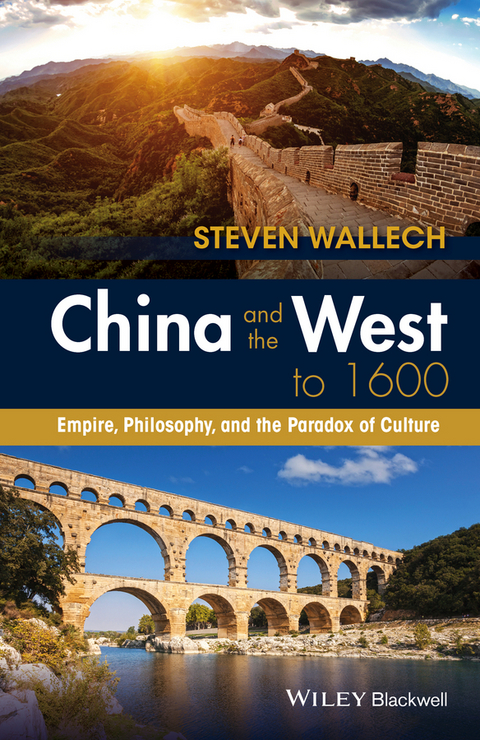
China and the West to 1600 (eBook)
John Wiley & Sons (Verlag)
978-1-118-88006-7 (ISBN)
Steven Wallech is the senior Professor of World History at Long Beach City College. He developed the world history program there, and integrated the world history curriculum with community colleges and universities throughout California. He is the author of World History: A Concise Thematic Analysis, Volumes One and Two (Wiley, 2012). He earned a Ph.D. in History from Claremont Graduate University and has been teaching at the college/university level for over 30 years.
Acknowledgements ix
Preface xi
Introduction 1
Maps 4
Timeline 7
1 The Paradox of Agriculture and its Impact on China and Western Civilization 8
The Oldest Paradox 8
Chinese Agriculture 13
The First Chinese Dynasties 19
Roman Agriculture 30
Italian Agriculture 31
Egypt 37
The Levant and Mesopotamia 41
Greece 43
Overview of the Roman Economy 46
Notes 49
2 Ancient Philosophy: Chinese versus Western 52
The Chinese Quest for Stability 54
Implementing Legalism: Li Si and the Qin Dynasty 65
The Han Dynasty 67
The Greek Worldview: Part One--the Problem 69
The Greek Worldview: Part Two--the Quest for a Solution 71
The Roman Worldview 79
The Kosmopolite 83
Christianity 84
Notes 92
3 The Nomads 96
Two Incompatible Lifestyles: Nomads versus Farmers 96
The Persistent Nomadic Threat, Cannon, and China's Three Main Issues 99
The Silk Road: Revelation of a Deadly Paradox of Culture 109
Loyalty, the State, and Paradise Lost 112
An Era of Chaos 116
The Fall of Rome 118
Chinese Potential for Reunification versus Western Fragmentation 120
Notes 123
4 Contrasting Medieval China and Europe 126
Unexpected Consequences 126
Revisiting the Paradox of Agriculture 128
The Sui Dynasty (581-618) 130
The Tang Dynasty (618-906) and the Rejuvenation of China 133
The Song (960-1279): The Golden Age Continues 140
A Nomadic Interlude 145
Evolution of Feudalism during the Fall of Rome 149
Medieval Agriculture: The Rise of Feudalism 152
The Late Middle Ages (1300-1500) 159
Contrasting Systems: A Unified China versus a Fragmented Europe 164
Notes 165
5 China and Medieval Europe: Cultural Orthodoxy and Creativity 169
The Economy, Administration, and Formation of a Chinese Orthodoxy 172
Foundations of a Medieval European Orthodoxy 180
A Revival of Learning: The Medieval Orthodoxy 189
Conclusions 203
Notes 204
6 The Nomad Apogee of Power 207
The Paradox of Culture Springs a Trap 207
Mongol Conquest and Rule 210
The Yuan Dynasty: A Century of Uneven Rule 221
The Ming Dynasty (1368-1644) 223
The Qing: The Second Nomadic Regime to Rule China (1644-1911) 231
Notes 244
7 Modernization 251
Germanic Europe during the Early Middle Ages 254
China does not Modernize: The Pitfalls of Tradition 286
Conclusion 296
Notes 297
Select Bibliography 301
Index 309
1
The Paradox of Agriculture and its Impact on China and Western Civilization
The Oldest Paradox
The use of agriculture created the first cultural paradox in world history, in that it both enabled the development and rise of the first civilizations and continuously threatened to undermine them and lead to their fall. This is because in the ancient era, they unintentionally created an artificial relationship with domesticated plants (and later animals) that was not permanently sustainable.
The first groups of people working in agriculture created a relationship with plants that proved to be quite unnatural. The circumstances that created this bond combined the warmth of a new climatic era at the end of the last Ice Age (around 18,000 years ago) with the appearance of an abundance of seed-bearing grasses that promised a bounty of new foods. In this new setting of melting ice, exposed new lands, and seed producing plants, hunters and gatherers began a new economy called foraging. These foragers collected seeds in different locations around the world by studying such plants as wild wheat, barley, rice, corn, lentils, chickpeas, peas, flax, rye, millets, sorghum, and so on, to learn their life cycles. These foragers learned that wild varieties of these plants produced pods that spontaneously opened to scatter their seeds on the wind and spread throughout the landscape. Studying the life cycle of these wild varieties taught these foragers when to approach clusters of these seed-bearing plants and harvest their kernels of food before they dispersed in the wind. Learning so much about the wild plants, these foragers noticed that every once in a while a rare genetic mutant appeared that did not scatter its seeds. This rare plant (one mutant in every two to four million wild plants) stood out because its pod did not open, its seeds grew to an unusually large size, and these seeds remained trapped with the parent plant.1 The large seeds in these unopened pods promised to provide a very rich diet if more of these plants could be found. But these plants did not reproduce.
Having learned a great deal about wild seed producing grasses, these foragers collected these mutant seeds whenever they appeared and sowed them rather than ate them. Very quickly, the number of mutant plants increased each year, changing fields of wild, seed-bearing plants into this rare mutant variety. By eating some of the large seeds, and planting the rest, these foragers unintentionally became farmers and rapidly began raising fields of mutant plants that could not reproduce on their own. A new bond had been forged: the first farmers in world history perpetuated the existence of plants that could not generate their numbers without human intervention.
Not surprisingly, this artificial bond between humans and their mutant plants led to a dramatic increase in the population of both. In a relatively short time this mutually beneficial relationship, which biologists call a “symbiosis,” changed the landscape. Wild varieties of seed-producing grasses gave way to human cultivators planting their mutant food sources. But this new symbiosis was not a natural relationship because these ancient farmers had sowed the seeds of plants that should have disappeared after one growing season.
Biologists refer to individual organisms that do not reproduce in the wild as omegas. The mutant plants that ancient farmers chose to cultivate certainly belonged to this category of life form. In contrast, biologists call successful organisms that do reproduce in the wild alphas. The wild variety of seed-producing grasses that scatter their seeds, sending them flying on the wind far away from the parent plant certainly belong to this category. These proved the most successful in the process Charles Darwin called “Natural Selection,” while planting mutant omega grasses required human intervention, or what biologists called “artificial selection.” All agricultural communities used artificial selection.
By selecting omega plants, the first farmers secured a reliable food source. The predictability of producing seeds from single omega parent plants provided offspring that matured at the same time and at the same rate. Also, since grasses are hermaphrodites, the male and female sex organs on the same mutant parent plant produced seeds with a very stable DNA. Such an abundance of food from a stable gene pool fed growing numbers of people and soon ancient farmers and their omega plants thrived together. The result was the rapid increase in the number of omega plants, as well as the number of those groups of people who had turned to agriculture (and by extension a sedentary lifestyle). As the number of humans and omega plants linked in the symbiotic relationship we know as agriculture continued to increase, these groups began to move aside the once widespread alpha plants, changed the physical landscape, and (unintentionally) narrowed the range of food sources available for human consumption. Soon thereafter, unintended consequences followed.
These consequences played out following a long and tortuous scenario, one repeated in more or less the same order in all long-lasting agricultural communities:
- The earliest form of agriculture, known as “slash and burn,” involved the killing of large forests of trees by stripping off their bark, burning the dead trees, and using the ash as fertilizer to grow omega plants.
- The human-omega plant symbiosis supported by slash and burn agriculture increased the total population of both groups of organisms.
- Continuous growth in the populations of sedentary human farmers and omega plants resulted in deforestation and altered the local landscape.
- Deforestation exposed the land under cultivation to soil depletion and erosion, making it particularly vulnerable to changes in climate, which could in turn lead to great ecological damage and even the collapse of the local ecosystem, the latter known as ecocide.
- Great ecological damage forced farmers to abandon exhausted fields and seek new locations in which they could settle and grow the crops upon which they had grown dependent for sustenance.
- The most desirable locations for permanent fields in which to grow crops were near rivers that could provide season after season of fresh soil and water thanks to annual floods of the river valleys and their nearby floodplains.
- In order to avoid drowning during these annual floods, local farmers began irrigation projects in attempt to both bring the water of the river closer to their fields and regulate the impact of the floods.
- Long periods of successful growing seasons and increased human numbers soon required farmers to devise methods to count their seeds, store them, and ration their supply in order to ensure a continuous supply of food to eat from harvest to harvest, year after year.
- The need to count seeds, measure time, and ration food supplies led to the development of mathematics, writing, and calendars by the people living in the successful farming communities.
- Those individuals who developed numbers, letters, characters, and concepts of time held specialized occupations, did not spend their days farming, and lived near one another in towns. These were near but separate from the fields and those individuals who remained tied to the land and had to tend to the crops on a daily basis.
- As human numbers continued to grow, towns became cities and the urban centers became the foundations of civilizations.
- As a civilization expanded, more and more of the surrounding local landscape fell under human control, causing nature to continue to retreat.
Eventually, however, nature always seemed to rebel. The increasingly large human imprint on the local ecology upset the delicate balance between ancient farmers, their omega plants, and the conditions that both needed to exist. This apparent natural rebellion could take the form of droughts, soil exhaustion, increased local aridity, violent floods, the sudden eruption of epidemic disease (whether in the human, or domesticated plant, or domesticated animal populations), or, most destructive of all, complete ecocide, or collapse of the power of the ecosystem to sustain life. Any and all of the unpleasant consequences of agriculture that inflicted damage on the natural environment could and usually did disrupt the human organization needed to continue to cultivate the local landscape. Such disruptions could cause a very high death rate among farmers and threaten the very foundations of a given civilization. Sometimes the inhabitants of the ancient farming community would find a way to recover from the disruption and continue to develop; sometimes the community would unravel and simply cease to exist. In either case, any surviving farmers found themselves still caught up in the incessant struggle to exist, but now sustenance by agricultural was the only way they knew how to feed themselves, so all who could do so moved to a new location, inevitably altering the landscape wherever they settled.
As agriculture developed in the ancient world, two very successful human communities that followed the above-mentioned scenario of humanity’s struggle with food production, its ecological impact, and its mounting population pressures, were China and the Western world. Within Chinese and Western civilizations’ long histories, Han China and Imperial Rome managed to produce the richest empires of the world’s ancient era and maintain a...
| Erscheint lt. Verlag | 30.3.2016 |
|---|---|
| Sprache | englisch |
| Themenwelt | Geschichte ► Allgemeine Geschichte ► Mittelalter |
| Geisteswissenschaften ► Geschichte ► Regional- / Ländergeschichte | |
| Schlagworte | Agriculture • Ancient Culture • Ancient history • Ancient World • Aristotle • barbarian invasion • Cannon • Cavalry • China • Christianity • city-state • comparative history • Confucianism • Cultural History • Cultural Studies • Daoism • Democracy • dynastic cycle • Fertile Crescent • feudalism • Germanic tribes • Geschichte • Ghengis Kahn • Greek Philosophy • Han dynasty • History • History Special Topics • Holy Roman Empire • Kulturwissenschaften • legalism • Middle Ages • Mongolian Empire • Mongols • northern steppe • Renaissance • Roman Empire • roman republic • Spezialthemen Geschichte • Voyages of Discovery • Weltgeschichte • Western civilization • Western Culture • Westliche Kultur • World History • Yangtze River • yellow river |
| ISBN-10 | 1-118-88006-4 / 1118880064 |
| ISBN-13 | 978-1-118-88006-7 / 9781118880067 |
| Informationen gemäß Produktsicherheitsverordnung (GPSR) | |
| Haben Sie eine Frage zum Produkt? |
 EPUB (Adobe DRM)
Kopierschutz: Adobe-DRM
Adobe-DRM ist ein Kopierschutz, der das eBook vor Mißbrauch schützen soll. Dabei wird das eBook bereits beim Download auf Ihre persönliche Adobe-ID autorisiert. Lesen können Sie das eBook dann nur auf den Geräten, welche ebenfalls auf Ihre Adobe-ID registriert sind.
Details zum Adobe-DRM
Dateiformat: EPUB (Electronic Publication)
EPUB ist ein offener Standard für eBooks und eignet sich besonders zur Darstellung von Belletristik und Sachbüchern. Der Fließtext wird dynamisch an die Display- und Schriftgröße angepasst. Auch für mobile Lesegeräte ist EPUB daher gut geeignet.
Systemvoraussetzungen:
PC/Mac: Mit einem PC oder Mac können Sie dieses eBook lesen. Sie benötigen eine
eReader: Dieses eBook kann mit (fast) allen eBook-Readern gelesen werden. Mit dem amazon-Kindle ist es aber nicht kompatibel.
Smartphone/Tablet: Egal ob Apple oder Android, dieses eBook können Sie lesen. Sie benötigen eine
Geräteliste und zusätzliche Hinweise
Buying eBooks from abroad
For tax law reasons we can sell eBooks just within Germany and Switzerland. Regrettably we cannot fulfill eBook-orders from other countries.
aus dem Bereich