


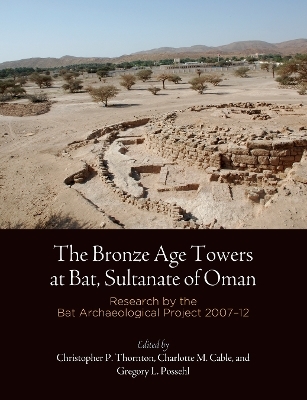
The Bronze Age Towers at Bat, Sultanate of Oman – Research by the Bat Archaeological Project, 27–12
Seiten
2017
University of Pennsylvania Museum of Archaeology & Anthropology (Verlag)
978-1-934536-06-3 (ISBN)
University of Pennsylvania Museum of Archaeology & Anthropology (Verlag)
978-1-934536-06-3 (ISBN)
Excavations at the UNESCO World Heritage Site of Bat in Oman (2007-2012) focused on third millennium B.C.E. stone towers. This most comprehensive study of its kind on the Oman Peninsula, explores the construction, chronology and purpose of these monumental structures, sheds light on the social and political dynamics of the ancient kingdom of Magan.
In the third millennium B.C.E., the Oman Peninsula was the site of an important kingdom known in Akkadian texts as "Magan," which traded extensively with the Indus Civilization, southern Iran, the Persian Gulf states, and southern Mesopotamia. Excavations have been carried out in this region since the 1970s, although the majority of studies have focused on mortuary monuments at the expense of settlement archaeology. While domestic structures of the Bronze Age have been found and are the focus of current research at Bat, most settlements dating from the third millennium B.C.E. in Oman and the U.A.E. are defined by the presence of large, circular monuments made of mudbrick or stone that are traditionally called "towers." Whether these so-called towers are defensive, agricultural, political, or ritual structures has long been debated, but very few comprehensive studies of these monuments have been attempted.
Between 2007 and 2012, the University of Pennsylvania Museum of Archaeology and Anthropology conducted excavations at the UNESCO World Heritage Site of Bat in the Sultanate of Oman under the direction of the late Gregory L. Possehl. The focus of these years was on the monumental stone towers of the third millennium B.C.E., looking at the when, how, and why of their construction through large-scale excavation, GIS-aided survey, and the application of radiocarbon dates. This has been the most comprehensive study of nonmortuary Bronze Age monuments ever conducted on the Oman Peninsula, and the results provide new insight into the formation and function of these impressive structures that surely formed the social and political nexus of Magan's kingdom.
In the third millennium B.C.E., the Oman Peninsula was the site of an important kingdom known in Akkadian texts as "Magan," which traded extensively with the Indus Civilization, southern Iran, the Persian Gulf states, and southern Mesopotamia. Excavations have been carried out in this region since the 1970s, although the majority of studies have focused on mortuary monuments at the expense of settlement archaeology. While domestic structures of the Bronze Age have been found and are the focus of current research at Bat, most settlements dating from the third millennium B.C.E. in Oman and the U.A.E. are defined by the presence of large, circular monuments made of mudbrick or stone that are traditionally called "towers." Whether these so-called towers are defensive, agricultural, political, or ritual structures has long been debated, but very few comprehensive studies of these monuments have been attempted.
Between 2007 and 2012, the University of Pennsylvania Museum of Archaeology and Anthropology conducted excavations at the UNESCO World Heritage Site of Bat in the Sultanate of Oman under the direction of the late Gregory L. Possehl. The focus of these years was on the monumental stone towers of the third millennium B.C.E., looking at the when, how, and why of their construction through large-scale excavation, GIS-aided survey, and the application of radiocarbon dates. This has been the most comprehensive study of nonmortuary Bronze Age monuments ever conducted on the Oman Peninsula, and the results provide new insight into the formation and function of these impressive structures that surely formed the social and political nexus of Magan's kingdom.
Christopher P. Thornton and Charlotte M. Cable are Codirectors of the Bat Archaeological Project. Gregory L. Possehl (1941-2011) was Professor Emeritus of Anthropology at the University of Pennsylvania and Curator Emeritus of the Asian Section at the University of Pennsylvania Museum of Archaeology and Anthropology.
| Erscheinungsdatum | 22.01.2017 |
|---|---|
| Verlagsort | Philadelphia |
| Sprache | englisch |
| Maße | 216 x 279 mm |
| Gewicht | 666 g |
| Themenwelt | Geisteswissenschaften ► Archäologie |
| Geschichte ► Allgemeine Geschichte ► Vor- und Frühgeschichte | |
| ISBN-10 | 1-934536-06-7 / 1934536067 |
| ISBN-13 | 978-1-934536-06-3 / 9781934536063 |
| Zustand | Neuware |
| Informationen gemäß Produktsicherheitsverordnung (GPSR) | |
| Haben Sie eine Frage zum Produkt? |
Mehr entdecken
aus dem Bereich
aus dem Bereich
auf den Spuren der frühen Zivilisationen
Buch | Hardcover (2023)
C.H.Beck (Verlag)
CHF 27,95
Erkennen. Bestimmen. Beschreiben
Buch | Softcover (2022)
Deutscher Kunstverlag
CHF 27,85


