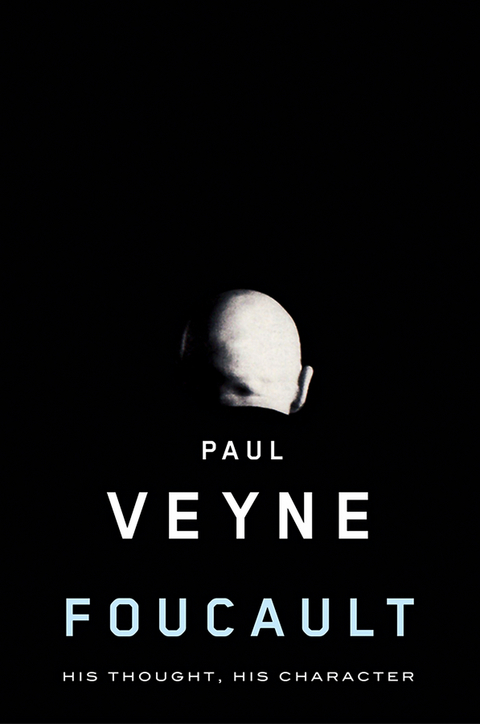
Foucault (eBook)
John Wiley & Sons (Verlag)
978-0-7456-8380-5 (ISBN)
A unique testimony by a scholar who knew Foucault well, this book succeeds brilliantly in grasping the core of his thought and in stripping away the confusions and misunderstandings that have so often characterized the interpretation of Foucault and his work.
Paul Veyne is Honorary Professor at the Collège de France.
Michel Foucault and Paul Veyne: the philosopher and the historian. Two major figures in the world of ideas, resisting all attempts at categorization. Two timeless thinkers who have long walked and fought together. In this short book Paul Veyne offers a fresh portrait of his friend and relaunches the debate about his ideas and legacy. Foucault is not who you think he is , writes Veyne; he stood neither on the left nor on the right and was frequently disowned by both. He was not so much a structuralist as a sceptic, an empiricist disciple of Montaigne, who never ceased in his work to reflect on 'truth games', on singular, constructed truths that belonged to their own time. A unique testimony by a scholar who knew Foucault well, this book succeeds brilliantly in grasping the core of his thought and in stripping away the confusions and misunderstandings that have so often characterized the interpretation of Foucault and his work.
Paul Veyne is Honorary Professor at the Collège de France.
Introduction 1
1 In Universal History, Everything is Singular:
'Discourse' 5
2 There is No 'a priori' that is Not Historical
22
3 Foucault's Scepticism 37
4 Archaeology 54
5 Universalism, Universals, Epigenesis: The Beginnings of
Christianity 59
6 Notwithstanding Heidegger, Man is an Intelligent Animal 66
7 The Physical and Human Sciences: Foucault's Programme
77
8 A Sociological History of Truths: Knowledge, Power, the Set-up
92
9 Was Foucault a Corrupter of the Young? Was He the Despair of
the Workers' Movement? 111
10 Foucault and Politics 125
11 Portrait of a Samurai 135
Notes 147
Index 187
"Paul Veyne's quirky and involving book is an idiosyncratic and
personal tribute, which is obviously, and movingly, deeply
felt."
The Philosophers' Magazine
"Foucault is well- known as one of the most influential thinkers
of the twentieth century. Writing from his profound knowledge of
the man, Paul Veyne here vividly brings out his character and
personality."
Geoffrey Lloyd, University of Cambridge
"It is fascinating to follow Paul Veyne's engagement with
Foucault: he was extremely close to Foucault, as the celebrated
history of sexuality developed as a project, and this essay, which
mixes reminiscences with argument and reflection, captures a real
flavour of the intellectual excitement of those times."
Simon Goldhill, University of Cambridge
1
In Universal History, Everything is Singular: ‘Discourse’
When The History of Madness was published, some of the most well-disposed French historians (including myself) failed at first to appreciate the scale and significance of the book. I thought Foucault was simply showing that our conception of madness has varied greatly in the course of the centuries. But that told us nothing new; we already knew that human realities betray a radical contingency (well known in the form of the ‘arbitrariness of cultures’) or, at the very least, are diverse and variable. There are no historical invariants, no essences, no natural objects. Our ancestors developed strange ideas about madness, sexuality, punishment and power. But it was as though we ourselves had silently recognized that those days of error were over, and believed that we were doing better than our ancestors and had discovered the truth around which they had stumbled. ‘That Greek text speaks of love in accordance with the ideas of the time,’ we would say to ourselves. But was our modern idea of love any better than theirs? We should not have presumed so to claim had that apparently trifling and unimportant question been put to us. But do we, even now, think about it seriously and philosophically? Foucault did.
I had not realized that, without claiming to, Foucault was taking part in one of the great debates in modern thinking: does truth, or does it not, correspond to its object; does it or does it not resemble what it states, as common sense supposes? The fact is that it is hard to see how we could possibly know if it does resemble what it states, since we have no other source of information that might offer confirmation. But let that pass. For Foucault, as for Nietzsche, William James, Austin, Wittgenstein, Ian Hacking and many others, each of them with views of their own, knowledge cannot be a faithful mirror to reality. No more than Richard Rorty1 does Foucault believe in that mirror, or in that ‘specular’ concept of knowledge. According to him, the object, in all its materiality, cannot be separated from the formal frameworks through which we come to know it, frameworks that Foucault, settling upon an ill-chosen word, calls ‘discourse’. That, in a nutshell, says it all.
Misunderstood, this concept of truth not corresponding to reality has made some people believe2 that, according to Foucault, mad people were not mad and that to speak of madness was nothing but ideology. Even a man such as Raymond Aron believed this to be the line taken by A History of Madness, as he told me, without beating about the bush; he protested that madness is all too real: you only need to see a madman to be sure of that. And he was quite right. Foucault himself held that, even though madness was not what its ‘discourse’ claimed it to be, that did not mean that there was no such thing.3
So what does Foucault mean by ‘discourse’? Something very simple: a most precise and close description of a historical formation, stripped bare, a revelation of its ultimate individual difference.4 Reaching the differentia ultima of a dated singularity requires an intellectual effort of perception: it is necessary to strip the event of the excessive draperies that make it unexceptional and rationalize it. The consequences of doing so are far-reaching, as we shall see.
In his first book, Foucault's heuristic starting point was a classification of the ‘discourse’ on what we call madness (or insanity, as earlier ‘discourse’ put it). The books that followed offered other subjects to exemplify the sceptic philosophy that he had developed from his attention to details. However, he himself never fully expounded his doctrine, but left that redoubtable task to his commentators.5
In the present work, I shall be endeavouring to explain to myself the thought of this man who was a great friend and, it seems to me, a great mind. I shall be citing repeatedly from his Dits et Ecrits (Sayings and Writings), as he refers there to the bases of his doctrine more often than he does in his major works.
Before I take the plunge, though, let us consider an example. Suppose we were planning to write a history of love or of sexuality through the ages. We might feel satisfied with our work when we had reached the point at which a reader could learn about the variations that pagans or Christians had elaborated, in their ideas and practices, on the well-known theme of sex. But suppose, having reached that point, there was still something that bothered us and we thought that we should press on further with our analysis. We might, for example, have felt that in one way or another a Greek or medieval author had expressed himself using particular words or turns of phrase which, despite our analysis, left a residue, a hint that suggested that, instead of taking no notice of that residue, as if it were just a clumsy expression, an approximation, a dead passage in the text, we should make an extra effort to make explicit what it appeared to imply. And suppose we were successful.
Then the scales would fall from our eyes: once a variation is made thoroughly explicit, the eternal theme is wiped out and all that remain in its place are successive variations, all different from one another, which we may call the ‘pleasures’ of Antiquity, the ‘flesh’ of the Middle Ages and the ‘sexuality’ of the modern age. Those are three general ideas that some people have successively elaborated around a kernel that is incontestably real and probably trans-historical, but that remains inaccessible, lurking behind them. Inaccessible or, rather, impossible to extricate: we would inevitably turn them into ‘discourse’.
Let us suppose that, thanks to the ‘programme’ of some branch of science, we learn something true, something scientific about homosexuality (for Foucault, the sciences amounted to more than empty words): for example (a gratuitous supposition on my part), that homosexual tastes are genetic in origin. Well, and then what? What, actually, is homosexuality? What should we do with that nugget, be it small or large, of the truth? Foucault wanted there to be some kind of ‘discourse’ on the subject of even an insignificant detail that related solely to anatomy or physiology, and not to the identity of individuals: in short, some detail that one would only discuss either in bed or with one's doctor.
Do we really need a true sex? [the ironic italics are Foucault's own.] With a consistency that borders on stubbornness, the societies of the modern West have replied in the affirmative. They have relentlessly brought up this question of ‘a true sex’ within an order of things in which one might have imagined that all that counted was the reality of bodies and the intensity of their pleasures.6
Love in Antiquity gave rise to ‘discourse’ about the ‘pleasures’ of Aphrodite that were in no way suspect, and about how they should be controlled ethically and within the city. It addressed amorous gestures of the period, as timid as it was sinless, a period in which, at night, only a libertine would make love, not in the dark, but by lamplight, and in which civic morality distinguished not so much between the sexes as between the active and passive roles of the lovers – a period in which the ideal of self-control meant that a Don Juan would be considered effeminate and in which the obsessional reprobation of cunnilingus (which, nonetheless, was practised) implied a reversal of a hierarchy of the sexes; a period in which a pederast became a figure of fun because he carried his pleasure so far that his heart was left as bereft of feeling as an artichoke.
Now let us take an example less agreeable than love: the penal code through the ages. It is not enough to say that, under the ancien régime, punishments were atrocious, reflecting the brutality of the mores of the age. The royal sovereign ‘came down with all his might’, inflicting the horrific tortures of the period upon a rebellious subject, so as to demonstrate to all and sundry the enormity of both the punishment and the disproportion between the powers of the rebel and those of his king, whom the ceremonial torture avenged. With the advent of the Age of Enlightenment, punishment inflicted in private by a specialized administrative apparatus became preventative and corrective. Now imprisonment was to be a coercive technique of training, designed to set in place new habits in any citizen who had no respect for the law.7 This was assuredly an instance of humanitarian progress, but we need furthermore to recognize that it was not just an improvement: it was a total change.
Fifteen centuries earlier, in the arenas of the Roman Empire, the deaths of those condemned were prepared in mythological settings. A condemned man was dressed up in the costume of a Heracles committing suicide by fire, and was burnt alive; Christian women were disguised as Danaids and were accordingly raped before they died, or else as Dirce, strapped to the horns of a bull. These were sarcastic staged events, each one a ludibrium. The civic body, which the offender had presumed to rival, sneered at him, laughing in his face, to show him that he was not the stronger. Each of those successive ‘discourses’ was implied in the penal law, actions, institutions, powers, customs and even buildings, all of which reflected it and formed what Foucault calls the ‘set-up’ (dispositif)....
| Erscheint lt. Verlag | 23.3.2016 |
|---|---|
| Sprache | englisch |
| Themenwelt | Geisteswissenschaften ► Philosophie ► Allgemeines / Lexika |
| Geisteswissenschaften ► Philosophie ► Philosophie der Neuzeit | |
| Geisteswissenschaften ► Psychologie ► Allgemeines / Lexika | |
| Geisteswissenschaften ► Psychologie ► Allgemeine Psychologie | |
| Schlagworte | Foucault, Michel • Philosophy, Post-structuralism • Psychologie • Psychology |
| ISBN-10 | 0-7456-8380-0 / 0745683800 |
| ISBN-13 | 978-0-7456-8380-5 / 9780745683805 |
| Informationen gemäß Produktsicherheitsverordnung (GPSR) | |
| Haben Sie eine Frage zum Produkt? |
 EPUB (Adobe DRM)
Kopierschutz: Adobe-DRM
Adobe-DRM ist ein Kopierschutz, der das eBook vor Mißbrauch schützen soll. Dabei wird das eBook bereits beim Download auf Ihre persönliche Adobe-ID autorisiert. Lesen können Sie das eBook dann nur auf den Geräten, welche ebenfalls auf Ihre Adobe-ID registriert sind.
Details zum Adobe-DRM
Dateiformat: EPUB (Electronic Publication)
EPUB ist ein offener Standard für eBooks und eignet sich besonders zur Darstellung von Belletristik und Sachbüchern. Der Fließtext wird dynamisch an die Display- und Schriftgröße angepasst. Auch für mobile Lesegeräte ist EPUB daher gut geeignet.
Systemvoraussetzungen:
PC/Mac: Mit einem PC oder Mac können Sie dieses eBook lesen. Sie benötigen eine
eReader: Dieses eBook kann mit (fast) allen eBook-Readern gelesen werden. Mit dem amazon-Kindle ist es aber nicht kompatibel.
Smartphone/Tablet: Egal ob Apple oder Android, dieses eBook können Sie lesen. Sie benötigen eine
Geräteliste und zusätzliche Hinweise
Buying eBooks from abroad
For tax law reasons we can sell eBooks just within Germany and Switzerland. Regrettably we cannot fulfill eBook-orders from other countries.
aus dem Bereich