


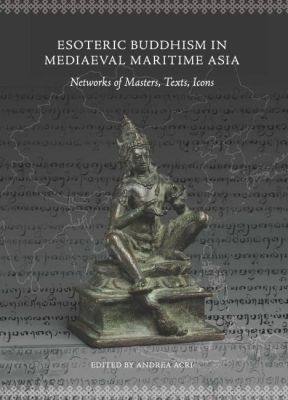
Esoteric Buddhism in Mediaeval Maritime Asia
Networks of Masters, Texts, Icons
Seiten
2016
Iseas (Verlag)
978-981-4695-08-4 (ISBN)
Iseas (Verlag)
978-981-4695-08-4 (ISBN)
- Titel nicht im Sortiment
- Artikel merken
Advocates a trans-regional, and maritime, approach to studying the genesis, development and circulation of tantric (or Esoteric) Buddhism across Maritime Asia from the seventh to the thirteenth centuries CE. The book lays emphasis on the mobile networks of human agents (“Masters”), textual sources (“Texts”) and images (“Icons”) through which tantric Buddhist traditions spread.
This volume advocates a trans-regional, and maritime, approach to studying the genesis, development and circulation of tantric (or Esoteric) Buddhism across Maritime Asia from the seventh to the thirteenth centuries CE. The book lays emphasis on the mobile networks of human agents (‘Masters’), textual sources (‘Texts’) and images (‘Icons’) through which tantric Buddhist traditions spread.
Capitalising on recent research and making use of both disciplinary and area-focused perspectives, this book highlights the role played by tantric Buddhist maritime networks in shaping intra-Asian connectivity. In doing so, it reveals the limits of a historiography that is premised on land-based transmission of Buddhism from a South Asian ‘homeland’ and advances an alternative historical narrative that overturns the popular perception regarding Southeast Asia as a ‘periphery’ that passively received overseas influences. Thus, a strong point is made for the appreciation of the region as both a crossroads and rightful terminus of Buddhist cults, and for the re-evaluation of the creative and transformative force of Southeast Asian agents in the transmission of tantric Buddhism across mediaeval Asia.
This volume advocates a trans-regional, and maritime, approach to studying the genesis, development and circulation of tantric (or Esoteric) Buddhism across Maritime Asia from the seventh to the thirteenth centuries CE. The book lays emphasis on the mobile networks of human agents (‘Masters’), textual sources (‘Texts’) and images (‘Icons’) through which tantric Buddhist traditions spread.
Capitalising on recent research and making use of both disciplinary and area-focused perspectives, this book highlights the role played by tantric Buddhist maritime networks in shaping intra-Asian connectivity. In doing so, it reveals the limits of a historiography that is premised on land-based transmission of Buddhism from a South Asian ‘homeland’ and advances an alternative historical narrative that overturns the popular perception regarding Southeast Asia as a ‘periphery’ that passively received overseas influences. Thus, a strong point is made for the appreciation of the region as both a crossroads and rightful terminus of Buddhist cults, and for the re-evaluation of the creative and transformative force of Southeast Asian agents in the transmission of tantric Buddhism across mediaeval Asia.
Andrea Acri is Visiting Research Fellow at the Nalanda-Sriwijaya Centre, ISEAS–Yusof Ishak Institute, Singapore.
| Erscheinungsdatum | 26.11.2016 |
|---|---|
| Sprache | englisch |
| Maße | 213 x 276 mm |
| Gewicht | 1264 g |
| Themenwelt | Geisteswissenschaften ► Geschichte ► Regional- / Ländergeschichte |
| Geisteswissenschaften ► Religion / Theologie ► Buddhismus | |
| Sozialwissenschaften ► Politik / Verwaltung | |
| Wirtschaft ► Volkswirtschaftslehre | |
| ISBN-10 | 981-4695-08-4 / 9814695084 |
| ISBN-13 | 978-981-4695-08-4 / 9789814695084 |
| Zustand | Neuware |
| Informationen gemäß Produktsicherheitsverordnung (GPSR) | |
| Haben Sie eine Frage zum Produkt? |
Mehr entdecken
aus dem Bereich


aus dem Bereich
die Geschichte meiner Urgroßmutter
Buch | Hardcover (2025)
C.H.Beck (Verlag)
CHF 32,15
Träume und Macht : eine Biografie
Buch | Hardcover (2025)
C.H.Beck (Verlag)
CHF 61,60


