


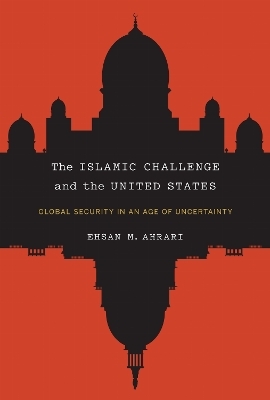
The Islamic Challenge and the United States
Global Security in an Age of Uncertainty
Seiten
2017
McGill-Queen's University Press (Verlag)
9780773548169 (ISBN)
McGill-Queen's University Press (Verlag)
9780773548169 (ISBN)
- Titel z.Zt. nicht lieferbar
- Versandkostenfrei
- Auch auf Rechnung
- Artikel merken
Examining the sources and prospects of the dominant conflict of our era: the confrontation between Islam and the United States.
On September 11, 2001, Osama bin Laden declared "global jihad" on the West. In response to the day's attacks, the United States has waged its own global war on terrorism, which the Pentagon has described as a generational conflict similar to the Cold War. In The Islamic Challenge and the United States, Ehsan Ahrari takes a close look at this ideological conflict, focusing on the Middle East, Africa, and South and Central Asia. Arguing that the war on terrorism is founded on secular fundamentalism (an ideology that envisions Islam as dangerous and volatile because it mixes religion and politics) and the Enlightenment narrative, Ahrari suggests that the United States sees global jihadists as absolutist, irrational, obscurantist, and anti-modern. While violence on behalf of the Muslim community – ummah – is thus framed as reprehensible, violence on behalf of the Western nation-state is seen as sometimes necessary and often praiseworthy. Unsettlingly, this framework does not encourage careful scrutiny of America's historical dealings with the Muslim world. The belief that religion causes violence, Ahrari argues, may blind the West to its own forms of fanaticism. A timely analysis of one of the most contested issues of our times, The Islamic Challenge and the United States is a must-read for global security practitioners, policymakers, and general readers.
On September 11, 2001, Osama bin Laden declared "global jihad" on the West. In response to the day's attacks, the United States has waged its own global war on terrorism, which the Pentagon has described as a generational conflict similar to the Cold War. In The Islamic Challenge and the United States, Ehsan Ahrari takes a close look at this ideological conflict, focusing on the Middle East, Africa, and South and Central Asia. Arguing that the war on terrorism is founded on secular fundamentalism (an ideology that envisions Islam as dangerous and volatile because it mixes religion and politics) and the Enlightenment narrative, Ahrari suggests that the United States sees global jihadists as absolutist, irrational, obscurantist, and anti-modern. While violence on behalf of the Muslim community – ummah – is thus framed as reprehensible, violence on behalf of the Western nation-state is seen as sometimes necessary and often praiseworthy. Unsettlingly, this framework does not encourage careful scrutiny of America's historical dealings with the Muslim world. The belief that religion causes violence, Ahrari argues, may blind the West to its own forms of fanaticism. A timely analysis of one of the most contested issues of our times, The Islamic Challenge and the United States is a must-read for global security practitioners, policymakers, and general readers.
Ehsan M. Ahrari is a former professor at the US Air War College, the National Defense University, and the Asia-Pacific Center for Security Studies.
| Erscheinungsdatum | 04.02.2017 |
|---|---|
| Verlagsort | Montreal |
| Sprache | englisch |
| Maße | 152 x 229 mm |
| Gewicht | 709 g |
| Themenwelt | Geisteswissenschaften ► Religion / Theologie ► Islam |
| Sozialwissenschaften ► Politik / Verwaltung ► Europäische / Internationale Politik | |
| Sozialwissenschaften ► Politik / Verwaltung ► Politische Theorie | |
| Sozialwissenschaften ► Politik / Verwaltung ► Staat / Verwaltung | |
| ISBN-13 | 9780773548169 / 9780773548169 |
| Zustand | Neuware |
| Informationen gemäß Produktsicherheitsverordnung (GPSR) | |
| Haben Sie eine Frage zum Produkt? |
Mehr entdecken
aus dem Bereich



aus dem Bereich


