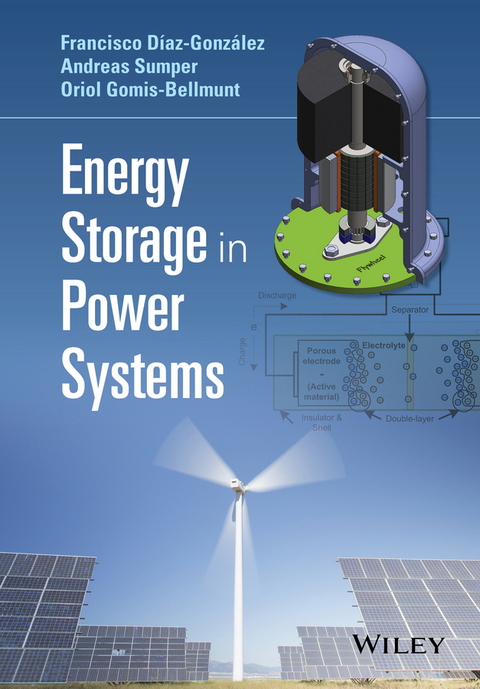
Over the last century, energy storage systems (ESSs) have continued to evolve and adapt to changing energy requirements and technological advances. Energy Storage in Power Systems describes the essential principles needed to understand the role of ESSs in modern electrical power systems, highlighting their application for the grid integration of renewable-based generation.
Key features:
- Defines the basis of electrical power systems, characterized by a high and increasing penetration of renewable-based generation.
- Describes the fundamentals, main characteristics and components of energy storage technologies, with an emphasis on electrical energy storage types.
- Contains real examples depicting the application of energy storage systems in the power system.
- Features case studies with and without solutions on modelling, simulation and optimization techniques.
Although primarily targeted at researchers and senior graduate students, Energy Storage in Power Systems is also highly useful to scientists and engineers wanting to gain an introduction to the field of energy storage and more specifically its application to modern power systems.
Francisco Díaz-González, Catalonia Institute for Energy Research, Spain
Francisco Díaz-González received his degree in industrial engineering from the School of Industrial Engineering of Barcelona, Technical University of Catalonia (UPC), Barcelona, Spain, in 2009, and his Ph.D. degree in electrical engineering from the UPC in 2013. He has experience in electrical and mechanical systems modeling and simulation. Between September 2009 and June 2015 he was based with the Catalonia Institute for Energy Research, Barcelona, Spain, but since July 2015, he has been based with CITCEA-UPC research group. His current research interests include the fields linked with energy storage technologies, electrical machines, and renewable energy integration in power systems.
Andreas Sumper, Centre d'Innovació Tecnològica en Convertidors Estàtics i Accionaments, Universitat Politècnica de Catalunya, Barcelona, Spain
Andreas Sumper received his Dipl.-Ing. degree in electrical engineering from the Graz University of Technology (Austria) in 2000 and his Ph.D. degree in electrical engineering from the Universitat Politècnica de Catalunya (UPC), Barcelona, Spain, in 2008. Since 2014 he has been an Associate Professor at the UPC and he leads the Smart Grid Research at CITCEA-UPC. His research interests are renewable energy generation, microgrids and smart grids, power system studies, and energy management.
Oriol Gomis-Bellmunt,Centre d'Innovació Tecnològica en Convertidors Estàtics i Accionaments, Universitat Politècnica de Catalunya, Barcelona, Spain
Oriol Gomis-Bellmunt received his degree in industrial engineering from the School of Industrial Engineering of Barcelona, Technical University of Catalonia (UPC), Barcelona, Spain, in 2001, and his Ph.D. degree in electrical engineering from the UPC, in 2007. Since 2004, he has been with the Department of Electrical Engineering, UPC, where he is a Lecturer and participates in the CITCEA-UPC research group. His research interests include the fields linked with smart actuators, electrical machines, power electronics, renewable energy integration in power systems, industrial automation and engineering education.
Over the last century, energy storage systems (ESSs) have continued to evolve and adapt to changing energy requirements and technological advances. Energy Storage in Power Systems describes the essential principles needed to understand the role of ESSs in modern electrical power systems, highlighting their application for the grid integration of renewable-based generation. Key features: Defines the basis of electrical power systems, characterized by a high and increasing penetration of renewable-based generation. Describes the fundamentals, main characteristics and components of energy storage technologies, with an emphasis on electrical energy storage types. Contains real examples depicting the application of energy storage systems in the power system. Features case studies with and without solutions on modelling, simulation and optimization techniques. Although primarily targeted at researchers and senior graduate students, Energy Storage in Power Systems is also highly useful to scientists and engineers wanting to gain an introduction to the field of energy storage and more specifically its application to modern power systems.
Francisco Díaz-González, Catalonia Institute for Energy Research, Spain Francisco Díaz-González received his degree in industrial engineering from the School of Industrial Engineering of Barcelona, Technical University of Catalonia (UPC), Barcelona, Spain, in 2009, and his Ph.D. degree in electrical engineering from the UPC in 2013. He has experience in electrical and mechanical systems modeling and simulation. Between September 2009 and June 2015 he was based with the Catalonia Institute for Energy Research, Barcelona, Spain, but since July 2015, he has been based with CITCEA-UPC research group. His current research interests include the fields linked with energy storage technologies, electrical machines, and renewable energy integration in power systems. Andreas Sumper, Centre d'Innovació Tecnològica en Convertidors Estàtics i Accionaments, Universitat Politècnica de Catalunya, Barcelona, Spain Andreas Sumper received his Dipl.-Ing. degree in electrical engineering from the Graz University of Technology (Austria) in 2000 and his Ph.D. degree in electrical engineering from the Universitat Politècnica de Catalunya (UPC), Barcelona, Spain, in 2008. Since 2014 he has been an Associate Professor at the UPC and he leads the Smart Grid Research at CITCEA-UPC. His research interests are renewable energy generation, microgrids and smart grids, power system studies, and energy management. Oriol Gomis-Bellmunt,Centre d'Innovació Tecnològica en Convertidors Estàtics i Accionaments, Universitat Politècnica de Catalunya, Barcelona, Spain Oriol Gomis-Bellmunt received his degree in industrial engineering from the School of Industrial Engineering of Barcelona, Technical University of Catalonia (UPC), Barcelona, Spain, in 2001, and his Ph.D. degree in electrical engineering from the UPC, in 2007. Since 2004, he has been with the Department of Electrical Engineering, UPC, where he is a Lecturer and participates in the CITCEA-UPC research group. His research interests include the fields linked with smart actuators, electrical machines, power electronics, renewable energy integration in power systems, industrial automation and engineering education.
Preface
From the outset, the electric power system has been designed to maintain a balance between generation and consumption in real time. This implies severe constraints regarding the short- and long-term operation of the system in terms of security, stability, and the sizing of the units. The current design paradigm is now challenged by the massive rollout of storage units in the power system. In recent years, the electric power system has been undergoing a transition caused by the massive introduction of intermittent renewable generation, which causes a need to incorporate advanced supervision and control features into the classical network operation. With the exponentially increasing numbers of units to be supervised and controlled, advanced computational methods combined with intelligent algorithms will enable the future Smart Grid. Energy storage has not been an initial driver that has triggered the Smart Grid, but it is now definitively a key part of the Smart Grid, not only facilitating the change of technology and design, but also the overlying business models.
The Smart Grid is somehow a starting point that is enabling the massive rollout of storage, leveraging the participation of novel players in the electricity markets who have different business objectives. One important feature of energy storage in power systems is the ability to smoothen intermittent renewable generation, both for large and small-sized operations. The massive rollout of renewables will drive the use of different (centralized or decentralized) storage solutions, which will create a sufficient market size for the storage technology and push the development of the technology.
The origin of this book can be traced back to 2009, when Francisco joined the Catalonia Institute for Energy Research (IREC) to start his doctoral thesis. Andreas and Oriol became his supervisors, and rapidly decided to focus the efforts on the utilization of energy storage technologies in wind power plants. We had gained some experience working in We had some experience working in the Centre d’Innovació Tecnològica en Convertidors Estàtics i Accionaments, Technical University of Catalonia (CITCEA–UPC) and IREC on electrical systems and on grid integration of wind farms in some projects with Ecotecnia (which was acquired by Alstom, becoming the wind division of the Alstom group). At that time, we started to move away from the concept of the wind farm to the more appropriate term “wind power plant.” Wind power was no longer a fancy green alternative source of energy, which could generate power when the wind blew. It was now part of a massive business, which already bore a very serious level of responsibility in the operation of the whole power system. Transmission system operators were drafting very demanding grid codes, in which wind farms were treated as dependable power plants.
We remember having discussions with some engineers in Ecotecnia (Alstom Renewables, wind division) about the possibility of incorporating energy storage in the wind turbines in order to provide ancillary services. Additionally, these devices could be used for other purposes, as power smoothing, correction of production forecasts, and energy market operations. While the potential of energy storage was evident, there were differing opinions on where to locate the storage, what technology to use, and how to size such energy storage systems. Some engineers supported the idea of wind turbines equipped with energy storage devices that could allow the smooth provision of power adjusted to the forecasted production levels and that could eventually provide ancillary services to the grid. Others argued that it made more sense to operate a single, larger energy storage device at the wind power plant level and provide the same services in an aggregated manner. Other colleagues stressed that eventually energy storage should be deployed on the demand side, close to the consumer, and that it should be combined with demand-side management. Finally, other engineers defended the idea that the optimal solution was to locate the energy storage devices in the distribution substations.
During the realization of the doctoral thesis, some contributions were made on the modeling and control of energy storage systems, especially flywheels combined with wind power plants. Francisco built a scaled test rig with which he could gain some practical experience and demonstrate the possibility of power smoothing using a flywheel. We also realized that there were some impressive advances in the development of energy storage technologies and also on different applications in electric power systems. For example, energy storage was being considered as the only possible solution for preventing rapid power drops in large photovoltaic power plants and in renewable power plants in general. Energy storage was also the backbone of the microgrid concept (which is absolutely necessary to balance power flows) and the lung of the Smart Grid of the future.
By the time the thesis came to an end and was successfully defended in September 2013, we realized that we were starting to understand the potential of energy storage in power systems with a high penetration of renewable energy. Our beliefs regarding the huge potential of energy storage utilization in future power systems triggered the idea of expanding the work done in the doctoral thesis, and in other projects that we had been developing, and start the adventure of writing a book on the topic. At that time, we probably did not appreciate the massive amount of work that was awaiting us when we began the preparation of this book in April 2014.
Let us move forward to spring 2015, at which time we were working to submit the manuscript to the publisher on time. We were writing this preface in the hope and belief that this book could provide some useful guidance to engineers and professionals interested in the utilization of energy storage in power systems that are rich in renewable energy sources. Nowadays, we often hear news stories about paradigm shifts and energy revolutions that will eventually change the way in which we understand electric power in our society. In all these communications, energy storage is part of the equation. We are not certain how future electrical energy systems will be shaped, but we trust that energy storage will play an important role.
According to the scope of the book, its contents are divided into eight main chapters. Chapter 1 first introduces readers to modern power systems. Electric power systems are experiencing a dramatic transformation from the conventional vertically integrated approach with few control actors, towards a system with a high penetration of renewable (and intermittent) generation and, as a consequence, a highly controlled system at any voltage level. As previously noted, such a transformation suggests the introduction of the term “Smart Grid,” and this is one of the main concepts underpinning future power system architectures. The Smart Grid architecture is defined in terms of domains, zones, and layers, and these are presented in the chapter. After the presentation of the power system architecture, the chapter continues with the presentation of energy management systems and the fundamentals of power system analysis. In this regard, basic concepts on optimization methods and optimal power flow computational techniques are presented. Viewed together, this results in a didactic approach to an understanding of the fundamentals of power systems. Moreover, though, the chapter also includes a practical example on load-flow calculation.
One of the main drivers of power system transformation is the field of renewable generation, and as such this is presented in Chapter 2. The chapter first discusses the contribution of the various forms of renewable energy in the worldwide energy mix. After this presentation, the chapter classifies the renewable power generation technologies into those based on rotative electrical generators, mechanically coupled to turbines or similar devices (e.g., wind turbines and hydropower); and those based on static power generation sources, producing electricity without any moving devices (e.g., photovoltaics). With regard to the former, the chapter describes wind turbine topologies in detail, and offers two numerical examples on the calculation of the power generated by both fixed- and variable-speed turbines. Finally, with regard to static renewable-based generating technologies, the chapter introduces the concept of photovoltaic generation and proposes a calculation on the analysis of PV panels. The chapter concludes with a brief presentation of the grid code requirements for the grid connection of renewables.
With the stepwise displacement of conventional generating plants by nonsynchronized renewable-based ones, the net level of synchronous power reserves in the system becomes reduced, and this can affect the frequency control in the system. For such reasons, and according to some European grid codes, wind power plants are required to provide power reserves in the same way as conventional generating units. As a contribution to the description of the requirements for the grid connection of renewables, Chapter 3 presents an extensive literature review on the European grid codes with regard to frequency support. While the chapter looks specifically at wind power plants, the results can be exported to other renewable energy generation technologies. Apart from discussing on grid codes, the chapter includes an extensive literature review on control methods for operating wind turbines, so that they can maintain a predetermined level of power reserves, thus enabling them to participate in tasks related...
| Erscheint lt. Verlag | 10.3.2016 |
|---|---|
| Sprache | englisch |
| Themenwelt | Geisteswissenschaften ► Geschichte |
| Naturwissenschaften ► Physik / Astronomie | |
| Technik ► Elektrotechnik / Energietechnik | |
| Schlagworte | batteries • Control • Energie • Energiespeicherung • Energy • Energy storae applications • Energy Storage • Flywheels • Modeling • Photovoltaics • Power Systems • Renewable Generation • Simulation • Stromversorgungssystem • supercapacitors • Wind Power |
| ISBN-13 | 9781118971307 / 9781118971307 |
| Informationen gemäß Produktsicherheitsverordnung (GPSR) | |
| Haben Sie eine Frage zum Produkt? |
 EPUB (Adobe DRM)
Kopierschutz: Adobe-DRM
Adobe-DRM ist ein Kopierschutz, der das eBook vor Mißbrauch schützen soll. Dabei wird das eBook bereits beim Download auf Ihre persönliche Adobe-ID autorisiert. Lesen können Sie das eBook dann nur auf den Geräten, welche ebenfalls auf Ihre Adobe-ID registriert sind.
Details zum Adobe-DRM
Dateiformat: EPUB (Electronic Publication)
EPUB ist ein offener Standard für eBooks und eignet sich besonders zur Darstellung von Belletristik und Sachbüchern. Der Fließtext wird dynamisch an die Display- und Schriftgröße angepasst. Auch für mobile Lesegeräte ist EPUB daher gut geeignet.
Systemvoraussetzungen:
PC/Mac: Mit einem PC oder Mac können Sie dieses eBook lesen. Sie benötigen eine
eReader: Dieses eBook kann mit (fast) allen eBook-Readern gelesen werden. Mit dem amazon-Kindle ist es aber nicht kompatibel.
Smartphone/Tablet: Egal ob Apple oder Android, dieses eBook können Sie lesen. Sie benötigen eine
Geräteliste und zusätzliche Hinweise
Buying eBooks from abroad
For tax law reasons we can sell eBooks just within Germany and Switzerland. Regrettably we cannot fulfill eBook-orders from other countries.
aus dem Bereich