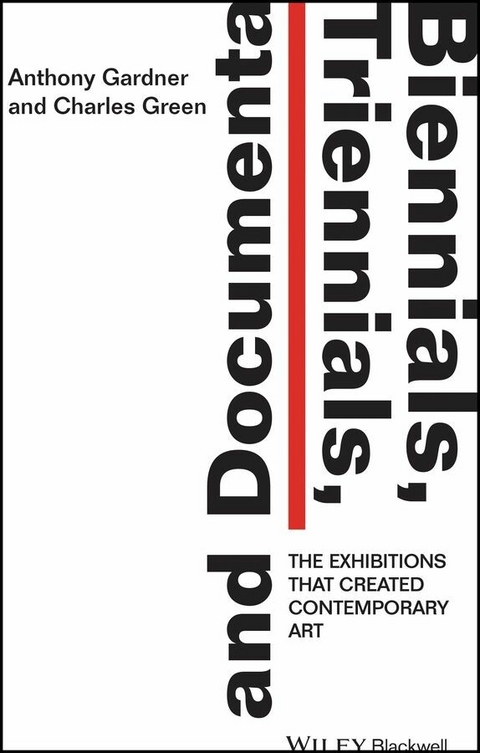
Biennials, Triennials, and Documenta (eBook)
John Wiley & Sons (Verlag)
978-1-119-21267-6 (ISBN)
- Provides a comprehensive global history of biennialization from the rise of the European star-curator in the 1970s to the emergence of mega-exhibitions in Asia in the 1990s
- Introduces a global array of case studies to illustrate the trajectory of biennials and their growing influence on artistic expression, from the Biennale de la Méditerranée in Alexandria, Egypt in 1955, the second Havana Biennial of 1986, New York's Whitney Biennial in 1993, and the 2002 Documenta11 in Kassel, to the Gwangju Biennale of 2014
- Explores the evolving curatorial approaches to biennials, including analysis of the roles of sponsors, philanthropists and biennial directors and their re-shaping of the contemporary art scene
- Uses the history of biennials as a means of illustrating and inciting further discussions of globalization in contemporary art
Charles Green is Professor of Contemporary Art at the University of Melbourne. He is the author of The Third Hand: Artist Collaborations from Conceptualism to Postmodernism (2001) and Peripheral Vision: Contemporary Australian Art 1970-94 (1995) and co-author of Framing Conflict: War, Peace and Aftermath (2014, with L. Brown and J. Cattapan). As Adjunct Senior Curator of Contemporary Art at the National Gallery of Victoria he co-curated Fieldwork: Australian Art 1968-2002 (2002), world rush_4 artists (2003), 2004: Australian Visual Culture Now (ACMI/NGVA, 2004), and 2006: Contemporary Commonwealth (ACMI/NGVA, 2006). Green is also an artist working in collaboration with Lyndell Brown since 1989.
Anthony Gardner is Associate Professor in Contemporary Art History and Theory at the Ruskin School of Art at the University of Oxford. He is the author of Politically Unbecoming: Postsocialist Art Against Democracy (2015), the editor of Mapping South: Journeys in South-South Cultural Relations (2013) and a co-editor of the journal ArtMargins.
Charles Green is Professor of Contemporary Art at the University of Melbourne. He is the author of The Third Hand: Artist Collaborations from Conceptualism to Postmodernism (2001) and Peripheral Vision: Contemporary Australian Art 1970-94 (1995) and co-author of Framing Conflict: War, Peace and Aftermath (2014, with L. Brown and J. Cattapan). As Adjunct Senior Curator of Contemporary Art at the National Gallery of Victoria he co-curated Fieldwork: Australian Art 1968-2002 (2002), world rush_4 artists (2003), 2004: Australian Visual Culture Now (ACMI/NGVA, 2004), and 2006: Contemporary Commonwealth (ACMI/NGVA, 2006). Green is also an artist working in collaboration with Lyndell Brown since 1989. Anthony Gardner is Associate Professor in Contemporary Art History and Theory at the Ruskin School of Art at the University of Oxford. He is the author of Politically Unbecoming: Postsocialist Art Against Democracy (2015), the editor of Mapping South: Journeys in South-South Cultural Relations (2013) and a co-editor of the journal ArtMargins.
Preface vii
Introduction 3
Part 1 The SecondWave
1 1972: The Rise of the Star-Curator 19
2 1979: Cultural Translation, Cultural Exclusion, and the Second Wave 49
3 1986: The South and the Edges of the Global 81
Part 2 The Politics of Legitimacy
4 1989: Asian Biennialization 111
5 1997: Biennials, Migration, and Itinerancy 145
Part 3 Hegemony or a New Canon
6 2002: Cosmopolitanism 183
7 2003: Delegating Authority 209
8 2014: Global Art Circuits 241
9 Conclusion 272
Index 279
"Biennials, Triennials and Documenta is an excellent introduction to the history of the globalization of biennials or biennalization. Green and Gardner cover all major biennial-type events and their constellations that emerged on the five continents: Documenta, Manifesta, Tirana, and Venice Biennales, among others, in Europe; in South America, the São Paulo Bienal and Bienal de La Habana; the Johannesburg Biennale in Africa; the Biennale of Sydney and Asia-Pacific Triennial, among others, in Australia; and Gwangju, Shanghai, and Istanbul Biennials in Asia." - H-Net: Humanities and Social Science Reviews Online, July 2019
Figure 0.1 Queue of art-world guests waiting patiently on the first morning of vernissage week to visit artist Mike Nelson's installation in the British Pavilion at the 54th Biennale of Venice, 2011. Photograph Charles Green.
Introduction
Why Biennials?
This book examines the history, display, and transformation of art by one of the most significant phenomena in contemporary global culture: landmark survey shows of international contemporary art or, as they are also known, “biennials.” The term is used inexactly and sometimes inappropriately, encompassing not just biennials but also triennials and even the quinquennial survey exhibition, documenta.1 These regularly recurring exhibitions have come, since the early 1990s, to define contemporary art. For decades now, biennials have been one of the most ubiquitous and celebrated exhibition formats across the globe, appearing in countries as different as Senegal, Albania, and China. Many visitors encounter contemporary art solely within their frames, while their mix of artists and art from diverse cultures and places has ensured that vital intercultural dialogues have emerged. This has brought clear benefits to art history and art-making. Biennials have drawn local practitioners into ostensibly globalized networks of art-world attention and financial support, publicizing regions or cities previously deemed “peripheral” to the metropolitan centers of London and New York. However, on another level, all this equally suggests that these exhibitions may have served as mirrors, even handmaidens, to the spread of transnational capital and imperialist politics associated with globalized neoliberalism. Biennials may be little more than a spectacle of “festivalism,” as critic Peter Schjeldahl has argued, with art replicating and reinforcing the neocolonial flows of international commerce, politics and power.2
The primary aim of this book is to uncover, map, and analyze the global history of biennials since the early 1950s. In particular, we intend to examine the remarkable development of these exhibitions – a cultural phenomenon that, following critics Julian Stallabrass, Paul O'Neill, and others, we call “biennialization” – and their relation to both transcultural potentials and international politics.3 For some critics, the connections between politics and biennials are deeply problematic. Biennialization may, truly, be irrevocably tied to the spectacle culture of neoliberalism, with exhibitions sponsored through a potent mix of state and corporate support designed to lure international tourism to sites struggling on the edges of global trade.4 This has certainly been true of the “biennial boom” in postcommunist Europe since the mid-1990s. The diversion of state funds from many small-scale cultural projects into the single, short-term event of the biennial can cripple local cultural production, as occurred when Slovenia's capital Ljubljana hosted the Manifesta biennial in 2000, while the corporate sponsorship of some biennials has suggested that biennialization may be a potent way for funders to penetrate new commercial or cultural markets. As George Yúdice has argued of biennialization in the Americas, biennials and contemporary culture may thereby become expedient means to support the political and corporate interests of their sponsors.5
Such accusations are common in contemporary art discourse and need to be considered in any study of the function and influence of biennials. Where this book differs from the general demonization of biennials is in our contention that biennialization can offer profound, critical insights into art's nexus with globalized commerce and political interests, both after 1989 and, surprisingly, long before it. We are, of course, not alone in this. Back in 2003, with his short essay, “The Unstable Institution,” Carlos Basualdo argued that biennials have the potential for cultural and social subversion.6 The drive to understand the genealogies of biennials is slowly gaining force in art history, following such esteemed commentators as Lawrence Alloway and Caroline Jones, who recognized biennialization's roots in nineteenth-century World Fairs and Parisian Salons.7 But a full account is required of the histories of innovation and influence that led to biennials becoming one of the most popular – perhaps even dominant – formats for presenting and promoting culture today.
Indeed, given the public popularity of biennials, their sustained scholarly analysis has been surprisingly piecemeal. We must emphasize this, for it is at odds with many people's intuitions that surely they have already digested a considerable quantity of scholarship on the subject of biennials. This lack is not due to the subject's relative newness; in-depth research on other aspects of global politics and culture has long circulated in the humanities.8 Rather, it is the rapid turnover of biennials and their curators, as well as the diversity of their themes and forms of infrastructure, that has resulted in analyses that are either necessarily introductory in scope, such as Charlotte Bydler's published doctoral dissertation in 2004, and Bruce Altshuler's two sourcebooks of 2008 and 2013 on famous modern and contemporary exhibitions in general, or limited to anthologies of anecdotes about specific exhibitions, such as Robert Storr's 2006 edited collection about the Venice Biennale, or else focused on the effects of biennialization on particular exhibitions, as with Rachel Weiss's comprehensive 2011 collection of essays on the Third Bienal de La Habana (1989).9 It is as if the features, purpose, and effects of biennials are self-evident. More prevalent still are the journalistic and populist accounts of biennials and contemporary art markets such as Sarah Thornton's 2008 and 2014 profiles of the contemporary art world, within which the biennial plays one part.10 Nonetheless, there are exceptions to this trend – John Clark's fine research on biennials and contemporary Asian art, for example, concentrates on the history of Asian biennials and ranks among the first scholarly examinations of the subject – and what these exceptions reveal is that charting and analyzing the histories of these shows is both possible and necessary. This is reinforced by the number of very well-attended conferences on biennials that have been held abroad in recent years: this includes, most notably, “Landmark Exhibitions: Contemporary Art Shows since 1968” at London's Tate Modern, and “The Bergen Biennial Conference” in Norway's Bergen Kunsthall, held in 2008 and 2009 respectively (the latter of which resulted in a landmark anthology about biennials, The Biennial Reader).11
The mounting international importance of biennials and their historical study has opened up a research gap that scholars are just beginning to address. But as we noted before, the surprise is the sheer scarcity of scholarly research so far published, and on occasion the inaccessibility of the relevant exhibition catalogues. There were calls to redress this all through the first decade of the twenty-first century: renowned German scholar Hans Belting convened a substantial research project in which biennials were meshed with the global transformation of contemporary art. In Belting's words, “the art market, with its global strategies, invites a serious study that has hardly begun.”12 James Meyer, at a major 2005 conference on biennials, similarly claimed that “what we lack are studies of the contemporary international show as a form [Meyer's emphasis].”13 It is past time for a critical overview of the phenomenon. It is precisely this that we have set out to offer in this volume, as we seek to redress these substantial oversights in the study of contemporary art. And contemporary art is a research field that is particularly significant, given it is one of the main growth areas in art history enrolments, dissertation topics, and curatorial studies courses.
This book is a historical survey of contemporary art and globalization, through an analysis of the biennials of international art that evolved in tandem with both (and so we will not cover biennials that have a national focus, such as the Whitney Biennial). Such a study is especially necessary given that, as Wu Chin-tao writes, “globalization has been the buzzword of the last two decades but the precise ways in which the process of globalization has impacted on the production and reception of art works and their institutional support systems are far from clear.”14 Contemporary art has boomed since the late 1980s. The period's key art productions have clustered around spectacular, expensive new art such as video installation and large color photography, implying venues able to provide the resources, scale, and public prominence required by these works. Biennials met these demands, offering newcomers to the global scene a stage on which to participate in the contemporary art industry, while enabling a dramatically expanded audience the chance to see recent art. Now, contemporary art is almost indistinguishable from its exhibitions, especially at these spectacles. These, the topic of this book, are taken to be indicative of the situation of art production and also revelatory of new developments...
| Erscheint lt. Verlag | 3.3.2016 |
|---|---|
| Sprache | englisch |
| Themenwelt | Kunst / Musik / Theater ► Kunstgeschichte / Kunststile |
| Geisteswissenschaften ► Geschichte ► Hilfswissenschaften | |
| Wirtschaft ► Betriebswirtschaft / Management | |
| Schlagworte | Aesthetics • ART • Art & Applied Arts • art fairs • Art History • art theory • Biennale • biennialization • Biennials • contemporary American art • contemporary Asian art • contemporary European art • Cosmopolitanism • Cultural Studies • Curation • curator • Curatorial studies • gallery studies • global art • global culture • Globalization • Kassel • Kunst • Kunst u. Angewandte Kunst • mega-exhibitions • modern art • Museen u. Kulturerbe • Museum & Heritage Studies • Museum Studies • Second Wave • South • star curator |
| ISBN-10 | 1-119-21267-7 / 1119212677 |
| ISBN-13 | 978-1-119-21267-6 / 9781119212676 |
| Informationen gemäß Produktsicherheitsverordnung (GPSR) | |
| Haben Sie eine Frage zum Produkt? |
 EPUB (Adobe DRM)
Kopierschutz: Adobe-DRM
Adobe-DRM ist ein Kopierschutz, der das eBook vor Mißbrauch schützen soll. Dabei wird das eBook bereits beim Download auf Ihre persönliche Adobe-ID autorisiert. Lesen können Sie das eBook dann nur auf den Geräten, welche ebenfalls auf Ihre Adobe-ID registriert sind.
Details zum Adobe-DRM
Dateiformat: EPUB (Electronic Publication)
EPUB ist ein offener Standard für eBooks und eignet sich besonders zur Darstellung von Belletristik und Sachbüchern. Der Fließtext wird dynamisch an die Display- und Schriftgröße angepasst. Auch für mobile Lesegeräte ist EPUB daher gut geeignet.
Systemvoraussetzungen:
PC/Mac: Mit einem PC oder Mac können Sie dieses eBook lesen. Sie benötigen eine
eReader: Dieses eBook kann mit (fast) allen eBook-Readern gelesen werden. Mit dem amazon-Kindle ist es aber nicht kompatibel.
Smartphone/Tablet: Egal ob Apple oder Android, dieses eBook können Sie lesen. Sie benötigen eine
Geräteliste und zusätzliche Hinweise
Buying eBooks from abroad
For tax law reasons we can sell eBooks just within Germany and Switzerland. Regrettably we cannot fulfill eBook-orders from other countries.
aus dem Bereich