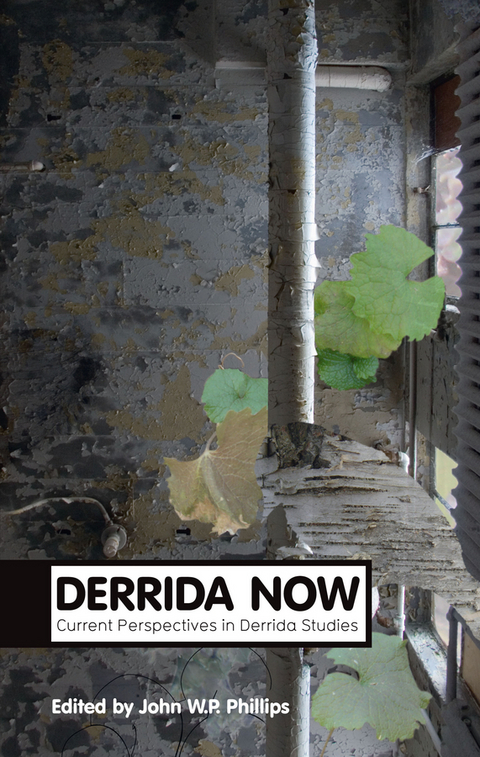
Derrida Now (eBook)
John Wiley & Sons (Verlag)
978-0-7456-6288-6 (ISBN)
John W. P. Phillips is associate professor in the department of English Language and Literature at the National University of Singapore
For more than 30 years and until his death in 2004, Jacques Derrida remained one of the most influential contemporary philosophers. It may be difficult to evaluate what forms his legacy will take in the future but Derrida Now provides some provocative suggestions. Derrida's often-controversial early reception was based on readings of his complex works, published in journals and collected in books. More recently attention has tended to focus on his later work, which grew out of the seminars that he presented each year in France and the US. The full texts of these seminars are now the subject of a major publication project, to be produced over the next ten years. Derrida Now presents contemporary articles based on or around the study of Derrida. It provides a critical introduction to Derrida's complex and controversial thought, offers careful analysis of some of his most important concepts, and includes essays that address the major strands of his thought. Derrida's influence reached not only into philosophy but also into other fields concerned with literature, politics, visual art, law, ecology, psychoanalysis, gender and sexuality and this book will appeal to readers in all these disciplines. Contributors include Peggy Kamuf, Geoff Bennington, Nicholas Royle, Roy Sellars, Graham Allen and Irving Goh.
John W. P. Phillips is associate professor in the department of English Language and Literature at the National University of Singapore
Contents
Editor's Introduction
John W.P. Phillips
1. Transcendental Difference and the Auto-Relation: Critical Overview
John W.P. Phillips
2. Derrida's Dignity
Geoffrey Bennington
3. Stepping Out with Freud and Derrida: On the Royal Road of Interpretation
Roy Sellars
4. The Transparent University: Kant, Derrida and a New University Law
Graham Allen
5. Does Deconstruction Imply Vegetarianism?
Martin McQuillan
6. After Derrida's Foi et savoir: From Rejection to the (Animal-)Reject for the "Post-Secular"
Irving Goh
7. Composition Displacement
Peggy Kamuf
8. Jacques Derrida and the Future of the Novel
Nicholas Royle
9. Derrida, Code Enforcement, and the Question of Justice
Hugh J. Silverman
Notes
"This book gathers the current thinking and perspectives on the work of Jacques Derrida and his treatments on a variety of contemporary issues, including animals, justice and death. Original and rigorous, and yet accessible, these essays also reveal the continued relevance of Derrida?s work in helping us think our present intellectual, cultural and political situations in our day-to-day lives."
Nicole Anderson, Macquarie University, Sydney
"This volume brings together some of the most knowledgeable, sensitive and attentive readers of Derrida to address a range of issues spanning the apparent divide between "early" and "late" Derrida. Bennington, for instance, is quasi-exemplary in his approach to Derrida's dignity. Royle re-opens and re-illuminates the challenging as well as loving relationship between literature and philosophy. Other questions addressed include the pressing matter of "the animal" throughout Derrida's work."
Judith Still, University of Nottingham"This volume brings together some of the leading lights in what can now be called the field of Derrida studies. Phillips does a fine job editing and introducing this volume."
Choice
1
Transcendental Difference and the Auto-Relation: Critical Overview
John W.P. Phillips
Introduction
‘Thought would always be to come . . .’ (Derrida, 1978: 153)
Here I attempt a critical reading of Jacques Derrida, one of the most influential, and some would say controversial, figures of the current philosophical age. The task of reading Derrida critically entails some peculiarly challenging considerations, not least because his influence on fields of critical reading in particular is second to none. Derrida taught a practice, according to which reading implies attention to a particular form of necessity. This practice insists that a reading take account of the strictly non-philosophical role in philosophy of the writer but without reduction to biographical (or psychological) narrative. Such a reading attends to the forms of what Derrida identifies by way of the signature and of certain ‘signature effects’. It would be out of the question here to avoid an attempt at such a reading of Derrida’s work.
The fragments of biographical narrative that often creep into considerations of Derrida’s thought have a place there.1 But Derrida’s work puts into question notions of person, context, narrative, and so on, thus radically revising them. Yet his painstaking investigation of a given philosophical work proceeds as if the questions he poses will yield a sufficient degree of generality to make it worth the effort. The yield – in that case – will be on the side of philosophy. The originality of the text in question relates then to what it helps uncover in the field of philosophical development in general. The so-called singularity of a philosophical text thus relates to philosophy as a whole, to the extent that it elucidates a fundamental philosophical concern.
How then does a text by Plato or Hegel or Husserl differ from the more general ‘text of philosophy’? A famous statement from Hegel puts things into perspective. In the ‘Preface’ to The Phenomenology of Spirit, Hegel complains about attempts to distinguish works of philosophy from one another:
The very attempt to determine the relationship of a philosophical work to other efforts concerning the same subject introduces an alien and irrelevant interest, which obscures precisely that which matters for the recognition of the truth. (Hegel, 1977: 116)
Hegel here states an uncontroversial truth that resists erosion throughout the most dominant paradigms of philosophical knowledge: the philosopher notwithstanding his noticeable peculiarities (not least those of their ‘style’) labours in the service of a greater truth or science. Derrida in a later interview confirms the traditional philosophical attitude: ‘The philosophical field, if it has an identity, if it has strict limits (and that are such as can be located on the basis of its traditions), has nothing to do with the unveiling of the identity of the thinker or the philosopher; this field is constituted, precisely, by cutting itself off from the autobiography or the signature of the philosopher’ (Derrida, 1995a: 144; 1995b: 135). Derrida’s observation here might lead us to suppose – if we react too quickly – that he occupies an antagonistic attitude towards philosophy; but things have a more interesting flavour than that suggests. The philosophical field ‘is constituted’ in the effort of its cutting itself off from its other (from the signature and identity of the philosopher). The identity of philosophy, and therefore of the philosopher, depends on its cutting itself off from the philosopher’s mortality. Such a ‘cutting off’, as Derrida puts it, implies the production not only of philosophy but also of its appropriate other. The signature emerges in the difference between philosophy and its other (or philosophy and the philosopher’s death).
So we are obliged to remain attentive to the implications of Derrida’s thought in its effect on how we read and in particular how we read Derrida. If that is the case, then any account of the content of Derrida’s thought, of his basic argumentation, should justify the contribution of these signature effects on that argumentation. Otherwise, we may fail to capture the potential impact of Derrida’s work.
In some preliminary remarks I can identify a few of the most startling consequences of three related formulations: those of theatricality, auto-immunity and hospitality. To produce an effective and rigorous philosophy requires that we also produce the scene or stage on which such a philosophy could proceed. It implies, therefore, clearing the stage of those conditions that make theatre as well as philosophy possible (though, as with philosophy, not all theatrical traditions require this clearing). It also introduces a consideration of the unconscious as an essentially undetermined sphere without which consciousness would not be what it is. So the role of theatre is intricately connected to Derrida’s reading of psychoanalytic texts.2
When I clear the stage I immunize myself against those conditions that allowed me to set the stage in the first place. Selfimmunization: the self immunizes itself against conditions that both threaten it and yet make it possible while at the same time immunizing itself against that very immunization.3 And when philosophy questions its (nearly illimitable) topics, it reveals conditions uncannily reflective of the conditions of philosophy itself. For example, hospitality in its idea conceals potentially diverse historical senses including those of hostility as well as those of care (Derrida emphasizes this double-edged background in the coinage hostipitality). And it requires in principle the relaxation of all the normal defences that might apply when someone (a person or state) invites a stranger into their space. In order to exercise the inalienable right to be hospitable, one must at the same time protect oneself from that same hospitality (Derrida, 2000: 77). A state protects its hospitable institutions by inventing complex citizenship and immigration laws to the extent that its hospitality inevitably (as we say) deconstructs itself in its idea. Now we understand deconstruction as a condition that simultaneously allows and prevents.
We can locate as a common root of structures of this kind the earliest formulations of terms like deconstruction, as well as différance and archi-writing (to name only three of the most familiar), which designate inevitably paradoxical structures of possibility.
1. The Meanings of Writing
The future can only be anticipated in the form of an absolute danger. It is that which breaks absolutely with constituted normality and can only be proclaimed, presented, as a sort of monstrosity. For that future world and for that within it which will have put into question the values of sign, word, and writing, for that which guides our future anterior, there is as yet no exergue.4 (Derrida, 1967/1976: 5)
Nothing, neither among the elements nor within the system, is anywhere ever simply present or absent. There are only, everywhere, differences and traces of traces. (Derrida, 1972/1981: 26)
Derrida’s writings from the late 1950s to the 1970s (sometimes considered his ‘early works’) focus consistently on a complex problem: the role and value of writing in western metaphysics from the Ancient Greeks to the present and beyond. That this problem at length opens out into quite radical and novel treatments of the most tenacious issues of philosophy has to do with the nature of the problem itself. The common-sense notion of writing (which, like everything else, we inherit from our own traditions) implies that we name by writing any system of inscribable marks used for representing spoken words or thoughts. Such systems operate on the basis of the fact that their marks can be repeated. Furthermore, the notion of repetition at work here cannot be reduced to a finite number of instances. Such a mark must in principle be repeatable to infinity.
Beyond what can be written with clarity about Jacques Derrida’s treatment of the question of writing, there remains a still enigmatic sense of danger, which for several reasons compels our attention. The most gripping of these resides in the insistence by which he proposes that this enigmatic ‘sense’ of writing both constitutes writing in general, in its essential structure, and yet puts its value (as word, as sense, as content) in question. Certain words or phrases, like ‘future world’, ‘absolute danger’, ‘a sort of monstrosity’, ‘exorbitant’, are distinctive in how Derrida composes this enigmatic yet essential sense: something dangerous ‘within’ its ‘future world’ constitutes and puts into question the value of writing.
A minor grammatical observation is needed now to capture the force of the question. If, following Derrida, we alter the tense of the verb ‘puts’ from present to future perfect, the sentence now reads: ‘Something within the future world will have put into question the value of writing.’ The future perfect if used in this way puts into suspense (will have suspended) the basic sense of the present that seems so commonplace for describing experience – here I am right now in the present. Ordinarily the future perfect operates as a grammatical...
| Erscheint lt. Verlag | 11.3.2016 |
|---|---|
| Reihe/Serie | Polity Theory Now |
| Polity Theory Now | Theory Now |
| Sprache | englisch |
| Themenwelt | Geisteswissenschaften ► Philosophie ► Geschichte der Philosophie |
| Geisteswissenschaften ► Philosophie ► Philosophie der Neuzeit | |
| Geisteswissenschaften ► Sprach- / Literaturwissenschaft ► Anglistik / Amerikanistik | |
| Geisteswissenschaften ► Sprach- / Literaturwissenschaft ► Literaturwissenschaft | |
| Schlagworte | Critical theory • Derrida, Jacques • Kritische Theorie • Literary & Cultural Theory • Literary Theory • Literature • Literaturtheorie • Literatur- u. Kulturtheorie • Literaturwissenschaft • Philosophie • Philosophy • theory, Derridean, philosophy, media |
| ISBN-10 | 0-7456-6288-9 / 0745662889 |
| ISBN-13 | 978-0-7456-6288-6 / 9780745662886 |
| Informationen gemäß Produktsicherheitsverordnung (GPSR) | |
| Haben Sie eine Frage zum Produkt? |
 EPUB (Adobe DRM)
Kopierschutz: Adobe-DRM
Adobe-DRM ist ein Kopierschutz, der das eBook vor Mißbrauch schützen soll. Dabei wird das eBook bereits beim Download auf Ihre persönliche Adobe-ID autorisiert. Lesen können Sie das eBook dann nur auf den Geräten, welche ebenfalls auf Ihre Adobe-ID registriert sind.
Details zum Adobe-DRM
Dateiformat: EPUB (Electronic Publication)
EPUB ist ein offener Standard für eBooks und eignet sich besonders zur Darstellung von Belletristik und Sachbüchern. Der Fließtext wird dynamisch an die Display- und Schriftgröße angepasst. Auch für mobile Lesegeräte ist EPUB daher gut geeignet.
Systemvoraussetzungen:
PC/Mac: Mit einem PC oder Mac können Sie dieses eBook lesen. Sie benötigen eine
eReader: Dieses eBook kann mit (fast) allen eBook-Readern gelesen werden. Mit dem amazon-Kindle ist es aber nicht kompatibel.
Smartphone/Tablet: Egal ob Apple oder Android, dieses eBook können Sie lesen. Sie benötigen eine
Geräteliste und zusätzliche Hinweise
Buying eBooks from abroad
For tax law reasons we can sell eBooks just within Germany and Switzerland. Regrettably we cannot fulfill eBook-orders from other countries.
aus dem Bereich