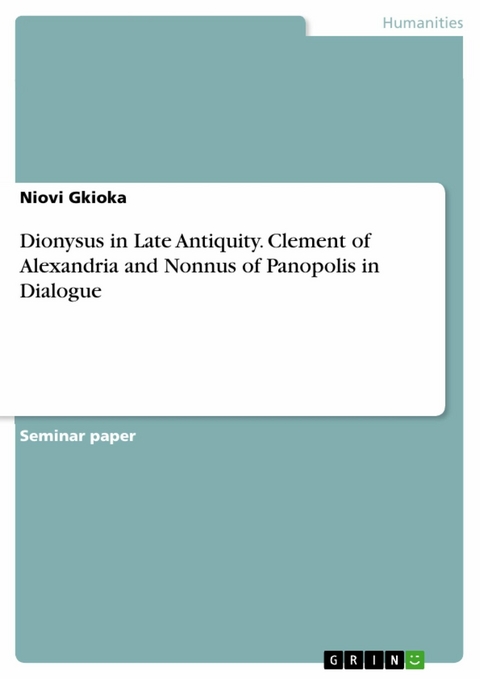
Dionysus in Late Antiquity. Clement of Alexandria and Nonnus of Panopolis in Dialogue (eBook)
26 Seiten
GRIN Verlag
978-3-668-17071-1 (ISBN)
Similarly, as Richard Seaford has asserted, weighing in on the long-standing debate of the similarities between the Acts and the “Bacchae” first documented by Wilhelm Nestle in his 1900 article ‘Anklänge an Euripides in der Apostelgeschichte,’ the Acts and the Bacchae feature too many affinities, and at key points – Paul’s conversion (Acts 9:3-7; 22:6-11; 26:12-18) and Paul and Silas’ prison escape (Acts 16:19-40) – to be taken as mere coincidence.
These very parallels between Dionysus and Christ were drawn more distinctively in the second and third century CE by Greek and Latin Apologists; that is Christian intellectuals who writing in defence of Christianity assumed a polemic stance against Dionysus.
| Erscheint lt. Verlag | 11.3.2016 |
|---|---|
| Verlagsort | München |
| Sprache | englisch |
| Themenwelt | Geisteswissenschaften ► Philosophie ► Geschichte der Philosophie |
| Geisteswissenschaften ► Philosophie ► Philosophie Altertum / Antike | |
| Schlagworte | Alexandria • Antiquity • Clement • Dialogue • Dionysus • Late • nonnus • panopolis |
| ISBN-10 | 3-668-17071-1 / 3668170711 |
| ISBN-13 | 978-3-668-17071-1 / 9783668170711 |
| Informationen gemäß Produktsicherheitsverordnung (GPSR) | |
| Haben Sie eine Frage zum Produkt? |
 EPUB (Ohne DRM)
Digital Rights Management: ohne DRM
Dieses eBook enthält kein DRM oder Kopierschutz. Eine Weitergabe an Dritte ist jedoch rechtlich nicht zulässig, weil Sie beim Kauf nur die Rechte an der persönlichen Nutzung erwerben.
Dateiformat: EPUB (Electronic Publication)
EPUB ist ein offener Standard für eBooks und eignet sich besonders zur Darstellung von Belletristik und Sachbüchern. Der Fließtext wird dynamisch an die Display- und Schriftgröße angepasst. Auch für mobile Lesegeräte ist EPUB daher gut geeignet.
Systemvoraussetzungen:
PC/Mac: Mit einem PC oder Mac können Sie dieses eBook lesen. Sie benötigen dafür die kostenlose Software Adobe Digital Editions.
eReader: Dieses eBook kann mit (fast) allen eBook-Readern gelesen werden. Mit dem amazon-Kindle ist es aber nicht kompatibel.
Smartphone/Tablet: Egal ob Apple oder Android, dieses eBook können Sie lesen. Sie benötigen dafür eine kostenlose App.
Geräteliste und zusätzliche Hinweise
Buying eBooks from abroad
For tax law reasons we can sell eBooks just within Germany and Switzerland. Regrettably we cannot fulfill eBook-orders from other countries.
aus dem Bereich