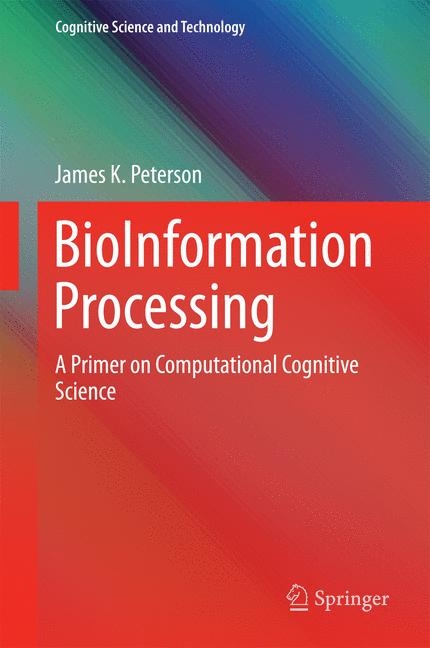
BioInformation Processing (eBook)
XXXV, 570 Seiten
Springer Singapore (Verlag)
978-981-287-871-7 (ISBN)
Dr. James Peterson is an Associate Professor in Mathematical Sciences and Biological Sciences at Clemson University, USA. His formal training is in mathematics but he has worked as an aerospace engineer and a software engineer also. He enjoys working on very hard problems that require multiple disciplines to make sense out of and he reads, studies and plays in cutting edge areas a lot as part of his interests.
This book shows how mathematics, computer science and science can be usefully and seamlessly intertwined. It begins with a general model of cognitive processes in a network of computational nodes, such as neurons, using a variety of tools from mathematics, computational science and neurobiology. It then moves on to solve the diffusion model from a low-level random walk point of view. It also demonstrates how this idea can be used in a new approach to solving the cable equation, in order to better understand the neural computation approximations. It introduces specialized data for emotional content, which allows a brain model to be built using MatLab tools, and also highlights a simple model of cognitive dysfunction.
Dr. James Peterson is an Associate Professor in Mathematical Sciences and Biological Sciences at Clemson University, USA. His formal training is in mathematics but he has worked as an aerospace engineer and a software engineer also. He enjoys working on very hard problems that require multiple disciplines to make sense out of and he reads, studies and plays in cutting edge areas a lot as part of his interests.
BioInformation Processing.- The Diffusion Equation.- Integral Transforms.- The Time Dependent Cable Solution.- Mammalian Neural Structure.- Abstracting Principles of Computation.- Abstracting Principles of Computation.- Second Messenger Diffusion Pathways.- The Abstract Neuron Model.- Emotional Models.- Generation of Music Data: J. Peterson and L. Dzuris.- Generation of Painting Data: J. Peterson, L. Dzuris and Q. Peterson.- Modeling Compositional Design.- Networks Of Excitable Neurons.- Training The Model.- Matrix Feed Forward Networks.- Chained Feed Forward Architectures.- Graph Models.- Address Based Graphs.- Building Brain Models.- Models of Cognitive Dysfunction.- Conclusions.- Background Reading.
| Erscheint lt. Verlag | 10.2.2016 |
|---|---|
| Reihe/Serie | Cognitive Science and Technology | Cognitive Science and Technology |
| Zusatzinfo | XXXV, 570 p. 165 illus. in color. |
| Verlagsort | Singapore |
| Sprache | englisch |
| Themenwelt | Geisteswissenschaften ► Psychologie |
| Informatik ► Theorie / Studium ► Künstliche Intelligenz / Robotik | |
| Mathematik / Informatik ► Mathematik ► Angewandte Mathematik | |
| Naturwissenschaften ► Physik / Astronomie | |
| Technik | |
| Schlagworte | abstract computation • BioInformation Processing • brain models • Chained Feed Forward Networks • Cognitive Dysfunction Models • Lagged Chains • Matrix Feed Forward Networks • Neural Structure |
| ISBN-10 | 981-287-871-8 / 9812878718 |
| ISBN-13 | 978-981-287-871-7 / 9789812878717 |
| Informationen gemäß Produktsicherheitsverordnung (GPSR) | |
| Haben Sie eine Frage zum Produkt? |
 PDF (Wasserzeichen)
DRM: Digitales Wasserzeichen
Dieses eBook enthält ein digitales Wasserzeichen und ist damit für Sie personalisiert. Bei einer missbräuchlichen Weitergabe des eBooks an Dritte ist eine Rückverfolgung an die Quelle möglich.
Dateiformat: PDF (Portable Document Format)
Mit einem festen Seitenlayout eignet sich die PDF besonders für Fachbücher mit Spalten, Tabellen und Abbildungen. Eine PDF kann auf fast allen Geräten angezeigt werden, ist aber für kleine Displays (Smartphone, eReader) nur eingeschränkt geeignet.
Systemvoraussetzungen:
PC/Mac: Mit einem PC oder Mac können Sie dieses eBook lesen. Sie benötigen dafür einen PDF-Viewer - z.B. den Adobe Reader oder Adobe Digital Editions.
eReader: Dieses eBook kann mit (fast) allen eBook-Readern gelesen werden. Mit dem amazon-Kindle ist es aber nicht kompatibel.
Smartphone/Tablet: Egal ob Apple oder Android, dieses eBook können Sie lesen. Sie benötigen dafür einen PDF-Viewer - z.B. die kostenlose Adobe Digital Editions-App.
Buying eBooks from abroad
For tax law reasons we can sell eBooks just within Germany and Switzerland. Regrettably we cannot fulfill eBook-orders from other countries.
aus dem Bereich