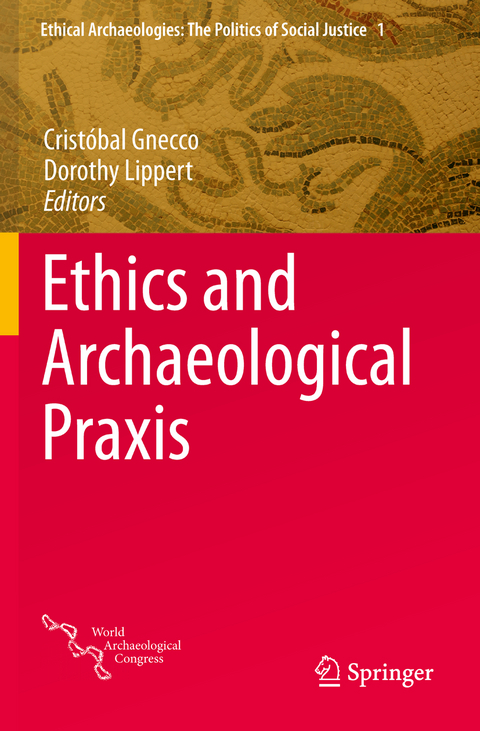
Ethics and Archaeological Praxis
Springer-Verlag New York Inc.
978-1-4939-3760-8 (ISBN)

Cristóbal Gnecco is Professor in the Department of Anthropology at the University of Cauca (Colombia), where he works on the political economy of archaeology, the geopolitics of knowledge, and the discourses on alterity. He currently serves as Chair of the Ph.D. Program in Anthropology at his university and as a co-editor of the journals Archaeologies and Arqueología Suramericana. Dorothy Lippert, National Museum of Natural History, Washington, DC.
Chapter 1: An entanglement of sorts: archaeology, ethics, praxis, multiculturalism.-Section 1: Is there a global archaeological ethics? Canonical conditions for discursive legitimacy and local responses.- Chapter 2: An Indigenous anthropologist’s perspective on archaeological ethics.- Chapter 3: Both sides of the ditch: the ethics of narrating the past in the present.- Chapter 4: Against global archaeological ethics: critical views from South America.- Chapter 5: Archaeology and ethics. The case of Central-Eastern Europe.- Chapter 6: Europe: beyond the canon.- Chapter 7: New worlds: ethics in contemporary North American archaeological practice.- Section 2: Archaeological ethics in the global arena: emergences, transformations, accommodations.- Chapter 8: Chapter Archaeology and capitalist development: lines of complicity.- Chapter 9: Archaeology and capitalism: successful relationship or economic and ethical alienation?.-Chapter10: Trading archaeology is not just a matter of antiquities. Archaeological practice as a commodity.- Chapter 11: The differing forms of public archaeology: where we have been, where we are now, and thoughts for the future.- Chapter 12: Ethics in the publishing of archaeology.- Chapter 13: Patrimonial ethics and the field of heritage production.- Chapter 14: Archeologies of intellectual heritage?.- Chapter 15: Just methods, no madness: historical archaeology on the Piikani First Nation.
| Erscheinungsdatum | 06.04.2016 |
|---|---|
| Reihe/Serie | Ethical Archaeologies: The Politics of Social Justice ; 1 |
| Zusatzinfo | 6 Illustrations, color; 4 Illustrations, black and white |
| Verlagsort | New York |
| Sprache | englisch |
| Maße | 155 x 235 mm |
| Themenwelt | Geisteswissenschaften ► Archäologie |
| Geschichte ► Allgemeine Geschichte ► Altertum / Antike | |
| Geisteswissenschaften ► Philosophie ► Allgemeines / Lexika | |
| Geisteswissenschaften ► Philosophie ► Ethik | |
| Schlagworte | archaeological practice and ethics • capitalism and archaeology • community archaeology • ethical principles of archaeology • ethics of public archaeology • indigenous viewpoints on the practice of archaeology • local archaeology • market archaeology • multiculturalism and archaeology • social accountability and archaeology • social accountability of archaeoogy |
| ISBN-10 | 1-4939-3760-X / 149393760X |
| ISBN-13 | 978-1-4939-3760-8 / 9781493937608 |
| Zustand | Neuware |
| Informationen gemäß Produktsicherheitsverordnung (GPSR) | |
| Haben Sie eine Frage zum Produkt? |
aus dem Bereich