


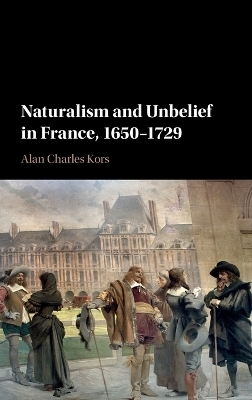
Naturalism and Unbelief in France, 1650–1729
Seiten
2016
Cambridge University Press (Verlag)
978-1-107-10663-5 (ISBN)
Cambridge University Press (Verlag)
978-1-107-10663-5 (ISBN)
Although atheism is a rising subject of interest today, the history of the possibility and emergence of atheism is less studied. This book will be of great interest to academics and non-academics with interests in free thought, theology, French culture, early modern Europe and the dissemination of ideas.
Atheism was the most fundamental challenge to early-modern French certainties. Leading educators, theologians and philosophers labelled such atheism as manifestly absurd, confident that neither the fact nor behaviour of nature was explicable without reference to God. The alternative was a categorical naturalism. This book demonstrates that the Christian learned world had always contained the naturalistic 'atheist' as an interlocutor and a polemical foil, and its early-modern engagement and use of the hypothetical atheist were major parts of its intellectual life. In the considerations and polemics of an increasingly fractious orthodox culture, the early-modern French learned world gave real voice and eventually life to that atheistic presence. Without understanding the actual context and convergence of the inheritance, scholarship, fierce disputes, and polemical modes of orthodox culture, the early-modern generation and dissemination of absolute naturalism are inexplicable. This book brings to life that Christian learned culture, its dilemmas, and its unintended consequences.
Atheism was the most fundamental challenge to early-modern French certainties. Leading educators, theologians and philosophers labelled such atheism as manifestly absurd, confident that neither the fact nor behaviour of nature was explicable without reference to God. The alternative was a categorical naturalism. This book demonstrates that the Christian learned world had always contained the naturalistic 'atheist' as an interlocutor and a polemical foil, and its early-modern engagement and use of the hypothetical atheist were major parts of its intellectual life. In the considerations and polemics of an increasingly fractious orthodox culture, the early-modern French learned world gave real voice and eventually life to that atheistic presence. Without understanding the actual context and convergence of the inheritance, scholarship, fierce disputes, and polemical modes of orthodox culture, the early-modern generation and dissemination of absolute naturalism are inexplicable. This book brings to life that Christian learned culture, its dilemmas, and its unintended consequences.
Alan Charles Kors is the Henry Charles Lea Professor of History, University of Pennsylvania. He taught at the École Pratique des Hautes Études and the Folger Library. He is also co-founder of the Foundation for Individual Rights in Education. He published the Encyclopaedia of the Enlightenment (2003), Atheism in France, 1650-1729 (1990) and D'Holbach's Coterie: An Enlightenment in Paris (1976).
Introduction; 1. From nature to God; 2. Reading the ancients and reading Spinoza; 3. Reductio ad naturalismum; 4. The passion of Malebranche; 5. Creation and evil; Conclusion; Bibliography.
| Erscheinungsdatum | 13.07.2016 |
|---|---|
| Verlagsort | Cambridge |
| Sprache | englisch |
| Maße | 160 x 237 mm |
| Gewicht | 610 g |
| Themenwelt | Geisteswissenschaften ► Religion / Theologie |
| Sozialwissenschaften | |
| ISBN-10 | 1-107-10663-X / 110710663X |
| ISBN-13 | 978-1-107-10663-5 / 9781107106635 |
| Zustand | Neuware |
| Informationen gemäß Produktsicherheitsverordnung (GPSR) | |
| Haben Sie eine Frage zum Produkt? |
Mehr entdecken
aus dem Bereich



aus dem Bereich
eine Philosophie der besten Jahre
Buch | Hardcover (2024)
Carl Hanser (Verlag)
CHF 38,90
Antisemitismus in der Bibel
Buch | Hardcover (2025)
Verlag Herder
CHF 29,90


