


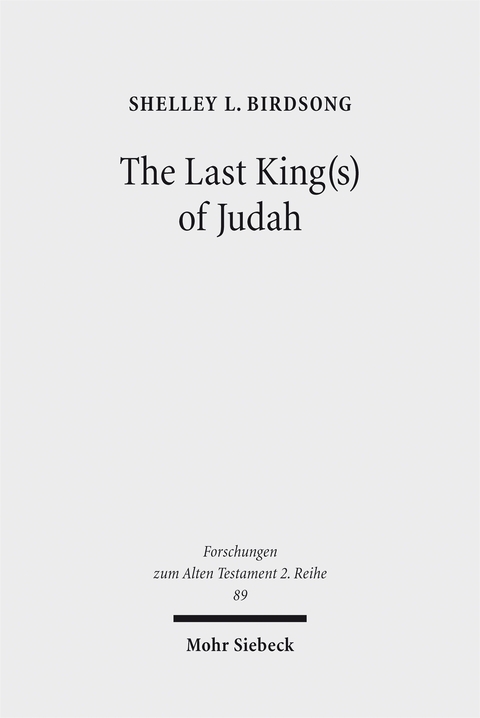
The Last King(s) of Judah
Zedekiah and Sedekias in the Hebrew and Old Greek Versions of Jeremiah 37(44):1-40(47):6
Seiten
Die hebräische und die griechische Fassung von Jeremia zeichnen sehr unterschiedliche Bilder von Zedekia und werfen dadurch eine Reihe literaturwissenschaftlicher und historisch-kritischer Fragen auf. Shelley L. Birdsong beleuchtet in dieser Untersuchung kritisch die beiden Charakterisierungen von Zedekia und befasst sich text- und formkritisch mit deren Beziehung.
Zedekiah ben Josiah was the last king of Judah, and under his leadership, in 586 BCE, Jerusalem was destroyed. Interestingly, the Hebrew and Old Greek versions of Jeremiah present very different portrayals of Zedekiah, prompting a variety of literary and historical-critical questions. In this study, Shelley L. Birdsong uses a multi-critical approach to highlight the two unique characterizations of Zedekiah and address their relationship text- and form-critically. She argues that the Greek text depicts Zedekiah as a manipulative and mysterious Machiavellian prince, whereas the Hebrew presents him as a hesitant and kind king who metaphorically mirrors the fall of his capital. Following this literary comparison, the author employs several scholarly methods to substantiate the claim that the Hebrew text is a later edited text. Overall, she demonstrates the importance of doing character studies in Septuagint scholarship and using multiple methods to create a more comprehensive picture of biblical characters.
Zedekiah ben Josiah was the last king of Judah, and under his leadership, in 586 BCE, Jerusalem was destroyed. Interestingly, the Hebrew and Old Greek versions of Jeremiah present very different portrayals of Zedekiah, prompting a variety of literary and historical-critical questions. In this study, Shelley L. Birdsong uses a multi-critical approach to highlight the two unique characterizations of Zedekiah and address their relationship text- and form-critically. She argues that the Greek text depicts Zedekiah as a manipulative and mysterious Machiavellian prince, whereas the Hebrew presents him as a hesitant and kind king who metaphorically mirrors the fall of his capital. Following this literary comparison, the author employs several scholarly methods to substantiate the claim that the Hebrew text is a later edited text. Overall, she demonstrates the importance of doing character studies in Septuagint scholarship and using multiple methods to create a more comprehensive picture of biblical characters.
Born 1982; 2004 BA in Biblical Studies; 2008 MA in Hebrew Bible and Philosophy of Religion; 2014 PhD in Hebrew Bible; 2014-15 Visiting Assistant Professor of Biblical Studies at Azusa Pacific University (CA); 2015-17 Visiting Assistant Professor of Religion at North Central College (IL).
| Erscheinungsdatum | 04.01.2017 |
|---|---|
| Reihe/Serie | Forschungen zum Alten Testament 2. Reihe |
| Verlagsort | Tübingen |
| Sprache | englisch |
| Maße | 157 x 238 mm |
| Gewicht | 419 g |
| Themenwelt | Religion / Theologie ► Christentum ► Bibelausgaben / Bibelkommentare |
| Geisteswissenschaften ► Religion / Theologie ► Judentum | |
| Geisteswissenschaften ► Sprach- / Literaturwissenschaft ► Literaturwissenschaft | |
| Schlagworte | Bible • Bible translation • Character • character studies • Criticism • Septuagint • Studies • Textual • Textual criticism • Translation |
| ISBN-13 | 9783161538889 / 9783161538889 |
| Zustand | Neuware |
| Informationen gemäß Produktsicherheitsverordnung (GPSR) | |
| Haben Sie eine Frage zum Produkt? |
Mehr entdecken
aus dem Bereich

aus dem Bereich
Buch | Softcover (2021)
De Gruyter (Verlag)
CHF 44,90


