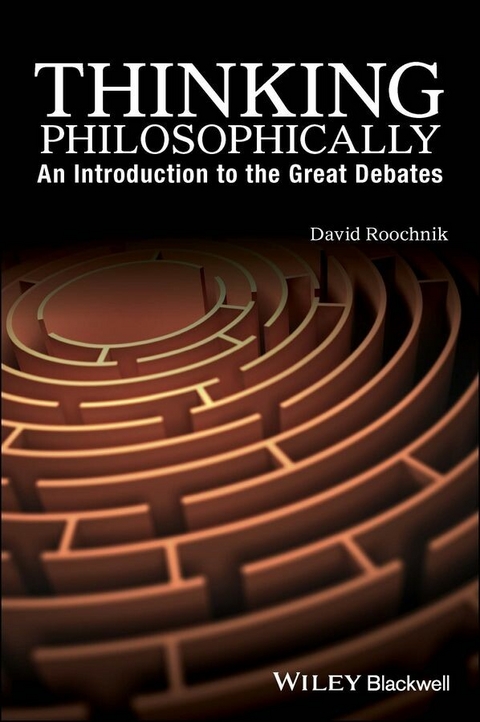
Thinking Philosophically (eBook)
John Wiley & Sons (Verlag)
978-1-119-06699-6 (ISBN)
- Introduces five fundamental philosophical debates in a highly engaging and accessible manner that invites readers to enter the discussion themselves
- Features chapters that each consider a central philosophical question dialectically by exploring the conflicting approaches of different philosophers
- Argues that the work of philosophers like Plato and Rousseau is just as relevant today as it was in their own time
- Provides a structure that encourages readers to apply philosophical principles to their everyday lives
David Roochnik is the Maria Stata Professor of Classical Greek Studies at Boston University, and is the recipient of numerous awards for excellence in teaching. His books include Retrieving Aristotle in an Age of Crisis (2013), Retrieving the Ancients: An Introduction to Greek Philosophy (Blackwell, 2004), Beautiful City: The Dialectical Character of Plato's Republic (2003), Art and Wisdom: Plato's Understanding of Techne (1996) and The Tragedy of Reason: Toward a Platonic Conception of Logos (1991).
David Roochnik is the Maria Stata Professor of Classical Greek Studies at Boston University, and is the recipient of numerous awards for excellence in teaching. His books include Retrieving Aristotle in an Age of Crisis (2013), Retrieving the Ancients: An Introduction to Greek Philosophy (Blackwell, 2004), Beautiful City: The Dialectical Character of Plato's Republic (2003), Art and Wisdom: Plato's Understanding of Techne (1996) and The Tragedy of Reason: Toward a Platonic Conception of Logos (1991).
Prologue xii
1 An Introduction to Philosophy 1
2 Alone or With Others? 27
3 What Should We Do? 65
4 Whom Should We Emulate? (1) 98
5 Whom Should We Emulate? (2) 127
6 What Do You Know? 145
7 Being in Time 175
Epilogue 206
Works Cited 209
Index 214
1
An Introduction to Philosophy
What Makes Philosophers Tick?
Philosophy is a peculiar enterprise, a strange form of conversation that began in Ancient Greece some 2500 years ago and continues today. The purpose of this book is to invite you to join in. But what is it you might be getting into?
On the one hand, philosophers are anything but unique. Like scientists, scholars, and students of every sort they are energized by an experience, or even a feeling: that of being bowled over – by curiosity, interest, amazement, fascination, perplexity, or wonder. This in turn sparks them to ask questions, usually ones that begin with “why.” Philosophers want answers to their questions; that is, they want to explain why things are the way they are. In short, like other intellectuals they are driven by the desire to know.
Astronomers are amazed by the planets, and want to know why they move as they do. Biologists are fascinated by the intricate mechanisms of living organisms and they try to figure out why they work as well as they do. Mathematicians are captivated by the complexity of formal relations, which inspires them to summon ever more intensely their capacity for analytical reasoning. Historians spend their days in archives because they wonder about the when, where, and why of the past. They too want to know.
Philosophers are also seized by wonder and strive to answer questions that they experience as urgent. But what they (we) wonder about is different from what triggers the astronomer, biologist, mathematician, or historian. Natural scientists are amazed by things like bacteria, plants, animals, rocks, or stars. They are interested in the world outside of themselves and so they turn to the microscope or telescope to see it better. Philosophers, by contrast, are amazed at, and so they scope, themselves. Mathematicians are dedicated to solving problems in algebra or geometry. For philosophers the very life they are leading is the problem. Historians study the past. Philosophers wonder why they have a past in the first place and what role, if any, it should play in their lives.
A line from Plato’s dialogue the Phaedrus makes this point sharply. Socrates – who is the inspiration for this book – is walking in the countryside with a companion who asks him whether he believes the stories about Boreas, the god to whom the Greeks assigned responsibility for the cold north wind. His companion’s question implies that a scientific account, a little lecture in meteorology, would be far better than a silly old myth. Socrates responds by saying that while he admires the work of the scientists who debunk such stories, he himself has no time for such pursuits. He explains why:
The reason, my friend, is this. I am still unable, as the Delphic inscription orders, to know myself; and it really seems to me ridiculous to look into extraneous matters before I have understood that.
(Phaedrus 230a)1
The philosopher, at least according to Socrates, seeks self-knowledge rather than knowledge of the external world or of the mathematical structures that underlie it. But be careful. This does not mean that Socrates seeks to understand his uniquely personal self. He has no interest in probing the details of his childhood or learning how the traumatic events of his past made him into the person he became. Instead, his question is far more broad: What does it mean to be who I am; that is, a human being?
Another line, this one from the Phaedo, elaborates. Again, Socrates is contrasting himself with the natural scientists of his day. While he professes to admire their work, he describes himself as singularly unsuited for that kind of research. As he puts it, “I didn’t have the nature” to study nature (96c). This statement implies that there are two senses of “nature.” One is external: the world of wind, water, and stars. The second, to which Socrates devotes himself, is human nature, which somehow is different.
When I was in biology class as a kid in high school, I was struck by how eagerly other students were peering into their microscopes. They were amazed at all the little creatures that were swimming around in the drop of pond water that was on the slide. Me? I was more interested in why they were so interested … and why I was not.
The word “philosophy” is derived from two Greek words: philia (love) and sophia (wisdom). But to describe philosophy simply as “the love of wisdom” is far too vague. After all, the biologist is also impelled by a love of wisdom – about living organisms – and the historian seeks wisdom about the past. What, then, distinguishes philosophers? Again: the wisdom for which they (we) strive concerns the nature and meaning of human life.
The biologist might object: “I too want to understand human life. After all, we are animals with hearts and lungs and, most interesting of all, with genes, those molecular stretches of DNA and RNA that contain the information responsible for building and maintaining our cells. Like all other organisms the human animal is subject to the laws of natural selection and so in studying fruit flies in my laboratory I’m actually studying myself.”
Where Socrates sees difference – there is human nature and then there are insects, plants, and cells – the biologist envisions an undivided realm of living organisms. Richard Dawkins, the renowned evangelist for Darwin’s theory of natural selection, makes this point forcefully:
An octopus is nothing like a mouse, and both are quite different from an oak tree. Yet in their fundamental chemistry they are rather uniform, and in particular the replicators that they bear, the genes, are basically the same kind of molecule in all of us – from bacteria to elephants.
(The Selfish Gene, p. 21)
Note the word I have highlighted. For Dawkins “us” refers not only to himself, you and me, but also to the octopus and oak tree. “We” are all one.
Or consider what he says about natural selection: it is “the blind, unconscious, automatic process which Darwin discovered, and which we now know is the explanation for the existence … of all life” (The Blind Watchmaker, p. 5). Even more extravagantly, he says this:
Darwinism encompasses all of life – human, animal, plant, bacterial … extraterrestrial. It provides the only satisfying explanation for why we all exist, why we are the way that we are. It is the bedrock on which rest all the disciplines known as the humanities.
(The Blind Watchmaker, p. x)
Dawkins claims that the entire living world, including us (you and me), is of a single piece and that only Darwinism offers a satisfying explanation of “why we all exist.” What is striking about this assertion is that it cannot itself be proven by the biological science he admires so greatly. For it is a totalizing claim that cannot possibly be verified by empirical evidence. No biologist, however assiduous, could actually study all of life. So, just as much as it is supported by his research, Dawkins’s claim is also what initiates and shapes it. It tells him who he is as a thinker and as such is as much a presupposition as it is a conclusion.
This is not a criticism. Every science, like every proof, method, or research program, requires just such presuppositions. After all, you can’t begin a search until you know what you’re looking for, or an inquiry until you have a sense of what sort of answers you hope to find. But Dawkins’s claim is so extravagant that we should at least raise the question: if he cannot prove that all living beings are essentially the same, that Darwinian natural selection is not just the bedrock of the humanities but the only satisfying explanation of why we all exist, then why should we believe him?
To paraphrase Dawkins, I too want to understand why I am the way I am. Part of who I am these days includes the fact that I ride a bicycle around the city of Boston. Why? Here are some scattershot answers.
I enjoy the convenience of using a bike rather than a car in a crowded city. It’s easier and more efficient than struggling in traffic and trying to park. It gets me from door to door.
I enjoy the physical exertion a bicycle demands, which in a small city like Boston is typically not much. I’m probably healthier as a result of my many years on the bike.
When I’m on my bike, especially at night when I’m on the esplanade flanking the Charles River, I feel a bit like a kid doing something slightly dangerous and out of bounds. This is one of my favorite times to ride.
Because of my years of cycling around Boston I now have intimate knowledge of several neighborhoods in my city. I understand the traffic patterns at various intersections, which streets are crowded, which have bike lanes or give me a good view of the harbor. I know what kind of people to expect on the sidewalks, where the parks are, and the best routes to good restaurants that have outdoor seating and serve cold beer. I know what the town feels like in a visceral way.
When I’m in a car I typically have the windows closed and either the heat or the air-conditioning on, and I listen to the radio. I’m sealed off from the streets, ensconced in my own little world, and there’s little chance of surprise. This is often quite pleasant and I still enjoy driving a great...
| Erscheint lt. Verlag | 20.1.2016 |
|---|---|
| Sprache | englisch |
| Themenwelt | Geisteswissenschaften ► Philosophie ► Allgemeines / Lexika |
| Geisteswissenschaften ► Philosophie ► Geschichte der Philosophie | |
| Geisteswissenschaften ► Philosophie ► Philosophie der Neuzeit | |
| Schlagworte | Ancient Greek philosophy • Ancient Philosophy • Aristotle • Einführungen in die Philosophie • Einführungen in die Philosophie • Geschichte der Philosophie • History of Philosophy • Introductions to Philosophy • <p>Philosophy • Philosophie • Philosophiegeschichte • Philosophy • Plato • Rousseau</p> |
| ISBN-10 | 1-119-06699-9 / 1119066999 |
| ISBN-13 | 978-1-119-06699-6 / 9781119066996 |
| Informationen gemäß Produktsicherheitsverordnung (GPSR) | |
| Haben Sie eine Frage zum Produkt? |
 EPUB (Adobe DRM)
Kopierschutz: Adobe-DRM
Adobe-DRM ist ein Kopierschutz, der das eBook vor Mißbrauch schützen soll. Dabei wird das eBook bereits beim Download auf Ihre persönliche Adobe-ID autorisiert. Lesen können Sie das eBook dann nur auf den Geräten, welche ebenfalls auf Ihre Adobe-ID registriert sind.
Details zum Adobe-DRM
Dateiformat: EPUB (Electronic Publication)
EPUB ist ein offener Standard für eBooks und eignet sich besonders zur Darstellung von Belletristik und Sachbüchern. Der Fließtext wird dynamisch an die Display- und Schriftgröße angepasst. Auch für mobile Lesegeräte ist EPUB daher gut geeignet.
Systemvoraussetzungen:
PC/Mac: Mit einem PC oder Mac können Sie dieses eBook lesen. Sie benötigen eine
eReader: Dieses eBook kann mit (fast) allen eBook-Readern gelesen werden. Mit dem amazon-Kindle ist es aber nicht kompatibel.
Smartphone/Tablet: Egal ob Apple oder Android, dieses eBook können Sie lesen. Sie benötigen eine
Geräteliste und zusätzliche Hinweise
Buying eBooks from abroad
For tax law reasons we can sell eBooks just within Germany and Switzerland. Regrettably we cannot fulfill eBook-orders from other countries.
aus dem Bereich