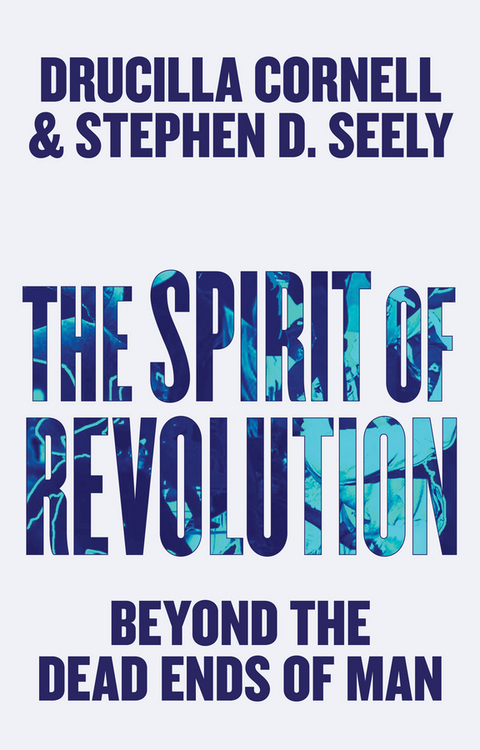
The Spirit of Revolution (eBook)
John Wiley & Sons (Verlag)
978-0-7456-9078-0 (ISBN)
In recent years, feminist and queer theory have effectively disavowed both 'the human' and revolutionary politics. In the face of massive geopolitical crisis, posthumanists have called for us to reconsider fundamentally the superiority and centrality of mankind and 'the human,' and question how Man can presume to change the world by revolutionary action, particularly when Marx's dreams seem to have been swept into the dustbin of history.
This provocative book reaffirms what is most basic in feminism - the attack on the 'universality' and sovereignty of Man - but contends that the only way this can mean anything other than pessimistic rhetoric is to embrace human agency and the struggle against colonialism and capitalism. In a series of 'creolized' readings - Foucault with Ali Shari'ati, Lacan with Fanon, and Spinoza with Sylvia Wynter - the authors demonstrate what is at stake in the ongoing debate between humanism and posthumanism, putting this debate in the context of contemporary global crises and the possibilities of revolution.
In its defense of 'political spirituality,' this book pushes for a new trajectory in response to the gross inequalities of today, one that offers us a very different view of revolution and its present-day potential.
Drucilla Cornell is Professor of Political Science, Women's Studies, and Comparative Literature at Rutgers University.
Stephen D. Seely is a PhD candidate in the Department of Women's and Gender Studies at Rutgers University
In recent years, feminist and queer theory have effectively disavowed both the human and revolutionary politics. In the face of massive geopolitical crisis, posthumanists have called for us to reconsider fundamentally the superiority and centrality of mankind and the human, and question how Man can presume to change the world by revolutionary action, particularly when Marx s dreams seem to have been swept into the dustbin of history.This provocative book reaffirms what is most basic in feminism the attack on the universality and sovereignty of Man but contends that the only way this can mean anything other than pessimistic rhetoric is to embrace human agency and the struggle against colonialism and capitalism. In a series of creolized readings Foucault with Ali Shari ati, Lacan with Fanon, and Spinoza with Sylvia Wynter the authors demonstrate what is at stake in the ongoing debate between humanism and posthumanism, putting this debate in the context of contemporary global crises and the possibilities of revolution.In its defense of political spirituality, this book pushes for a new trajectory in response to the gross inequalities of today, one that offers us a very different view of revolution and its present-day potential.
Drucilla Cornell is Professor of Political Science, Women's Studies, and Comparative Literature at Rutgers University. Stephen D. Seely is a PhD candidate in the Department of Women's and Gender Studies at Rutgers University
Introduction
1. Legacies of Erotic Transformation: Feminism and Revolution
2. Burning Problems of Our Time: Revolution, Erotic Ethics, and Political Spirituality
3. An Other Future: The Erotics of Revolution, The Psychosis of Colonialism, and the Haunting Promise of a New Humanity
4. Undertaking Man, Making the Human: Toward a New Ceremony
Conclusion
"A remarkable book, worthy of the twenty-first century and the new demands placed on theory and practice. Cornell and Seely argue for a spirit of revolution that is at once wary of the false hegemony of man, while nevertheless insisting on the promise of a new politics that finds its energy in sexual difference and queerness. This book will generate lively debate; it is not one more "turn" towards inhuman, posthuman or non-human materialisms, but it is all the more revolutionary for holding on to struggles of the polity."
Claire Colebrook, Penn State
"The Spirit of Revolution is a courageous, very engaging and timely work that packs a real revolutionary punch. Supplementing political economy, the authors speak directly and brilliantly to the erotic, racial, and spiritual challenges of self-transformation that must be integral parts of any attempt at re-imagining the urgently needed socialist alternative to contemporary capitalism. This is engaged philosophy at its best, with great power to expand consciousness and deepen our ethical responses to the planetary dimensions of crisis that we must now address. An extremely important philosophical work."
Paget Henry, Brown University
1
Legacies of Erotic Transformation
Feminism and Revolution
There’s Nothing Revolutionary about a Blowjob
In the early 1970s, one of the authors was told by a member of the central committee of her Marxist-Leninist organization that it is part of her revolutionary responsibility to provide him with a blowjob. Young and earnest, she decided to write an internal response to this demand. She did not, at the time, call her response “There’s Nothing Revolutionary about a Blowjob,” although this was her point, and instead wrote a paper entitled “True Love and the Transition to Socialism.” This chapter dwells somewhere between the two: the first point being that not only is such a demand utterly sexist, but it has nothing to do with revolution whatsoever, while the second is that the transition to socialism entails the possibility of loving differently, which demands nothing less than the complete reconfiguration of erotic relations. Unfortunately, the crucial search for the latter (i.e., erotic transformation) leads all too often into the attitude critiqued in the former (i.e., blowjobs conflated with revolutionary praxis). And this attitude is not present only in revolutionary parties. Indeed, one of the main motivations of this chapter is to question the “politics” of sexual acting out embraced by certain forms of queer and feminist (or, perhaps, postfeminist) theory—a politics in which anything goes sexually, in which more and “better” sex is seen as manifestly positive, and in which making any type of judgment about sex is viewed as inherently reactionary and conservative.
This form of sexual “politics” is largely a response to the perceived “sex negativity” of U.S. culture which, according to Gayle Rubin, views sex with an automatic suspicion and hostility (2011: 148). For us, however, the left—queer, feminist, and socialist—has, by and large, failed to adequately grapple with right-wing sexual moralism in the U.S., which is generally written off as merely a sign of ignorance and intolerance, and responded to by the proliferation and celebration of sexuality as a mode of resistance. For example, homosexuality has long been read by those on the right not only as a form of decadence, but as spreading a type of “infection” throughout society as a whole. One response to this within queer theory is that the transmission of a queer infection to the social body is all to the good because, through an identification with the death drive, queers have the power and possibility of disabling the heterosexist foundations of the social as a whole (a claim we address extensively in Chapter 3). The problem, for us, goes much deeper than this to something that most feminist and queer theorists seem loath to acknowledge: the legitimate fear of ethical collapse that precipitates such virulence against queer subjects, a fear that takes a tremendous toll on the majority of people living under conditions of neoliberal capitalism (see Cornell 2005). In the face of this, a “politics” of sexual acting out seems rather impotent, if not itself part of the problem. As a result, we want to “return” queer and feminist theory to revolution as the only ultimate solution to the rightful terror that comes with living in a dying empire, with all its violence (including sexual violence), its decadence, and the disintegration of anything like a shared ethical world that promotes what Michel Foucault called “the care of the self and others” (1988).
To be sure, however, any revolution must include a profound confrontation with sexuality, or rather, something greater than “sexuality”: the erotic. In this chapter, then, we assemble a genealogy of well-known thinkers to argue that a fundamental transformation in erotic life has “always” been a part of both feminist and socialist politics. Moreover, all of the thinkers in this long and important “tradition” also implicitly recognize that unless we completely undo the reign of Man—including phallocentric heterosexism and the reproduction of the species as it is currently configured—then communism will be nothing but an “empty signifier” (Laclau 1996) or “Idea” (Badiou 2010). As such, these thinkers highlight erotic transformation as a crucial dimension of what Paget Henry has identified as the “vertical dramas of consciousness” that are independent from but necessary to the “horizontal . . . dramas of nationalism, proletarian liberation, and societal reorganization” (2000: 121). The “vertical” revolution, in Henry and other Africana and Caribbean philosophers, involves the deep transformations in the psyche that would enable one to live and engage differently with others in a world beyond colonialism, capitalism, and, as we are arguing here, phallocentric heterosexism. Throughout most of the genealogy we trace in this chapter, the “vertical” and “horizontal” revolutions—erotic restructuration and socialism—remain explicitly and inextricably linked. Erotic structuration, in other words, could never simply take the form of “sex,” and there could be no autonomous “sexual revolution” independent from the struggle against capitalism. This is markedly different from much of the queer and postfeminist theory of our postrevolutionary times in which the erotic has been reduced almost entirely to sex, and the revolutionary struggle for a different way of living together has been almost entirely abandoned.
Our central purpose here, then, is to review this “revolutionary tradition and its lost treasure,” to borrow a phrase from Hannah Arendt (2006), and in doing so, to aim and fire at a branch of contemporary theory that has explicitly dissociated itself from revolution and, worse yet, from the life-affirming joy that lies at the very heart of what would motivate us to try to change the world together in the search for different forms of erotic relation beyond Man. Perhaps some of these recent theorists have it right, according to the tradition that we will discuss, given that within the constraints of advanced capitalism any affirmation of being sexual or sexuate otherwise will falter before the dictates of a day-to-day life under exploitation, leading us to believe that there is nothing “queer” we can possibly do other than embracing the death drive. Yet, of course, none of the writers in the revolutionary tradition would ever have thought that there could be any “freed” sexuality or different sexuation unless the dictates of modern capitalism were completely undone in the collective struggle to achieve communism. Simply put: if “pleasure” is defined merely by whatever quick fuck you can fit in while working 86 hours a week, then no wonder pleasure seems like an embrace of the death drive, because who can put in that kind of time? And yet, why is it that the death drive, melancholia, and the forms of “psychosis” that have been celebrated in the queer literature are so rarely linked directly to the brutalities of life under capitalist exploitation? This point is certainly not lost on any of the revolutionary thinkers that we will discuss, all of whom explicitly connect all forms of psychic collapse to the capture of our individual and collective lives by phallocentrism and capitalism. We thus want to strongly insist that the turn toward “anything goes” sexual pleasure-seeking found in both queer and postfeminist theory completely misses what was best in the thinkers who insisted that revolution must be thoroughgoing in all aspects of life—including the erotic—if it was to be at all worthy of the name of a communist life together. In other words, if part of capitalist exploitation includes the sexual commodification of what Foucault (1990a: 158) calls “bodies and pleasures,” then the struggle for communism must include the undoing of that commodification. Therefore, to challenge the norms around sexuality—either in the name of being “anti-bourgeois” or in the name of “queerness”—cannot take place without a challenge to the commodifying grip of what we call “sexuality” itself, as well as to the intimate connection of sexuality with capitalism. True love and the transition to socialism, we argue, entails an insistence that there is simply nothing revolutionary about a blow-job.
Feminism, Revolution, and the Erotic Underpinnings of the Social
Feminism has its birth in revolutionary politics. Indeed, from the dawn of the European “Age of Revolutions,” feminist thinkers have devoted themselves to understanding and, more importantly, transforming the erotic relations that lie at the root of all social and political formations. We see this clearly in the work of two of the most discussed early feminist philosophers, Mary Wollstonecraft and Olympe de Gouges. While these thinkers are often positioned as the foremothers of bourgeois “egalitarian” feminism, we find in their work a deep and profound grappling with their realization that no truly ethical relations are possible within sexism. For both Wollstonecraft and de Gouges, what the French Revolution had revealed is that any revolutionary struggle to transform society in the name of justice is doomed to failure to the degree that it ignores the need for a radical reconfiguration...
| Erscheint lt. Verlag | 19.1.2016 |
|---|---|
| Sprache | englisch |
| Themenwelt | Geisteswissenschaften ► Philosophie ► Allgemeines / Lexika |
| Sozialwissenschaften ► Politik / Verwaltung ► Politische Theorie | |
| Sozialwissenschaften ► Soziologie ► Allgemeine Soziologie | |
| Schlagworte | Antihumanism • Fanon • Feminism • Feminismus • Feministische Theorien • feminist theory • Foucault • Gender & Philosophy • Geschlechterfragen u. Philosophie • Humanism • Inequality • Lacan • Philosophie • Philosophy • Political Philosophy & Theory • Political Science • Politics • Politikwissenschaft • Politische Philosophie u. Politiktheorie • posthumanism • Queer Theory • Revolution • Shariati • Sociology • Soziologie • Spinoza • Wynter |
| ISBN-10 | 0-7456-9078-5 / 0745690785 |
| ISBN-13 | 978-0-7456-9078-0 / 9780745690780 |
| Informationen gemäß Produktsicherheitsverordnung (GPSR) | |
| Haben Sie eine Frage zum Produkt? |
 EPUB (Adobe DRM)
Kopierschutz: Adobe-DRM
Adobe-DRM ist ein Kopierschutz, der das eBook vor Mißbrauch schützen soll. Dabei wird das eBook bereits beim Download auf Ihre persönliche Adobe-ID autorisiert. Lesen können Sie das eBook dann nur auf den Geräten, welche ebenfalls auf Ihre Adobe-ID registriert sind.
Details zum Adobe-DRM
Dateiformat: EPUB (Electronic Publication)
EPUB ist ein offener Standard für eBooks und eignet sich besonders zur Darstellung von Belletristik und Sachbüchern. Der Fließtext wird dynamisch an die Display- und Schriftgröße angepasst. Auch für mobile Lesegeräte ist EPUB daher gut geeignet.
Systemvoraussetzungen:
PC/Mac: Mit einem PC oder Mac können Sie dieses eBook lesen. Sie benötigen eine
eReader: Dieses eBook kann mit (fast) allen eBook-Readern gelesen werden. Mit dem amazon-Kindle ist es aber nicht kompatibel.
Smartphone/Tablet: Egal ob Apple oder Android, dieses eBook können Sie lesen. Sie benötigen eine
Geräteliste und zusätzliche Hinweise
Buying eBooks from abroad
For tax law reasons we can sell eBooks just within Germany and Switzerland. Regrettably we cannot fulfill eBook-orders from other countries.
aus dem Bereich