


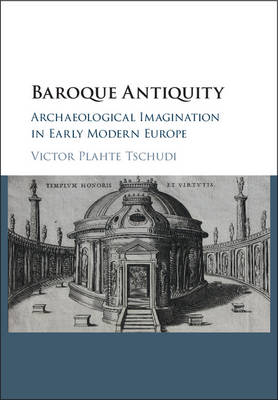
Baroque Antiquity
Archaeological Imagination in Early Modern Europe
Seiten
2016
Cambridge University Press (Verlag)
978-1-107-14986-1 (ISBN)
Cambridge University Press (Verlag)
978-1-107-14986-1 (ISBN)
Why were seventeenth-century antiquarians so spectacularly wrong? Even if they knew what ancient monuments looked like, they deliberately distorted the representation of them in print. This pioneering study combines several histories to show how Roman antiquity was transformed to appeal to popes and princes alike in the Baroque period.
Why were seventeenth-century antiquarians so spectacularly wrong? Even if they knew what ancient monuments looked like, they deliberately distorted the representation of them in print. Deciphering the printed reconstructions of Giacomo Lauro and Athanasius Kircher, this pioneering study uncovers an antiquity born with print culture itself and from the need to accommodate competitive publishers, ambitious patrons and powerful popes. By analysing the elements of fantasy in Lauro and Kircher's archaeological visions, new levels of meaning appear. Instead of being testimonies of failed archaeology, they emerge as complex architectural messages responding to moral, political, and religious issues of the day. This book combines several histories - print, archaeology, and architecture - in the attempt to identify early modern strategies of recovering lost Rome. Many books have been written on antiquity in the Renaissance, but this book defines an antiquity that is particularly Baroque.
Why were seventeenth-century antiquarians so spectacularly wrong? Even if they knew what ancient monuments looked like, they deliberately distorted the representation of them in print. Deciphering the printed reconstructions of Giacomo Lauro and Athanasius Kircher, this pioneering study uncovers an antiquity born with print culture itself and from the need to accommodate competitive publishers, ambitious patrons and powerful popes. By analysing the elements of fantasy in Lauro and Kircher's archaeological visions, new levels of meaning appear. Instead of being testimonies of failed archaeology, they emerge as complex architectural messages responding to moral, political, and religious issues of the day. This book combines several histories - print, archaeology, and architecture - in the attempt to identify early modern strategies of recovering lost Rome. Many books have been written on antiquity in the Renaissance, but this book defines an antiquity that is particularly Baroque.
Victor Plahte Tschudi is a Professor in Architectural History at the Oslo School of Architecture and Design. He writes on the interpretation of Roman monuments in texts and images from the Renaissance to the present.
Introduction; 1. The archaeology of prints; 2. Custom-made Rome; 3. Moral monuments; 4. Peter versus Jupiter; 5. Father Kircher's retreats; 6. Christ in Tivoli.
| Erscheinungsdatum | 10.11.2016 |
|---|---|
| Zusatzinfo | 8 Plates, color; 100 Halftones, black and white |
| Verlagsort | Cambridge |
| Sprache | englisch |
| Maße | 188 x 262 mm |
| Gewicht | 880 g |
| Themenwelt | Geisteswissenschaften ► Archäologie |
| Geschichte ► Allgemeine Geschichte ► Neuzeit (bis 1918) | |
| Geisteswissenschaften ► Geschichte ► Regional- / Ländergeschichte | |
| ISBN-10 | 1-107-14986-X / 110714986X |
| ISBN-13 | 978-1-107-14986-1 / 9781107149861 |
| Zustand | Neuware |
| Informationen gemäß Produktsicherheitsverordnung (GPSR) | |
| Haben Sie eine Frage zum Produkt? |
Mehr entdecken
aus dem Bereich

aus dem Bereich
Geschichte einer wilden Handlung
Buch | Hardcover (2024)
C.H.Beck (Verlag)
CHF 47,60


