


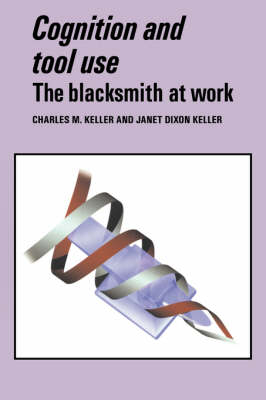
Cognition and Tool Use
The Blacksmith at Work
Seiten
1996
Cambridge University Press (Verlag)
9780521552394 (ISBN)
Cambridge University Press (Verlag)
9780521552394 (ISBN)
Anthropologists Janet and Charles Keller provide an account of situated learning based on the ethnographic study of blacksmithing. Through both concrete and abstract accomplishment, they demonstrate a dynamic dialectic between knowledge and practice which characterizes this specific trade and much of human behaviour.
In Cognition and Tool Use, anthropologists Janet and Charles Keller provide an account of human accomplishment based on ethnographic study. Blacksmithing, the transformation of glowing iron into artistic and utilitarian products, is the activity they chose to develop a study of situated learning. This domain, permeated by visual imagery and physical virtuosity rather than verbal logic, appears antithetical to the usual realms of cognitive study. For this reason, it provides a new entrée to human thought and an empirical test for an anthropology of knowledge. How does a mind in practice approach a stable, 'sedimented' body of knowledge and create something truly original? What does human tool use say about human thought? What does someone need to know to successfully produce a material artifact and how do they learn it? In addressing these questions, the authors offer an interdisciplinary perspective on the principled creativity of human behaviour.
In Cognition and Tool Use, anthropologists Janet and Charles Keller provide an account of human accomplishment based on ethnographic study. Blacksmithing, the transformation of glowing iron into artistic and utilitarian products, is the activity they chose to develop a study of situated learning. This domain, permeated by visual imagery and physical virtuosity rather than verbal logic, appears antithetical to the usual realms of cognitive study. For this reason, it provides a new entrée to human thought and an empirical test for an anthropology of knowledge. How does a mind in practice approach a stable, 'sedimented' body of knowledge and create something truly original? What does human tool use say about human thought? What does someone need to know to successfully produce a material artifact and how do they learn it? In addressing these questions, the authors offer an interdisciplinary perspective on the principled creativity of human behaviour.
1. Introduction; 2. Profile of artist blacksmiths; 3. The stock of knowledge; 4. Constellations for action; 5. Emergence and accomplishment in an account of production; 6. Imagery in ironwork; 7. Beyond blacksmithing.
| Erscheint lt. Verlag | 28.9.1996 |
|---|---|
| Zusatzinfo | 13 Halftones, unspecified; 28 Line drawings, unspecified |
| Verlagsort | Cambridge |
| Sprache | englisch |
| Maße | 152 x 229 mm |
| Gewicht | 500 g |
| Themenwelt | Geisteswissenschaften ► Psychologie ► Allgemeine Psychologie |
| Geisteswissenschaften ► Psychologie ► Sozialpsychologie | |
| Geisteswissenschaften ► Psychologie ► Verhaltenstherapie | |
| ISBN-13 | 9780521552394 / 9780521552394 |
| Zustand | Neuware |
| Informationen gemäß Produktsicherheitsverordnung (GPSR) | |
| Haben Sie eine Frage zum Produkt? |
Mehr entdecken
aus dem Bereich


aus dem Bereich
Lernen, Emotion, Motivation, Gedächtnis
Buch | Softcover (2025)
Beltz (Verlag)
CHF 39,20
Wahrnehmung, Aufmerksamkeit, Denken, Sprache
Buch | Softcover (2025)
Julius Beltz (Verlag)
CHF 39,20


