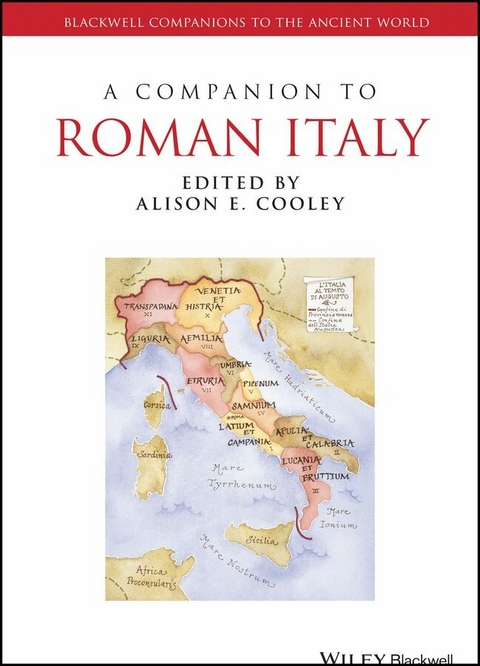
A Companion to Roman Italy (eBook)
576 Seiten
Wiley-Blackwell (Verlag)
978-1-118-99310-1 (ISBN)
A Companion to Roman Italy investigates the impact of Rome in all its forms-political, cultural, social, and economic-upon Italy's various regions, as well as the extent to which unification occurred as Rome became the capital of Italy.
- The collection presents new archaeological data relating to the sites of Roman Italy
- Contributions discuss new theories of how to understand cultural change in the Italian peninsula
- Combines detailed case-studies of particular sites with wider-ranging thematic chapters
- Leading contributors not only make accessible the most recent work on Roman Italy, but also offer fresh insight on long standing debates
Alison E. Cooley is Professor in the Department of Classics and Ancient History at the University of Warwick, UK. Her publications include Res Gestae divi Augusti (2009), The Cambridge Manual of Latin Epigraphy (2012), and Pompeii and Herculaneum: A Sourcebook (2014).
Alison E. Cooley is Professor in the Department of Classics and Ancient History at the University of Warwick, UK. Her publications include Res Gestae divi Augusti (2009), The Cambridge Manual of Latin Epigraphy (2012), and Pompeii and Herculaneum: A Sourcebook (2014).
Acknowledgements
Notes on Contributors
List of Illustrations
INTRODUCTION: SETTING THE SCENE
Chapter 1 Italy before the Romans
Elena Isayev
PART ONE: THE IMPACT OF ROME - UNIFICATION AND INTEGRATION
Chapter 2 Rome's encroachment upon Italy
Rafael Scopacasa
Chapter 3 Italy and the Greek East, second century BC
Celia E. Schultz
Chapter 4 The Social War
Edward Bispham
Chapter 5 Civil wars and triumvirate
Edward Bispham
Chapter 6 Coming to terms with dynastic power, 30 BC-AD 69
Alison E. Cooley
Chapter 7 Italy during the High Empire, from the Flavians to Diocletian
Alison E. Cooley
Chapter 8 Late Roman and Late Antique Italy: from Constantine to Justinian
Neil Christie
PART TWO: LOCAL AND REGIONAL DIVERSITY
2.1 Cultural diversity
Chapter 9 Funerary practices
Emma-Jayne Graham and Valerie M. Hope
Chapter 10 Diversity in Architecture and Urbanism
Margaret Laird
Chapter 11 Language and Literacy in Roman Italy
Kathryn Lomas
2.2 Greek Italy
Chapter 12 Roman Naples
Kathryn Lomas
Chapter 13 Magna Graecia, 270 BC - AD 200
Kathryn Lomas
2.3 Case-study: Becoming Roman in Cisalpina
Chapter 14 The changing face of Cisalpine identity
Clifford Ando, Chicago
PART THREE: TOWN AND COUNTRY
3.1 Settlement patterns
Chapter 15 Urbanization
Joanne Berry
Chapter 16 Urban Peripheries
Penelope Goodman
Chapter 17 Villas
Nigel Pollard
3.2 Case-studies of towns and their territories
Chapter 18 Republican and early imperial towns in the Tiber Valley
Simon Keay and Martin Millett
Chapter 19 Cosa and the ager Cosanus
Elizabeth Fentress and Phil Perkins
Chapter 20 Pompeii and the ager Pompeianus
Ray Laurence
Chapter 21 Ostia
Janet DeLaine
PART FOUR: ECONOMY AND SOCIETY
Chapter22 Regional interaction
Rebecca Benefiel
Chapter 23 Agricultural production
Robert Witcher
Chapter 24 Local elites
John Patterson
Chapter25 Sub-elites
Jonathan Perry
List of Illustrations
| Fig. 1.1 | Map of Italy with sites cited in the text (modern names in italics). Drawing: Antonio Montesanti. |
| Fig. 1.2 | Warrior returning home, from Andriulo Necropolis, Tomb 5340, Poseidonia (Paestum). Fourth century BC. Photograph: Elena Isayev. |
| Fig. 1.3 | Necropolis of Alfedena. Redrawn by Antonio Montesanti after L. Mariani, 1901. “Aufidena.” Monumenti Antichi dell’Accademia Nazionale dei Lincei 10: 225–638, tav.II. |
| Fig. 1.4 | Necropolis of Alfedena – Campo Consolino. Redrawn by Antonio Montesanti after F. Parise Badoni and M. Ruggeri Giove, 1981. Alfedena: la necropoli di Campo Consolino. Chieti, fig. 17. |
| Fig. 1.5 | Necropolis of Opi – Val Fondillo. Redrawn by Antonio Montesanti after G. Tagliamonte, 1996. I Sanniti. Caudini, Irpini, Pentri, Carricini, Frentani. Milan, fig. 4. |
| Fig. 1.6 | Ivory Lion, sixth century BC from Sant’Omobono, side A. Inv. AC 27878, Capitoline Museum, Rome. Photo copyright: Musei Capitolini, Rome. |
| Fig. 1.7 | Ivory Lion, from Sant’Omobono, side B. Name inscribed in Etruscan: Araz Silqetenas Spurianas. Inv. AC 27878, Capitoline Museum, Rome. Photo copyright: Musei Capitolini, Rome. |
| Fig. 1.8 | Ivory Boar, sixth century BC from a necropolis near ancient Carthage, side B. Drawing: Antonio Montesanti after E. Peruzzi, 1970. Origini di Roma: La. Famiglia, vol. 1, Florence: Valmartina, tav. I. |
| Fig. 1.9 | Ivory Boar, from a necropolis near ancient Carthage. Close up of inscription on side B, inscribed in Etruscan: Mi puinel karthazie els q[---]na (I (am) Puinel from Carthage…). Drawing: Antonio Montesanti after E. Peruzzi, 1970. Origini di Roma: La Famiglia, vol. 1, Florence: Valmartina, tav. II. |
| Fig. 1.10 | Sanctuary at Pietrabbondante, view from the theater to the valley. Photograph: Elena Isayev. |
| Fig. 1.11 | Pietrabbondante theater, cavea seating with carved griffin. Photograph: Elena Isayev. |
| Fig. 1.12 | Pietrabbondante theater, telamon supporting the parodos retaining wall. Photograph: Elena Isayev. |
| Fig. 2.1 | Roman and Latin colonies in central/southern Italy down to 263 BC. Drawing: Rafael Scopacasa, adapted from Cornell, 1989. |
| Fig. 2.2 | Roman expansion in central and southern Italy. Drawing: Rafael Scopacasa, adapted from Cornell, 1989. |
| Fig. 2.3 | Eastern sector of Beneventum, showing Roman wall surrounding pre-colonial arx, pre-colonial find spots, and colonial find spots. Drawing: Rafael Scopacasa, adapted from Giampaola, 2000. |
| Fig. 3.1 | Map of Italy and the Greek East. Drawing: Christopher Ratté. |
| Fig. 3.2 | Sanctuary of Fortuna Primigenia, Praeneste. Redrawn by Christopher Ratté from F. Fasolo and G. Gullini, Il Santuario di Fortuna Primigenia a Palestrina (Istituto di archeologia, Università di Roma: Rome, 1953): vol. 2, plate 3. |
| Fig. 5.1 | Denarius of 70 BC with Roma and Italia shaking hands. Courtesy of Prof. C. Howgego & the Trustees of the Ashmolean Museum. |
| Fig. 6.1 | Schematic map of Italy’s regions under Augustus. Drawing: A.E. Cooley. |
| Fig. 7.1 | 100-foot marker on the cliff-face at Terracina. Photograph: A.E. Cooley. |
| Fig. 8.1 | Rome, Arch of Constantine, south face, left side passage: view of the re-used and reworked Hadrianic-period roundel sculptures set over a Constantinian frieze depicting a siege by Constantine’s troops of a fortified city in Italy, either Susa or Verona. A winged victory on the left flies in to help deliver the city’s capture. Photograph: N. Christie. |
| Fig. 8.2 | View of the exterior of the fifth-century baptistery at Albenga in western Liguria, north-west Italy; the windows and interior identify notable later eighth-century restorations here. Photograph: N. Christie. |
| Fig. 8.3 | Internal view of the main gate and circuit of the citadel or castrum of Susa, of circa AD 300. Photograph: N. Christie. |
| Fig. 8.4 | Colossal (5 m high) bronze imperial statue at Barletta in south-eastern Italy, argued to represent Valentinian I (AD 364–375). Photograph: N. Christie. |
| Fig. 9.1 | Funerary relief from Amiternum showing a funerary procession. Drawing: J. Willmott. From M. Carroll, 2011b. “‘The mourning was very good.’ Liberation and liberality in Roman funerary commemoration.” In Memory and Mourning. Studies on Roman Death, eds V.M. Hope and J. Huskinson, Oxford, Oxbow, 126–49, fig. 8.1. |
| Fig. 9.2 | Cappuccina burial F216, Vagnari. Reproduced with permission: Tracy Prowse and Alastair Small. |
| Fig. 9.3 | The Herculaneum Gate Necropolis, Pompeii. Photograph: Valerie Hope. |
| Fig. 9.4 | The Via Annia Necropolis, Aquileia. Photograph: Valerie Hope. |
| Fig. 10.1 | Map of ancient Italy labeling the towns, regions, and other features discussed in this chapter. Adapted from a map generated with Antiquity À-la-carte, Ancient World Mapping Center (awmc.unc.edu). |
| Fig. 10.2 | Plan of the Greek colony of Poseidonia. (The agora is shaded grey) Adapted from Gros and Torelli, 2010: Fig. 88, and Cerchiai, Jannelli, and Longo, 2004: 62. |
| Fig. 10.3 | The heröon in the agora of Poseidonia (circa 520–510 BC) surrounded by the Roman enclosure wall (circa 273 BC). Album/Art Resource. |
| Fig. 10.4 | Poseidonia, the temple of Athena in the northern sanctuary, built late sixth century BC. Photograph: M. Laird, with the kind permission of the Soprintendenza per i Beni Archeologici di Salerno. |
| Fig. 10.5 | Plan of the Etruscan colony at Marzabotto. Adapted from Bentz and Reusser, 2008: abb. 12. |
| Fig. 10.6 | An Etruscan temple and its decorative system. Adapted from Izzet, 2007: fig. 4.3. |
| Fig. 10.7 | A Villanovan miniature hut urn from the Iron Age cemetery at Osteria dell’Osa, eighth century BC. Drawing: M. Laird after Bietti Sestieri, 1992: fig. 4.6. |
| Fig. 10.8 | The roof system of the Etrusco-Ionian roof (Roof 2) from Satricum, circa 540 BC. Lulof, 1997: fig. 1, by permission of the author. |
| Fig. 10.9 | The Roman Forum circa 100 BC (left) and circa AD 10 (right). Buildings indicated with a dashed line are conjectural. Buildings shown in grey are Republican structures that survived into the Augustan period. Plan: M. Laird. |
| Fig. 10.10 | Paestum, plan of the forum and surrounding areas after 273 BC. Destroyed Greek buildings are shown in grey. Greek buildings which were reused are shown in black. Adapted from Sewell, 2010: fig. 13, and Greco and Theodorescu, 1983a: fig. 3. |
| Fig. 10.11 | Plan of Falerii Novi. Millett 2007: fig. 3, by permission of the author and Journal of Roman Archaeology. |
| Fig. 10.12 | Praeneste, view of the Sanctuary of Fortuna Primigenia. Late first century BC. Scala/Art Resource, NY. |
| Fig. 10.13 | Arch commemorating Augustus’s repair of the via Flaminia, outside Ariminum, circa 27 BC. Alinari/Art Resource, NY. |
| Fig. 10.14 | Portraits of the imperial household at Caere, first century AD. From left to right: Deified Augustus, Deified Livia, Tiberius in the guise of Jupiter. © Vanni Archive/Art Resource, NY. |
| Fig. 10.15 | Marble portrait of Valerianus, from the Basilica of the Bassus family at Rusellae. Late first century AD. With the kind permission of the Soprintendenza per i Beni Archeologici della Toscana. |
| Fig. 11.1 | The principal non-Latin languages of Italy. Drawing: K. Lomas. |
| Fig. 11.2 | A selection of Italian alphabets: Etruscan, Venetic Early Latin, Oscan,... |
| Erscheint lt. Verlag | 5.1.2016 |
|---|---|
| Reihe/Serie | Blackwell Companions to the Ancient World |
| Blackwell Companions to the Ancient World | Blackwell Companions to the Ancient World |
| Sprache | englisch |
| Themenwelt | Geschichte ► Allgemeine Geschichte ► Vor- und Frühgeschichte |
| Geschichte ► Allgemeine Geschichte ► Altertum / Antike | |
| Geisteswissenschaften ► Geschichte ► Regional- / Ländergeschichte | |
| Schlagworte | Agriculture • Ancient & Classical History • Architecture • cisalpina • Classical Studies • Colonization • COSA • Elite • Empire • Ethnicity • Etruscan • Funerary practices • Geschichte • Geschichte des Altertums u. der klassischen Antike • Greek • History • Humanistische Studien • Italy • Kultur der römischen Antike • Kultur der römischen Antike • Late Antiquity • Latin • Literacy • Naples • Oscan • Ostia • Pompeii • Römische Geschichte • Republic • Rom • Roman Culture • Roman History • Roman Italy • Romans • Rome • Römische Geschichte • Social War • State-Formation • sub-elite • Tiber Valley • urbanization • urban peripheries • villas |
| ISBN-10 | 1-118-99310-1 / 1118993101 |
| ISBN-13 | 978-1-118-99310-1 / 9781118993101 |
| Informationen gemäß Produktsicherheitsverordnung (GPSR) | |
| Haben Sie eine Frage zum Produkt? |
 EPUB (Adobe DRM)
Kopierschutz: Adobe-DRM
Adobe-DRM ist ein Kopierschutz, der das eBook vor Mißbrauch schützen soll. Dabei wird das eBook bereits beim Download auf Ihre persönliche Adobe-ID autorisiert. Lesen können Sie das eBook dann nur auf den Geräten, welche ebenfalls auf Ihre Adobe-ID registriert sind.
Details zum Adobe-DRM
Dateiformat: EPUB (Electronic Publication)
EPUB ist ein offener Standard für eBooks und eignet sich besonders zur Darstellung von Belletristik und Sachbüchern. Der Fließtext wird dynamisch an die Display- und Schriftgröße angepasst. Auch für mobile Lesegeräte ist EPUB daher gut geeignet.
Systemvoraussetzungen:
PC/Mac: Mit einem PC oder Mac können Sie dieses eBook lesen. Sie benötigen eine
eReader: Dieses eBook kann mit (fast) allen eBook-Readern gelesen werden. Mit dem amazon-Kindle ist es aber nicht kompatibel.
Smartphone/Tablet: Egal ob Apple oder Android, dieses eBook können Sie lesen. Sie benötigen eine
Geräteliste und zusätzliche Hinweise
Buying eBooks from abroad
For tax law reasons we can sell eBooks just within Germany and Switzerland. Regrettably we cannot fulfill eBook-orders from other countries.
aus dem Bereich