


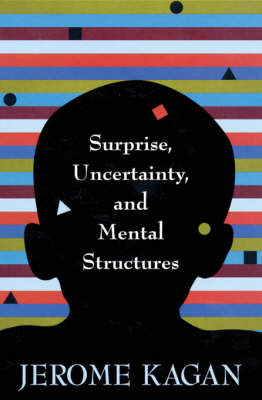
Surprise, Uncertainty, and Mental Structures
Seiten
2002
Harvard University Press (Verlag)
978-0-674-00735-2 (ISBN)
Harvard University Press (Verlag)
978-0-674-00735-2 (ISBN)
In the distinctive manner that has made him one of the most influential forces in developmental psychology, Kagan challenges scientific commonplaces about mental processes, pointing in particular to the significant but undervalued role of surprise and uncertainty in shaping behavior, emotion, and thought.
When we are startled by the new, confronted with discrepancies, our knowing gives way to uncertainty—and changes. In the distinctive manner that has made him one of the most influential forces in developmental psychology, Jerome Kagan challenges scientific commonplaces about mental processes, pointing in particular to the significant but undervalued role of surprise and uncertainty in shaping behavior, emotion, and thought.
Drawing on research in both animal and human subjects, Kagan presents a strong case for making qualitative distinctions among four different types of mental representation—perceptual schemata, visceral schemata, sensorimotor structures, and semantic networks—and describes how each is susceptible to the experience of discrepancy and the feeling of surprise or uncertainty. The implications of these findings are far-reaching, challenging current ideas about the cognitive understandings of infants and revealing the bankruptcy of contemporary questionnaire-based personality theory. More broadly, Kagan’s daring, thoroughly informed, and keenly reasoned book demonstrates the risks of making generalizations about human behavior, in which culture, context, and past experience play such paramount and unpredictable roles.
When we are startled by the new, confronted with discrepancies, our knowing gives way to uncertainty—and changes. In the distinctive manner that has made him one of the most influential forces in developmental psychology, Jerome Kagan challenges scientific commonplaces about mental processes, pointing in particular to the significant but undervalued role of surprise and uncertainty in shaping behavior, emotion, and thought.
Drawing on research in both animal and human subjects, Kagan presents a strong case for making qualitative distinctions among four different types of mental representation—perceptual schemata, visceral schemata, sensorimotor structures, and semantic networks—and describes how each is susceptible to the experience of discrepancy and the feeling of surprise or uncertainty. The implications of these findings are far-reaching, challenging current ideas about the cognitive understandings of infants and revealing the bankruptcy of contemporary questionnaire-based personality theory. More broadly, Kagan’s daring, thoroughly informed, and keenly reasoned book demonstrates the risks of making generalizations about human behavior, in which culture, context, and past experience play such paramount and unpredictable roles.
Jerome Kagan was Daniel and Amy Starch Research Professor of Psychology Emeritus at Harvard University.
Introduction 1. Discrepancy and Schemata 2. Inconsistency and Semantic Networks 3. Event-related Potentials 4. Implications for Development 5. Implications for Creativity and Personality Epilogue Notes Acknowledgments Index
| Erscheint lt. Verlag | 15.5.2002 |
|---|---|
| Zusatzinfo | 1 halftone; 7 line illustrations |
| Verlagsort | Cambridge, Mass |
| Sprache | englisch |
| Maße | 140 x 210 mm |
| Gewicht | 449 g |
| Themenwelt | Geisteswissenschaften ► Psychologie ► Allgemeine Psychologie |
| Geisteswissenschaften ► Psychologie ► Verhaltenstherapie | |
| ISBN-10 | 0-674-00735-2 / 0674007352 |
| ISBN-13 | 978-0-674-00735-2 / 9780674007352 |
| Zustand | Neuware |
| Informationen gemäß Produktsicherheitsverordnung (GPSR) | |
| Haben Sie eine Frage zum Produkt? |
Mehr entdecken
aus dem Bereich


aus dem Bereich
Paket bestehend aus »Das Patienten-Manual« und »Das Trainer-Manual«
Buch | Softcover (2025)
Schattauer (Verlag)
CHF 125,95


