


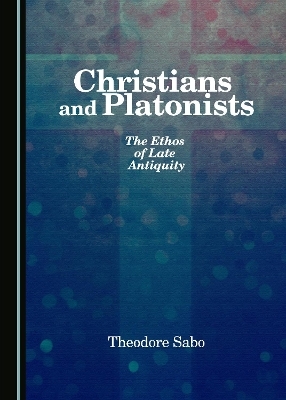
Christians and Platonists
The Ethos of Late Antiquity
Seiten
2015
|
Unabridged edition
Cambridge Scholars Publishing (Verlag)
978-1-4438-8269-9 (ISBN)
Cambridge Scholars Publishing (Verlag)
978-1-4438-8269-9 (ISBN)
The Christians, Gnostics, and Platonists of late antiquity all shared that era's dislike of matter and the body. The first part of this book looks at key words like ethos, aion, and saeculum. The second part investigates the Neoplatonists, the Platonists of late antiquity.
The Christians, Gnostics, and Platonists of late antiquity all shared that era's dislike of matter and the body. The first part of this book looks at key words like ethos, aiōn, and saeculum. The second part investigates the Neoplatonists, the Platonists of late antiquity. In the writings of Plotinus and Porphyry, Iamblichus and Proclus, the dislike of matter and the body was boldly expressed. The third part shows that Gnosticism was second to none in its insistence that matter and the body were evil. It was elitist, suspicious of the political world, and often filled with an interest in magic and immorality. Simon Magus, Carpocrates, and Valentinus are only a few of the Gnostics who are considered. The last part discovers dislike of matter and the body in the early Christians, although with less consistency to their worldview. It was especially notable in the attempt of Origen and Arius to place God the Son at a lower metaphysical level than God the Father in order to protect God from the evil entity of matter. The desert fathers, the Arians, Ambrose, and Augustine are all included.
The Christians, Gnostics, and Platonists of late antiquity all shared that era's dislike of matter and the body. The first part of this book looks at key words like ethos, aiōn, and saeculum. The second part investigates the Neoplatonists, the Platonists of late antiquity. In the writings of Plotinus and Porphyry, Iamblichus and Proclus, the dislike of matter and the body was boldly expressed. The third part shows that Gnosticism was second to none in its insistence that matter and the body were evil. It was elitist, suspicious of the political world, and often filled with an interest in magic and immorality. Simon Magus, Carpocrates, and Valentinus are only a few of the Gnostics who are considered. The last part discovers dislike of matter and the body in the early Christians, although with less consistency to their worldview. It was especially notable in the attempt of Origen and Arius to place God the Son at a lower metaphysical level than God the Father in order to protect God from the evil entity of matter. The desert fathers, the Arians, Ambrose, and Augustine are all included.
Theodore Sabo is a resident of Washington State and an extraordinary lecturer at North-West University of South Africa. His Ph.D. thesis was on the origins of Eastern Christian mysticism. He has published in Acta Classica and the Journal for Late Antique Religion and Culture.
| Erscheinungsdatum | 24.01.2016 |
|---|---|
| Verlagsort | Newcastle upon Tyne |
| Sprache | englisch |
| Maße | 148 x 212 mm |
| Themenwelt | Geschichte ► Allgemeine Geschichte ► Vor- und Frühgeschichte |
| Geschichte ► Teilgebiete der Geschichte ► Religionsgeschichte | |
| Geisteswissenschaften ► Philosophie ► Philosophie Altertum / Antike | |
| Religion / Theologie ► Christentum ► Kirchengeschichte | |
| Geisteswissenschaften ► Religion / Theologie ► Weitere Religionen | |
| ISBN-10 | 1-4438-8269-0 / 1443882690 |
| ISBN-13 | 978-1-4438-8269-9 / 9781443882699 |
| Zustand | Neuware |
| Informationen gemäß Produktsicherheitsverordnung (GPSR) | |
| Haben Sie eine Frage zum Produkt? |
Mehr entdecken
aus dem Bereich


aus dem Bereich
Reise in die Römerzeit
Buch | Hardcover (2025)
Galiani Berlin (Verlag)
CHF 44,75
auf den Spuren der frühen Zivilisationen
Buch | Hardcover (2023)
C.H.Beck (Verlag)
CHF 27,95


